

Affiliate Marketing Glossary: 60+ Terms Every Affiliate Should Know


Ever tried to navigate a city without a map or GPS? This is exactly how lost you’ll feel when you do affiliate marketing without properly understanding the industry language.
You might initially achieve some success, but it won’t last long, cost more, and lead to avoidable mistakes.
That’s why it’s important to familiarize yourself with some key terms commonly used in affiliate marketing.
Whether you’re just about to kick off your affiliate journey or are a veteran, you need to grasp the concepts behind A/B testing, CTAs, Cookies, and more.
So, we’ve prepared this affiliate marketing glossary to help you better understand and enhance your knowledge with these 60+ essential terms that are commonly used in affiliate networks.
Key Takeaways:
- Affiliate marketing terms mostly fall into five buckets: the people involved, how you get paid, how activity gets tracked, the metrics that tell you if it’s working, and the legal stuff you can’t skip.
- Commission models (CPA, CPC, CPL, CPS) all answer the same question differently: what exactly are you being paid for?
- Cookie duration and attribution windows quietly decide how much of your traffic actually gets credited to you.
- Amazon Associates runs on its own vocabulary (OneLink, Bounty, PA-API, qualifying purchase) that general affiliate marketing dictionaries don’t cover, and it directly affects how much you earn.
What is the affiliate marketing glossary, and how does it help?
Affiliate marketing is full of specific terms and acronyms that can confuse anyone. You might wonder when you first heard words like “CPS” or “link cloaking.”
This is where the affiliate marketing glossary serves as a dictionary. It’s a curated list with clear definitions of key affiliate marketing terms, phrases, and jargon commonly used in this industry.
It helps beginners and even seasoned pros to understand the technical language, acronyms, and concepts that are essential to becoming a successful affiliate.
It assists you in decoding the industry jargon like PPC, CPA, conversion rate, deep linking, etc. It also helps you communicate effectively with the affiliate networks, managers, and other marketers.
Having a solid understanding of common affiliate marketing terms gives you a real edge. It enables you to make smarter decisions when choosing programs, interpreting data, or optimizing strategies.
60+ Common affiliate marketing terms you need to know
There are hundreds of jargons or terms you’ll find in affiliate marketing. But you won’t need all of them. You can’t even recall all that well. So what’s a better idea?
You should only be familiar with the most commonly used terms in affiliate marketing. So, let’s explore some of the major terms from the affiliate marketing glossary for newbies to clear up the concepts.
Who’s who: the people and players
Before anything else, affiliate marketing runs on relationships between a handful of specific roles. Get these mixed up, and every other term gets confusing fast.
1. Advertiser
The advertiser is the business that owns the product or service being promoted. They’re the ones paying out commissions, and in most affiliate marketing glossaries, you’ll also see this called a merchant.
2. Merchant
It’s the same thing as an advertiser, just a different word for it. You’ll hear “merchant” more in e-commerce and SaaS affiliate contexts and “advertiser” more in performance marketing and ad networks. Don’t overthink which one to use.
3. Affiliate/publisher
This is you (or whoever’s doing the promoting).
An affiliate earns a commission by driving traffic, leads, or sales to the advertiser through a unique tracked link. “Publisher” is the more formal, network-side term for the same role, so if an affiliate manager calls you a publisher, that’s not a demotion; it’s just industry habit.
4. Affiliate network
A platform that sits between advertisers and affiliates, handling tracking, reporting, and payouts so neither side has to build that infrastructure itself. Think of it as the matchmaking and accounting layer of affiliate marketing.
5. Affiliate manager
The person on the advertiser’s side who runs the program day to day: recruiting affiliates, answering questions, approving creative, and making sure everyone’s playing by the rules.
6. Affiliate agreement
The legal contract between you and the advertiser or network. It spells out commission rates, payment terms, and what you’re allowed (and not allowed) to do with your links. Read it before you start driving traffic, not after something goes wrong.
7. Sub-affiliate
An affiliate who was referred to a program by another affiliate. The original affiliate (sometimes called a super affiliate) may earn a small cut of what their sub-affiliates generate, which is where two-tier programs come from.
Commission and payout model-related affiliate terms
This is the part most people actually care about, and it’s also where most of the confusing acronyms live. Every commission model answers one question: what action triggers your payment?
8. Commission
The base concept: money you earn for generating a sale, lead, or action through your link. It’s either a flat amount or a percentage of the sale, and which one you’re dealing with changes everything else about how you should optimize.
9. Cost Per Action (CPA)
You get paid when someone completes a specific action, which could be a signup, a download, or a form submission, not necessarily a purchase. This is a common affiliate marketing term in lead-gen-heavy niches like finance and SaaS.
10. Cost Per Click (CPC)
You’re paid every time someone clicks your link, regardless of what they do afterward. It’s simple and often used alongside PPC advertising, but it also means low-quality clicks still pay, which is why some programs have moved away from it.
Related read: 7 highest-paying pay-per-click affiliate programs
11. Cost Per Lead (CPL)
A close cousin of CPA. You earn when someone completes a lead-generating action, like a sign-up or an inquiry, that the advertiser will follow up on later.
12. Cost Per Sale (CPS)
You only get paid when a sale actually happens. It’s the most common model in e-commerce and Amazon affiliate marketing specifically, since Amazon pays based on completed purchases, not clicks or leads.
13. Recurring commission
Instead of a one-time payout, you keep earning as long as the customer you referred stays subscribed. Common in SaaS affiliate programs, rare in Amazon affiliate marketing, since Amazon’s model is transaction-based rather than subscription-based.
14. Tiered commission
Your commission rate goes up as you hit certain performance milestones: more sales, more referred affiliates, more volume. It’s a program’s way of rewarding its top performers instead of paying everyone the same flat rate.
15. Pay bump
A temporary or permanent bonus on top of your usual commission rate, often tied to a specific promotion or as a reward for consistently strong performance.
16. Payout
The actual transfer of your earned commissions, once you’ve cleared the program’s minimum payout threshold and payment schedule.
16. Minimum payout threshold
The minimum balance you need to accumulate before a program will actually send you money. If a program’s threshold is $100 and you’re earning $8 a month, that’s worth knowing before you get excited about a payout that’s still a year away.
17. Lifetime Value (LTV)
The total revenue a customer is expected to generate over their entire relationship with a business, not just their first purchase.
Programs sometimes factor LTV into how generous their commissions are, since a customer worth $2,000 over three years justifies a higher upfront payout than a one-time $40 sale.
18. Upsell
An additional offer made to a customer after they’ve already decided to buy. If your referral triggers an upsell that the customer accepts, it can bump up your total commission on that transaction.
Get access to our exclusive offers and pro tips!
Tracking, links, and attribution-related affiliate marketing terms
This is the plumbing of affiliate marketing. Nobody gets excited about it, but if it’s broken, you don’t get credit for the traffic you’re sending, and that’s the whole game.
19. Cookies
Small files stored in a visitor’s browser that identify which affiliate referred them. When cookies fire correctly, the advertiser’s system knows to credit your account for the resulting sale.
20. Cookie duration
The window of time a cookie stays active after someone clicks your link. If your cookie duration is 24 hours and someone buys 26 hours later, you don’t get credit.
This is genuinely one of the most important affiliate marketing terms in the glossary to understand before choosing which programs to prioritize, since a 24-hour window and a 30-day window can mean wildly different earnings from the same traffic.
Related read: Amazon affiliate cookie duration explained
21. First click
An attribution model where the first affiliate to refer a customer gets the commission, even if that customer clicks through other affiliate links before eventually buying.
The opposite (last click) credits whoever sent the final click before conversion, so it’s worth knowing which model a program uses.
22. Tracking ID / Sub-ID
A custom tag added to your affiliate links so you can see exactly which page, ad, or campaign a click came from. If you’re running the same offer across five blog posts, sub-IDs are how you find out which one is actually converting.
23. Pixel tracking
A snippet of tracking code (commonly the Facebook Pixel) is placed on a landing page to measure what visitors do after they arrive, useful for retargeting and measuring ad performance beyond the initial click.
24. Postback URL
A server-to-server tracking method that sends conversion data directly between the advertiser’s system and the affiliate platform, without relying on the visitor’s browser. It’s more reliable than cookie-based tracking, especially now that browsers are cracking down on third-party cookies.
25. Deep linking
Linking directly to a specific product or page instead of a homepage. It’s a small technical detail that makes a real difference: someone who lands exactly on the product you reviewed converts a lot better than someone who lands on a generic homepage and has to go searching.
26. Link cloaking
Turning a long, ugly affiliate URL into something shorter and cleaner. Beyond just looking better, cloaked links are easier to manage, update, and swap out without editing every post they appear in.
Related read: Link cloaking: hide affiliate URLs with AzonPress
27. Unique clicks
The number of distinct people who clicked your link, counted once per person, no matter how many times they clicked. Compare this against total (raw) clicks to see whether your traffic is broad or just a few people clicking repeatedly.
28. Impression
Counted every time your link or ad is shown to someone, whether or not they click it. It tells you about reach, not performance, so don’t confuse a high impression count with a successful campaign.
29. Hyperlink
The clickable text, button, or image that sends someone to another page. In affiliate marketing specifically, this is almost always your tracked link, dressed up as normal-looking content.
30. Anchor text
The visible, clickable words in a hyperlink. Using relevant, natural anchor text (rather than “click here” repeated fifty times) helps both readers and search engines understand what they’re clicking into.
Metrics-related terms in affiliate marketing
Terms are one thing, but affiliate marketing runs on numbers. These are the ones that tell you whether your traffic is converting or just accumulating.
31. Click-Through Rate (CTR)
The percentage of people who click your link after seeing it.
Formula: (Clicks ÷ Impressions) × 100
It’s one of the first metrics beginners learn, and for good reason: a low CTR usually means your placement, copy, or offer isn’t landing before you even get to conversion.
32. Conversion rate
The percentage of clickers who actually complete the action you’re being paid for, usually a purchase.
Formula: (Conversions ÷ Clicks) × 100
A good CTR with a bad conversion rate usually points to a mismatch between what you promised in your content and what the person found when they clicked through.
Related read: Affiliate marketing conversion rate: how to calculate it
33. Earnings Per Click (EPC)
How much do you earn, on average, for every click on your link?
Formula: Total earnings ÷ Total clicks
EPC is arguably the single most useful metric for comparing two different offers or programs, since it collapses commission rate, price point, and conversion rate into one number.
Related read: What is EPC in affiliate marketing? The key term explained
34. Return on Investment (ROI)
How profitable a campaign is, comparing what you made to what you spent to make it.
Formula: (Revenue − Cost) ÷ Cost × 100
If you’re running paid traffic to affiliate offers, ROI is the number that ultimately decides whether the whole effort was worth it.
35. Link juice
An SEO term describing the authority or ranking value passed from one page to another through links. Building link juice to your content, through internal links and quality backlinks, is a big part of why some affiliate posts outrank others even with similar content.
Content, SEO, and traffic terms
Affiliate marketing and SEO overlap so much that you can’t really learn one without brushing up against the other.
36. Keyword
A word or phrase people type into search engines. Affiliates build content around keywords to attract people who are already looking for what they’re promoting, rather than trying to convince cold traffic from scratch.

37. LSI keyword
Terms related to your main keyword that help search engines understand your content’s context. If your main keyword is “best hiking boots,” LSI keywords might include “waterproof,” “ankle support,” or “trail rating,” words that naturally show up in genuinely useful content on the topic.

38. SEO (Search Engine Optimization)
The practice of optimizing content and site structure to rank higher in organic search results, earning free traffic instead of paying for every visitor.
39. SEM (Search Engine Marketing)
The paid counterpart to SEO is getting traffic through paid search ads rather than organic rankings. Affiliates use it to drive faster, more immediate traffic to offers, usually while their SEO content is still climbing the rankings.
40. Landing page
The page someone arrives at after clicking your link is built to push them toward one specific action. A dedicated landing page will almost always outperform sending traffic to a generic homepage.
41. Niche
The specific topic or market segment an affiliate focuses on, whether that’s home fitness gear, budget travel, or kitchen gadgets. Choosing a niche you can credibly write about, not just one with high commissions, tends to be what separates affiliates who last from ones who burn out in six months.
Related read: How To Choose The Best Niche For Affiliate Marketing
42. Geo-targeting
Showing different content or offers based on a visitor’s location. If you’re promoting a product that’s only available (or only worth promoting) in certain regions, geo-targeting keeps you from wasting impressions on people who can’t actually convert.
43. Native advertising
Ads designed to blend into the surrounding content rather than looking like an obvious ad. Done well, it feels like part of the page. Done badly, it feels like a trick, so tread carefully with disclosure here (more on that below).
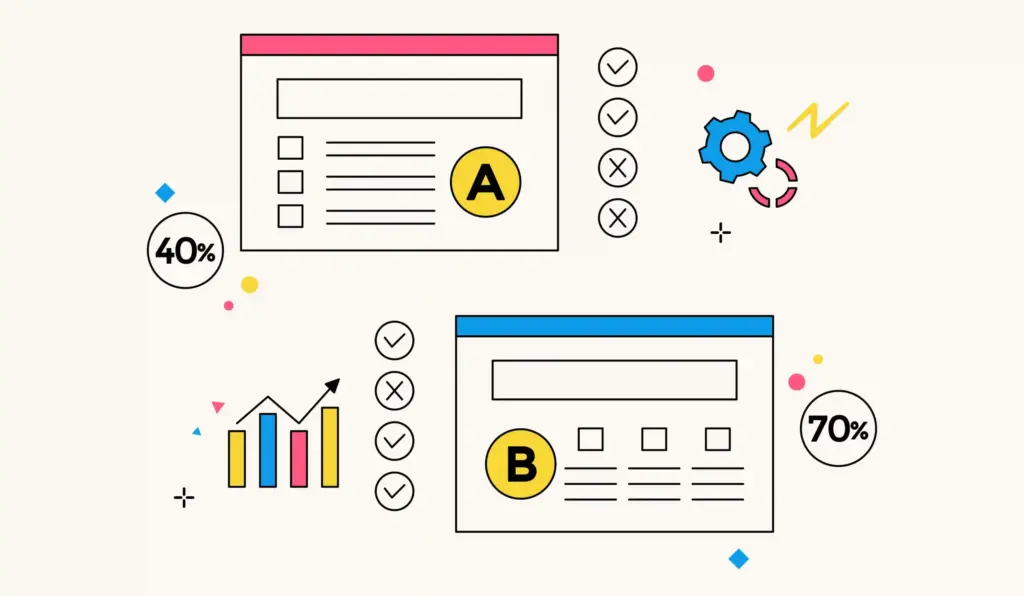
44. Split testing / A/B testing
Running two versions of a page, headline, or offer side by side to see which one performs better. It’s one of the few genuinely reliable ways to improve conversion rate without guessing.
45. Alt text
A short description added to an image’s code. It helps search engines understand images (which supports SEO) and helps visually impaired users navigate your site through screen readers.
Compliance and legal affiliate marketer terms
This section isn’t optional reading. Skipping it is how affiliates lose accounts and, in some cases, face real fines.
46. FTC Disclosure
A legal requirement is to clearly tell your audience when a link could earn you a commission. It’s not a suggestion, and it’s not something you can bury in a footer. The FTC has issued fines ranging from thousands to millions of dollars for disclosure violations, and it applies to every affiliate program, not just Amazon.
Related read: Perfect Amazon affiliate disclosure examples you can copy
47. Chargeback
When a customer disputes a charge and gets refunded by their bank. If that happens on a sale you referred, you typically lose the commission tied to it, which is why chargeback rates matter more than people expect when comparing programs.
48. White label
A product built by one company that another company rebrands and sells as its own. Some affiliates work with white-label tools or products as part of a broader monetization strategy alongside standard affiliate commissions.
Amazon affiliate-specific terms
Most affiliate marketing glossaries stop at generic terms, which is a problem if you’re actually running an Amazon Associates account, because Amazon has its own vocabulary layered on top of everything above. Here’s the terminology that’s specific to Amazon affiliate marketing.
49. Amazon Associates
The official name of Amazon’s affiliate program. With hundreds of thousands of active affiliates, it’s the largest affiliate program in the world, and when people say “Amazon affiliate marketing,” this is what they mean.
Related read: How to become an affiliate marketer for Amazon
50. Associate ID (Tracking ID)
The unique ID assigned when you join Amazon Associates is automatically appended to every link you generate. It’s how Amazon knows which sales to credit to your account, and you’ll pick your first one (often based on your brand name) during signup.
Related read: What is Your Preferred Associates Store ID in Amazon?
51. Operating Agreement
Amazon’s version of the affiliate agreement, the specific rules associates have to follow, covers everything from where you can post links to how you have to disclose your relationship with Amazon. It’s stricter than most general affiliate program terms, and violating it is the fastest way to lose your account.
Related read: 10 key Amazon affiliate program requirements
52. 24-hour cookie window
Amazon’s cookie duration and it’s notably shorter than most affiliate programs, which often run 30 to 90 days. The upside: if someone clicks your link for a $15 phone case and ends up buying a $400 vacuum within that same 24 hours, you get credit for that too. That’s the qualifying purchase rule at work.
53. ASIN (Amazon Standard Identification Number)
A unique 10-character code that Amazon assigns to every product in its catalog. You’ll use ASINs constantly as an Amazon affiliate, whether you’re pulling product data through the PA-API or searching for products directly inside a tool like AzonPress, since searching by ASIN is often faster and more precise than searching by product name.
54. Qualifying purchase
Any item added to a visitor’s cart and purchased within the cookie window, whether or not it’s the product you actually linked to. It’s a quirk unique to Amazon’s model and one of the reasons Amazon affiliate marketing can convert well even on unrelated impulse purchases.
55. Category commission rate
Unlike flat-rate programs, Amazon pays different commission percentages depending on the product category, generally somewhere between 1% and 20%. Knowing which categories pay better is a real factor in deciding what to feature and promote.
Related read: Amazon Affiliate Commission Rates By Category 2026 (Updated)
56. PA-API (Product Advertising API)
Amazon’s official API for pulling live product data, pricing, availability, and images directly into your site. Some tools require it; others (like AzonPress) are built to work with or without it, which matters if you’ve ever had an API application delayed or rejected.
57. Bounty
A fixed, one-time payment for a specific action rather than a percentage of a sale, often used for things like Amazon Prime or Audible sign-ups referred through your links. Bounties behave more like CPA commissions than the standard Amazon percentage model.
58. OneLink
Amazon’s tool for monetizing international traffic. It automatically redirects visitors to their local Amazon marketplace, so a UK visitor clicking your US-based link still lands on Amazon.co.uk, and you still get credit for the sale.
59. Idea List
A curated, shareable list of Amazon products that associates can build and publish, useful for gift guides, roundups, or “everything I “use”-style content without needing a full blog post for every product.
60. Amazon Influencer Program
A separate track from standard associates, built for creators with an active social media following rather than a website. It comes with its own storefront page and its own set of eligibility requirements.
A few affiliate program terms worth knowing before you sign up
Beyond individual definitions, a few phrases show up constantly in the terms of service of nearly every affiliate program:
- Exclusivity clauses restrict you from promoting competing products or programs.
- Non-compete periods can restrict what you promote even after you leave a program.
- Termination clauses spell out exactly what gets an account shut down, so they are worth reading closely, especially for Amazon.
- Payment terms cover not just your minimum payout threshold but the schedule (net-30, net-60) and accepted payment methods.
Reading the fine print on affiliate program terms before you commit real time to a program will save you from building an audience around something that changes its rules six months in.
Wrapping up
Now you’ve got the city map in your hand, which will make your journey smoother, quicker, and way less confusing. Understanding the affiliate marketing lingo similarly helps you to make smart decisions, keep track of your progress, and communicate like a pro.
So, whether you’re just starting or looking to sharpen your skills, this glossary is your go-to guide whenever you hit a roadblock.





Read Similar Blogs
We build lasting partnerships to boost and manage revenue growth



Leave a Reply