

Affiliate Marketing Conversion Rate: How to Calculate It


Search “good affiliate marketing conversion rate,” and you’ll get answers all over the map. One source says 0.5% to 1%. Another says 4% to 5%. A network claims its average is 3.6%. So which one are you supposed to believe?
The honest answer: none of them, on their own.
Conversion rate in affiliate marketing depends so heavily on your niche, traffic source, and what counts as a “conversion” that a single benchmark number is almost meaningless without context.
This guide breaks down exactly what affiliate conversion rate means, how to calculate it correctly, what numbers actually count as good, and what moves the needle when yours is lagging.
TL;DR
What is affiliate marketing conversion rate?
Affiliate marketing conversion rate is the percentage of people who click your affiliate link and go on to complete the action you’re being paid for, usually a purchase, sign-up, or lead form. It’s calculated as: (Number of Conversions ÷ Number of Clicks) × 100.
If 500 people click your affiliate link and 10 of them buy, your conversion rate is 2%.
Of every metric affiliates track, conversion rate is one of the most telling, because it doesn’t just measure how much traffic you’re sending; it measures whether that traffic actually wants what’s on the other side of the link.
A high affiliate marketing conversion rate means your audience and the offer are genuinely matched. A low one usually means something in that match is off.
How do you calculate conversion rate in affiliate marketing
The formula to calculate conversion rate is simple, but most people mess up one part of it: which number goes in the denominator.
Conversion Rate (%) = (Number of Conversions ÷ Total Clicks) × 100
A few things to get right when you calculate your landing page conversion rate:
- Use unique clicks, not total clicks. If one person clicks your link three times, that should count once.
- A “conversion” is whatever action you’re actually paid for. For most affiliates, that’s a sale, but it could be a free trial sign-up, an email capture, or a lead form, depending on the program.
- Don’t confuse conversion rate with click-through rate (CTR). CTR measures how many people clicked your link after seeing your content. Conversion rate measures how many of those clicks turned into something valuable.
Worked example: Your blog post sends 800 unique clicks to an affiliate offer in a month. 24 of those visitors complete a purchase. To calculate the conversion rate here: (24 ÷ 800) × 100 = 3%.
Most affiliate networks and conversion rate calculator tools built into their dashboards do this math for you automatically, so in practice, you rarely need to calculate conversion rate by hand.
But knowing how the number is built helps you spot when something looks off and makes it easier to measure conversion rate consistently across different offers and platforms.
Get access to our exclusive offers and pro tips!
What is a good conversion rate for affiliate marketing?
This is where most articles give you one number and move on. The real answer to what counts as a good conversion rate for affiliate marketing needs a little more nuance, because it depends on three things: your niche, your traffic source, and how strict the definition of “conversion” is for that specific offer.
As a rough baseline, the average affiliate marketing conversion rate sits around 0.5% to 1%, with 1% to 5% generally counted as a good conversion rate for affiliate marketing.
Some niches and well-optimized programs see considerably more. Affiliate network Awin, for example, has reported a network-wide average conversion rate closer to 3.6%, with top-performing programs reaching 4% to 5% or higher.
The spread exists because not all “conversions” mean the same thing. A high-intent action like a paid purchase will naturally produce a lower conversion rate than a low-friction action like an email opt-in.
In general, the conversion rate for affiliate marketing varies by industry and region worldwide.
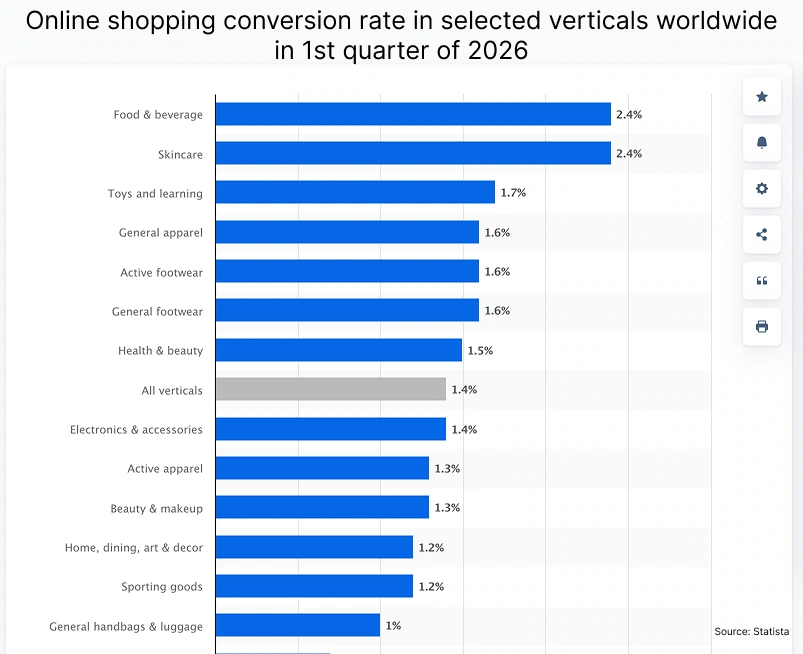
Metrics that affect your affiliate marketing conversion rate
Conversion rate doesn’t exist in isolation; it’s shaped by a few other numbers worth tracking alongside it:
- Click-through rate (CTR): how many people click your link after seeing your content. A healthy CTR is typically between 0.5% and 1%, with anything above 1% considered strong.
Low CTR with a high conversion rate usually means your content isn’t reaching enough people; high CTR with a low conversion rate usually means the wrong audience is clicking. - Earnings per click (EPC): how much revenue, on average, each click generates. This combines your conversion rate and commission value into one number, useful for comparing offers against each other.
- Average order value (AOV): how much customers spend per transaction. A lower conversion rate paired with a high AOV can still outperform a higher conversion rate on low-value transactions.
Looking at your conversion rate alongside these three gives you a much clearer picture of where the problem actually is when performance dips.
How to improve conversion rate in affiliate marketing
Match the content intent to the link
If someone clicks an affiliate link from a “best of” listicle, they want a comparison, not a hard sell. Mismatched intent is one of the most common silent killers of affiliate marketing conversion rate.
Send traffic to a relevant landing page, not just the homepage
If your affiliate link drops visitors on a generic page instead of the exact product or offer you mentioned, you’re adding friction that costs you sales and quietly drags down your conversion rate.
Build trust before the link
Reviews that read as genuinely tested, with specifics, screenshots, or first-hand detail, convert noticeably better than generic “top 10” roundups. Audiences are good at detecting recommendations that feel automated, and trust is one of the fastest ways to improve conversion rate.
Prioritize traffic quality over traffic volume
A smaller, well-targeted audience that’s already considering the purchase will almost always out-convert a larger, less relevant one. This is usually a bigger lever for improving your conversion rate than getting more eyeballs.
Reduce friction at the point of click
Clear CTAs, mobile-optimized pages, and fast load times all matter more than people expect, since affiliate clicks frequently come from social or mobile traffic where patience is thin and a slow page can tank your conversion rate fast.
Test placement and context, not just copy
Where a link sits in your content (mid-article vs. end, inline vs. button) often moves the conversion rate more than tweaking the wording around it. This alone is one of the simplest ways to improve website conversion rate without rewriting anything.
How to measure and track your conversion rate
Most affiliate networks come with a built-in conversion rate calculator inside their dashboard, so you rarely need to calculate conversion rate manually.
For deeper insight into how to measure conversion rate beyond the basic number, pairing that dashboard data with Google Analytics (or a similar tool) lets you see what happens before the click.
The pages, traffic sources, and content pieces that are sending the visitors who actually convert versus the ones who just click and leave.
If you’re running your own affiliate or referral program rather than just promoting other people’s offers, having conversion tracking built into your payment or donation flow makes it much easier to measure conversion rate without stitching together multiple tools.
FAQs on Affiliate Marketing Conversion Rate
Q. Why is my conversion rate low even though I’m getting a lot of traffic?
High traffic with a low conversion rate usually points to a mismatch between who’s clicking and what the offer actually delivers. It often means the traffic is curious rather than ready to buy, or the landing page experience doesn’t match what your content promised.
Q. Does the conversion rate differ by device (mobile vs desktop)?
Yes, mobile traffic typically converts lower than desktop traffic for affiliate links, mainly due to slower checkout flows, smaller screens, and more distractions.
Q. Is a 0% conversion rate normal when I’m just starting?
Early on, yes, especially with low traffic volume where a single sale or no sales at all can swing the percentage wildly. A 0% conversion rate becomes a real concern only once you’ve accumulated enough clicks (generally a few hundred) to treat the number as statistically meaningful.
Q. How often should I check my affiliate conversion rate?
Weekly is usually enough to catch real trends without overreacting to daily noise. Checking too frequently, especially with low traffic, can lead to chasing random fluctuations instead of real patterns.
Q. Is conversion rate the same as ROI?
No. Conversion rate tells you what percentage of clicks turn into action, while ROI tells you whether the revenue from those conversions actually outweighs your costs (time, ad spend, tools). You can have a strong conversion rate and still see weak ROI if commissions are low or costs are high.
Q. Does seasonality affect affiliate conversion rate?
Yes, significantly in some niches. Categories tied to holidays, back-to-school, or year-end shopping often see real conversion rate swings tied to buyer intent rather than anything you changed in your content or funnel.
Q. What’s considered a bad affiliate conversion rate?
There’s no universal cutoff, but if you’re consistently well below 0.5% with reasonable traffic and a relevant audience, it’s usually a sign that something in the funnel (offer fit, landing page, traffic quality) needs attention rather than just more volume.
Wrapping up
Don’t chase a single industry number; chase your own improvement. Establish your baseline, measure conversion rate consistently, and focus on the handful of levers (relevant landing pages, trust-building content, traffic quality) that actually improve conversion rate rather than vanity traffic metrics that look good but don’t pay out.





Read Similar Blogs
We build lasting partnerships to boost and manage revenue growth



Leave a Reply