

10 Non-Scammy Ways to Promote Affiliate Links


Most people who fail at affiliate marketing make the same mistake: they treat their audience like a target, not a person.
They dump links in Facebook groups, spam email lists, and post “BUY THIS NOW” content that nobody asked for. Then they wonder why nobody clicks.
Affiliate marketing works best when it doesn’t feel like marketing at all. The affiliates earning consistent commissions aren’t the pushiest ones. They’re the most helpful ones. They focus on solving problems, building trust, and recommending products when they genuinely add value.
If you’re looking for effective ways to promote affiliate links without coming across as spammy, you’re in the right place. In this guide, we’ll cover 10 proven strategies that help you earn more affiliate commissions while keeping your audience’s trust intact.
TL;DR
Affiliate marketing works when you lead with value, not with links. Here’s what actually moves the needle:
– Reviews, comparisons, and “best of” listicles are your highest-converting content formats; they target readers who are already close to buying
– How-to content and resource pages earn passive clicks naturally, and the product recommendation fits because it solves the problem you’re already addressing
– You don’t need a big audience; SEO content, YouTube videos, and Reddit/Quora answers reach people through search, not follower count
– Social media and paid ads work best as amplifiers, driving traffic to content that already converts, not raw links into a feed
– Disclose every affiliate link, every time, readers who trust you click more, not less
What makes affiliate link promotion “Scammy” in the first place?
Before getting into the strategies, it’s worth naming what to avoid.
Affiliate promotion feels scammy when:
- You recommend products you haven’t used or don’t genuinely like
- You hide the fact that you’re earning a commission
- You push products that don’t match what your audience actually needs
- You prioritize high commission rates over product quality
- You bombard people with links without providing any real value
None of that is sustainable. It burns trust fast, and trust is the only real currency in affiliate marketing.
Now here’s what actually works.
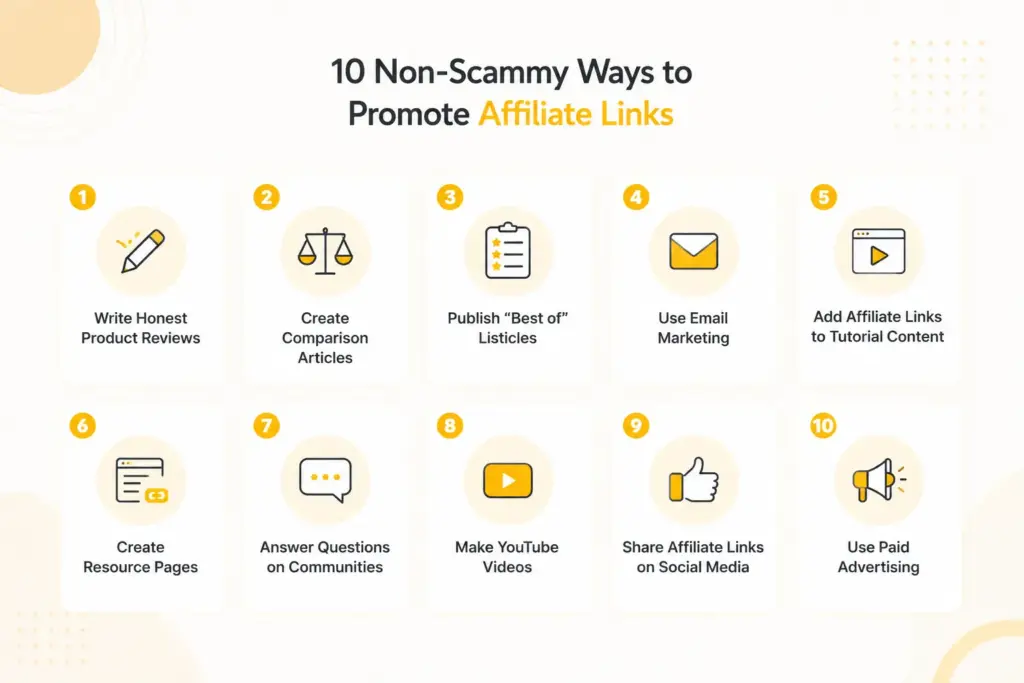
10 Non-scammy ways to promote affiliate links
Dropping affiliate links everywhere rarely works and can quickly damage your credibility.
Many affiliate marketers struggle to promote their affiliate links without coming across as pushy or spammy.
If you’re in the same boat, these 10 proven strategies will help you share your recommendations naturally while building trust with your audience.
1. Write honest, in-depth product reviews
Product reviews are one of the highest-converting content formats in affiliate marketing, but only when they’re real. Most affiliate reviews online are thin, positive-only pieces that exist purely to rank and convert. That’s exactly the gap you can exploit by doing it properly.
A strong affiliate review covers:
- What the product does and who it’s for
- What you liked (specifically, with examples)
- What you didn’t like or what’s missing
- Who should buy it and who shouldn’t
- Pricing and where to get it
The “who shouldn’t buy” section is especially important. It signals to readers that you’re giving a genuine assessment, not just trying to close a sale. Acknowledging limitations actually builds credibility and increases the chance they trust your recommendation.
To perform better in SEO for the target keywords “[product name] review” or “[product name] honest review”. These are high-buyer-intent searches; people looking for reviews are usually close to making a purchase decision.
Bonus tip: If you’re an Amazon affiliate, AzonPress lets you display real product reviews, star ratings, and pricing inside your WordPress blog posts automatically. No manual updates needed when prices change.
2. Create comparison articles
“[Product A] vs [Product B]” content is some of the most clicked, most cited content in affiliate marketing.
Why?
Because people searching for comparisons have already done their research. They’ve narrowed it down to two options and need help deciding. They’re not browsing, they’re almost ready to buy.
A good comparison article:
- Lays out what each product does best (without pretending one is perfect)
- Uses a clear side-by-side table for features, pricing, and use cases
- Makes a recommendation based on specific reader scenarios
- Doesn’t force a winner if both are genuinely good for different people
Example structure:
- Introduction: Who this comparison is for
- Quick verdict table
- Breakdown by category (features, pricing, ease of use, support)
- Which one to pick and why
- Conclusion with both affiliate links clearly disclosed
“[Product A] vs [Product B]” queries have strong commercial intent and often trigger featured snippets. Use an HTML comparison table; both readers and AI search engines prefer structured data over paragraphs for comparisons.
Thirsty Affiliate Vs AzonPress: Let’s Discover Which is Best?
3. Publish “Best of” listicles for buyer-intent keywords
“Best [product category] for [use case]” is one of the most searched content formats online.
Think: “Best email marketing tools for small businesses” or “Best WordPress affiliate plugins for beginners.”
These work because:
- The reader is already in buying mode
- You can include multiple affiliate products naturally
- Each entry can have its own affiliate link without feeling forced
The key is to actually curate, not just list everything with an affiliate program. Pick 5–8 genuinely good options, explain who each one is for, and make it easy for readers to click through based on their specific situation.
What to include for each item:
- What it does
- Who it’s best for
- Pricing
- Pros and cons (briefly)
- Your affiliate link with proper disclosure
Target “best [category] for [specific audience or use case]” keywords. These are evergreen and attract consistent traffic year-round. Update them annually to keep rankings.
4. Use email marketing
Email is one of the most effective channels for affiliate marketing because you already have the reader’s attention. They opted in because they trust you.
That trust is easy to waste.
The wrong way: sending dedicated “promotional” emails that are just link dumps with no context.
The right way: recommending affiliate products inside genuinely helpful emails.
What this looks like in practice:
- A weekly newsletter that covers a topic your audience cares about and mentions a relevant tool as part of the advice
- A “tools I use” email where you share your actual setup with honest assessments
- A follow-up email sequence where you recommend a product that solves a specific problem you’ve just taught them about
One rule: never recommend something in an email you wouldn’t recommend to a friend. Your list took time to build. Don’t trade it for a commission.
Disclosure: Always disclose in email when links are affiliate links. A simple line at the top or bottom is enough: “This email contains affiliate links.
Get access to our exclusive offers and pro tips!
5. Add affiliate links to tutorial and how-to content
How-to content is useful, evergreen, and naturally product-first. When you’re teaching someone to do something, it’s completely organic to recommend the tools that make it easier.
Examples:
- “How to build an affiliate product showcase on WordPress” → naturally mentions AzonPress
- “How to set up recurring donations on your nonprofit website” → naturally mentions Paymattic
- “How to start a YouTube channel” → naturally mentions a camera, mic, or editing software
This type of content performs well because:
- It’s useful regardless of whether the reader buys anything
- The product recommendation comes as a natural solution, not a pitch
- How-to content ranks well in both traditional search and AI search engines
How-to content with clearly numbered steps and specific tool names gets cited more often by AI assistants like ChatGPT and Perplexity. Structure your steps with H3 headings, keep each step focused on one action, and mention the affiliate product by name with context for why it fits.
6. Create resource pages or “tools I use” pages
A resource page is a standalone page on your site that lists the tools, products, and services you actually use with affiliate links to each.
This is one of the most passive forms of affiliate income. Write it once, keep it updated, and link to it from your about page, footer, or blog posts.
What makes a good resource page:
- Organized by category (e.g., writing tools, SEO tools, WordPress plugins, email platforms)
- Brief explanation of why you use each tool
- Your honest take, including anything you’d change or what you use it for specifically
- Clear disclosure at the top of the page
Resource pages work because readers who visit them are actively looking for recommendations. They’re not stumbling on a link; they want to know what you use.
Internal linking tip: Mention your resource page inside relevant blog posts. “For my full list of WordPress tools, see my resources page.” This drives warm traffic to a high-intent page.
7. Answer questions on Quora, Reddit, and Forums
This is one of the best strategies for affiliate marketing without a large following, and it’s almost always overlooked.
People go to Reddit and Quora specifically looking for recommendations and advice. If you can give genuinely helpful answers to relevant questions, you’re reaching a highly targeted audience at exactly the moment they’re looking for what you’re promoting.
How to do this without getting banned:
- Focus on giving a complete, useful answer first; the affiliate link is secondary
- Only include a link when it’s genuinely relevant to the question
- Disclose that it’s an affiliate link (most platforms require this anyway)
- Build a history of helpful contributions before dropping links; cold accounts with only promotional posts get flagged fast
- Check each platform’s rules on affiliate links before posting (Reddit rules vary by subreddit)
Example: Someone asks, “What’s the best way to accept donations on a WordPress site?” A thorough answer explaining donation plugin options, what to look for, and why you’d recommend Paymattic specifically, with a disclosure, is genuinely helpful and not spammy.
8. Make YouTube videos around buyer-intent searches
YouTube is the second-largest search engine in the world, and it’s heavily cited by Google’s AI Overviews. If you’re not using YouTube affiliate marketing, you’re leaving traffic on the table.
Video formats that work well for affiliate promotion:
- Product reviews (show the UI, walk through real use cases)
- Tutorials (“How to use [Product]”)
- Comparisons (“[Product A] vs [Product B]”)
- “Best of” roundups (“Best tools for [use case]”)
Put your affiliate links in the video description with a clear disclosure. Mention them verbally in the video, too: “I’ll link everything in the description below.”
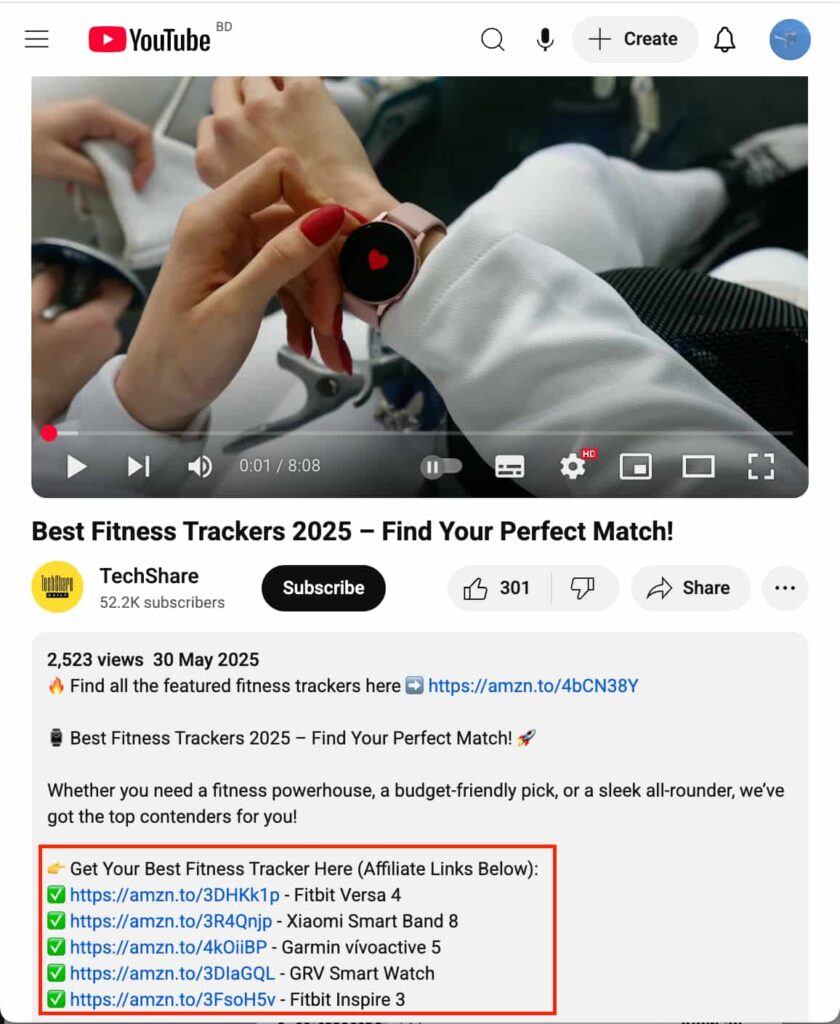
You don’t need a huge subscriber count to start. Search-optimized YouTube videos get found through YouTube’s search and suggested videos, not just subscriptions. A well-optimized video with 200 views can drive consistent affiliate clicks for years.
9. Share affiliate links on social media
Social media and affiliate marketing have a complicated relationship. Done badly, it looks like spam. Done well, it’s one of the fastest ways to drive traffic to your affiliate content.
The key distinction: don’t post raw affiliate links. Post content that leads to your affiliate content.
What actually works by platform:
Pinterest – Underrated for affiliate marketing. Pinterest functions more like a search engine than a social network. Create pins that link directly to your blog posts, comparison articles, or product reviews. Product-heavy niches (home, fashion, food, tools, WordPress resources) perform especially well here. Pins have a long shelf life — a well-optimized pin can drive traffic for months or years.
Instagram and TikTok – Short-form video content works well for product demonstrations, “tools I use” posts, and before/after results. Use the link in bio to direct followers to a landing page or resource page with your affiliate links. Stories with swipe-up links (if you have access) are the most direct route.
Facebook Groups – Only in groups where self-promotion is allowed, and you’re already an active, helpful contributor. A cold link drop from a new account gets removed immediately. Build a presence first, then share relevant recommendations when the context is right.
LinkedIn – Works for B2B affiliate products: SaaS tools, WordPress plugins, business software. Write posts that teach something useful and mention the product as a tool you use. LinkedIn posts that lead with a practical insight consistently outperform promotional posts.
Twitter/X – Thread format works well. A thread breaking down “5 tools I use for affiliate marketing” with honest takes on each performs better than a single tweet with a link.
One rule across all platforms: Disclose. A simple “affiliate link” or “#ad” label is enough on most platforms, and it’s required by the FTC and most platform policies.
Social Media for Affiliate Marketing: [Best Platforms + Tips]
10. Use paid advertising to scale what’s already working
Paid ads for affiliate marketing work, but only after you know what converts organically first.
Running ads to an untested affiliate offer is expensive guesswork. Running ads to a landing page or review post that already converts from organic traffic is a calculated investment.
The right sequence:
- Create content (review, comparison, landing page)
- Drive organic traffic and track conversions
- Once you see a conversion rate worth scaling, add paid traffic
Platforms worth considering:
Google Ads – Target buyer-intent keywords (“best [product],” “[product] review,” “[product] alternatives”). Send traffic to a dedicated landing page or your review post. Make sure the affiliate program allows paid search traffic; some don’t.
Facebook and Instagram Ads – Better for visually-driven niches and products with broad appeal. Retargeting works well here: show ads to people who visited your review or comparison page but didn’t click through to purchase.
Pinterest Ads – Promoted pins blend naturally into the feed and work well for lifestyle, home, and product-focused niches. Lower cost-per-click than Google or Meta in many categories.
What to watch:
- Check the affiliate program’s terms first: Many programs restrict paid ads, especially on branded keywords (e.g., bidding on the merchant’s brand name in Google Ads). Violating this can get you removed from the program.
- Track your cost per conversion, not just clicks: If you’re spending $50 in ads to earn a $20 commission, the math doesn’t work.
- Use a dedicated landing page: Rather than sending paid traffic directly to a merchant’s site. You need to capture data, control the message, and build your own audience even when paying for traffic.
Paid advertising isn’t where most affiliates should start. But once you have a proven offer and a page that converts, it’s one of the fastest ways to scale affiliate income without waiting months for SEO to compound.
Affiliate link promotion mistakes to avoid
Even with the right strategies in place, certain habits will undercut your results. Here’s what to avoid:
Posting links without context: A link with no explanation gives readers no reason to click and no reason to trust you. Always lead with value.
Promoting products you don’t use: If you can’t speak from experience, your recommendation carries no weight. Stick to what you know.
Making unrealistic claims: “This tool made me $10,000 in a week” might get clicks — but it damages credibility and attracts the wrong audience. Be honest about what the product can realistically do.
Using fake urgency: Manufactured countdown timers and “only 2 left!” warnings for digital products feel manipulative. If there’s no real urgency, don’t create fake urgency.
Ignoring your audience’s needs: Promoting a product just because it pays a high commission, when it doesn’t actually fit your audience, is a fast way to lose subscribers and readers.
Skipping affiliate disclosures: Disclosure isn’t optional in most regions, and beyond the legal requirement, it’s simply the honest thing to do. Your audience won’t penalize you for it. They’ll respect you for it.
The real secret of affiliate link promotion
C the right way to promote affiliate links
All of these strategies share one thing: they start with being useful.
The content exists to help the reader. The affiliate link is a natural extension of that help, not the reason the content exists.
When you write a review, you’re helping someone make a decision. When you answer a Quora question, you’re solving a problem. When you build a comparison table, you’re saving someone hours of research.
Do that consistently, disclose honestly, and recommend products you actually believe in, and affiliate income follows naturally.
Frequently asked questions
Here are some frequently asked questions on “non-scammy ways to promote affiliate links”
1. What is the best way to promote affiliate links?
Create content that answers a question your audience is already searching for, a review, tutorial, or comparison, and place the affiliate link naturally inside it. Content that solves a real problem converts far better than standalone link promotion.
2. Can I promote affiliate links without an affiliate marketing website?
Yes. YouTube, email newsletters, Pinterest, and online communities all work without a website. That said, a website gives you a permanent home for SEO content and a resource page, both of which build long-term affiliate income more reliably than social platforms alone.
3. How do I share affiliate links without spamming?
Only add a link when it genuinely improves the reader’s or viewer’s experience. If the product is directly relevant to what you’re discussing and you’ve made a case for why it helps, the link belongs there. If you’re adding it just to add it, leave it out.
4. Is affiliate marketing without followers possible?
Yes. SEO-driven content, YouTube videos, and forum participation like Reddit and Quora don’t require an existing audience. They work through search and discovery. You need good content optimized for what people are searching for, not a large social media following.
5. Where should beginners promote affiliate links?
Start with one content platform, a blog or YouTube channel, and build from there. These platforms create permanent, searchable content that grows in value over time. Once you have a content foundation, add email as your second channel.



Read Similar Blogs
We build lasting partnerships to boost and manage revenue growth



Leave a Reply