


Affiliate Marketing Checklist : A Guide for Growing Affiliates


“How do I even begin?” “What do I need to put in place?
These are the common questions most people ask, before they start their affiliate marketing journey.
Many of them don’t fail because they lack motivation; they fail because they have too much information and no clear order of operations.
There’s advice everywhere. But very little of it tells you what to do first, second, and third, and what to skip entirely.
That’s the gap this guide closes.
We’ve built a complete affiliate marketing checklist for grwoing affiliates: over 15 actionable steps that take you from zero to a running affiliate program, organized in the exact sequence they should happen.
Let’s get into it.
TL;DR
– Start with clear goals and measurable KPIs before choosing products or traffic channels.
– Choose a niche with real demand, buyer intent, and reliable affiliate opportunities.
– Research competitors to identify commission benchmarks and content gaps.
– Create a commission structure that attracts affiliates while remaining profitable.
– Establish transparent payment methods, schedules, and payout policies early.
– Protect your business with clear affiliate terms, compliance guidelines, and fraud policies.
– Use the right tools to simplify content creation, tracking, and affiliate management.
– Build a content structure around pillar pages, supporting articles, comparisons, and reviews.
– Focus on recruiting affiliates who have relevant audiences and strong content quality.
– Give affiliates the training and resources they need to start promoting successfully.
– Provide ready-to-use marketing assets to reduce friction and improve participation.
– Track performance regularly and optimize content, offers, and conversion paths.
– Maintain consistent communication to keep affiliates engaged and motivated.
– Use bonuses and incentives to encourage stronger promotion and long-term partnerships.
– Monitor for fraud and compliance issues to protect commissions and brand reputation.
– Treat affiliate marketing as a system-driven business rather than a short-term tactic.
What is an affiliate marketing checklist?
An affiliate marketing checklist is a structured list of all the critical steps you need to complete in the right order to launch, run, and grow a successful affiliate program or affiliate site.
Think of it as a flight pre-check. A pilot doesn’t rely on memory before takeoff. They run through the same checklist every time, because skipping even one item can have consequences. Your affiliate marketing program deserves the same discipline.
This checklist covers:
- Program setup and structure
- Content and SEO strategy
- Affiliate recruitment and onboarding
- Tools and automation
- Compliance and fraud prevention
- Performance tracking and optimization
What to know before starting affiliate marketing?
The global affiliate marketing industry is projected to reach $10 billion by 2026 and $31.7 billion by 2031. The opportunity is massive. But only the marketers who build systems instead of just publishing links will capture a meaningful share of it.
Before you start your affiliate marketing journey, get these three things clear in your head:
Affiliate marketing is a long game: The first six months are the hardest, and it builds momentum like a flywheel. The marketers who give up too early are the ones who treat it like a get-rich-quick scheme instead of a real business.
Your website is your most important asset: A website is the only platform you truly own. Social media accounts can be suspended, and algorithm changes can wipe out your reach overnight. A website builds long-term SEO value, bringing free, targeted traffic from Google for years.
Your niche matters more than your first product: Choosing a niche with real demand and strong monetization opportunities is more important than finding a single high-commission product. A good niche gives you room to create content and promote multiple products over time.
Trust influences conversions: Visitors are more likely to click your affiliate links when your recommendations feel genuine. Honest reviews, transparent disclosures, and real insights often outperform aggressive sales tactics.
Now let’s run through the affiliate marketing checklist.
The beginner’s affiliate marketing checklist
I know getting started can feel overwhelming, but don’t worry. Follow these steps in order, check each box, and you’ll be ready to launch with confidence.
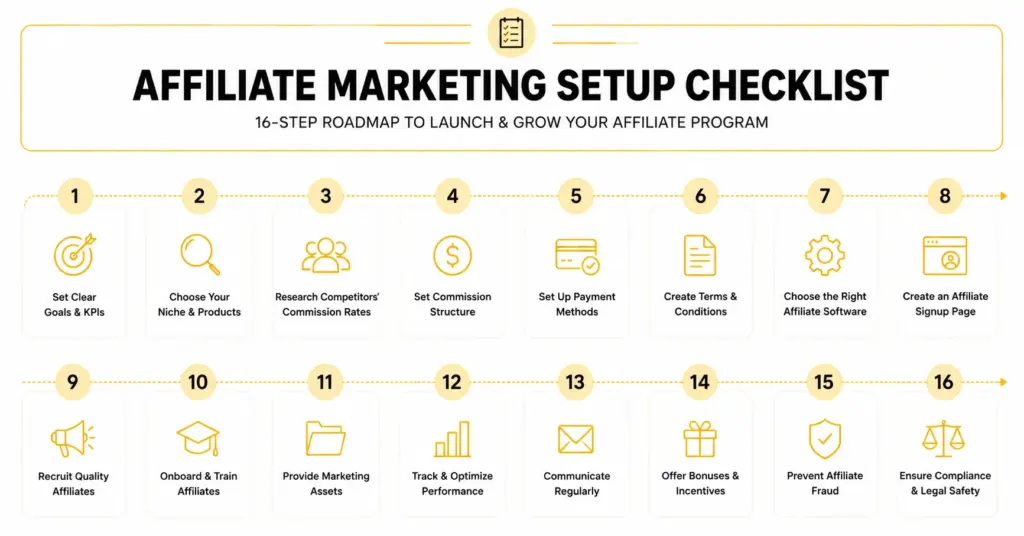
Step 1: Set clear goals and KPIs
Most affiliate marketers start with products. Smart affiliate marketers start with numbers.
Before anything else, define what success looks like. Vague intentions produce vague results.
Set targets for:
- Monthly revenue goal (Month 1, Month 6, Month 12)
- Traffic targets (sessions per month)
- Conversion rate (clicks to sales)
- Email list size (if relevant)
- Number of affiliate partners you want to recruit (for program managers)
Key KPIs to track from Day 1:
- Earnings Per Click (EPC)
- Affiliate Conversion Rate
- Average Order Value (AOV)
- Return on Ad Spend (ROAS) if running paid traffic
- Cost Per Acquisition (CPA)
A good rule of thumb: set a 90-day goal, a 6-month goal, and a 12-month goal. Use the first 90 days as a test period to validate your niche, content strategy, and commission assumptions before scaling.
Step 2: Choose your niche and products
Product selection before niche clarity is a common beginner mistake. Flip the order.
Start with niche selection:
- Is there search demand? (Use Google Keyword Planner, Ahrefs, or Semrush)
- Are buyers in this niche comfortable purchasing online?
- Can you create genuine, helpful content here?
- Is there a monetizable affiliate program in this niche?
Then evaluate products:
- Commission rate (1–3% is typical for Amazon; 20–50% is common in SaaS)
- Average price point (higher price = higher commission per sale)
- Cookie duration (longer = more time to earn credit for a referral)
- Refund/return rate (high refunds can claw back your commissions)
A successful 2026 strategy involves multiple income streams: Amazon, high-ticket programs, and brand partnerships, and multiple traffic channels. Don’t lock yourself into a single program from Day 1.
Step 3: Do market research on competitors’ commission rates
You can’t set a competitive commission structure (if you’re running a program) or choose the right affiliate marketing programs to join without knowing what others are offering.
Research framework:
- Identify top competitors in your niche
- Check if they have public affiliate programs (look for “Affiliates” links in their footer)
- Note their commission rates, cookie windows, and payout thresholds
- Look at their top-performing affiliate content using tools like Ahrefs Site Explorer
- Identify gaps in topics they haven’t covered, programs underserving your niche
Use Google Analytics to gauge affiliate traffic sources and understand where competing sites are driving their audience from. This informs both your content strategy and your traffic channel priorities.
For affiliate program managers: decide on a commission structure that is attractive to affiliates while remaining profitable for your business. Percentage-based, fixed fee, or tiered options all have tradeoffs worth evaluating carefully.
Get access to our exclusive offers and pro tips!
Step 4: Determine your affiliate commission structure
If you’re building a program (not just joining one), your commission structure is the most important recruitment tool you have.
Recurring commission structures are becoming a major differentiator. If your product is subscription-based, offering a lifetime recurring commission dramatically increases affiliate lifetime value and dramatically improves the quality of affiliates you attract.
Set your commission ceiling at no more than 30% of your average gross margin. Test it for 90 days before locking it in permanently.
Step 5: Select payment methods and schedule
Nothing erodes affiliate trust faster than payment confusion. Define this before you recruit a single partner.
Decisions to make:
- Payout method: PayPal, bank transfer (ACH), Wise, check
- Minimum payout threshold: $50–$100 is standard; too low creates admin overhead, too high frustrates new affiliates
- Payout schedule: Monthly (most common), bi-weekly, or Net-30/Net-60
- Validation window: The time between a sale and commission approval (to account for refunds) is typically 30 days
Use predictable payout cycles, minimum thresholds, and a validation window for refunds or fraud checks. Keep payout logic simple in the first 90 days. One person should reconcile affiliate platform data against payment records weekly so finance, marketing, and partners see the same numbers.
Affiliates talk to each other. A reputation for reliable, on-time payments is one of the most effective (and underrated) affiliate recruitment tools.
Step 6: Write affiliate terms and conditions
Skipping T&Cs is how affiliate programs create legal and operational headaches for themselves later.
Your affiliate agreement should cover:
- Permitted and prohibited promotional methods (no PPC on brand terms, no spam)
- Disclosure requirements (FTC mandates this in the US)
- Commission structure and any clawback clauses
- Cookie policy and attribution rules
- Fraud and abuse policy
- Termination conditions
- Intellectual property usage rights for branded assets
Create clear and comprehensive terms and conditions to protect your brand and ensure compliance. Consider consulting legal counsel to address potential liabilities.
AI-generated content, virtual influencers, and automated endorsements are a rapidly evolving compliance gray zone. Maintain compliance in this area by staying ahead of emerging rules rather than waiting for enforcement to clarify them. Your T&Cs should address AI-generated affiliate content explicitly.
Step 7: Choose the right affiliate marketing software
Your software is your operational backbone. Choose it based on program complexity and budget, not marketing copy.
Affiliate marketing software directly affects your revenue, because how you display affiliate products matters as much as which products you promote.
AzonPress is built specifically for this: it lets WordPress users create eye-catchy Amazon affiliate product display table, comparison tables, and dynamic listings that pull live Amazon data. For Amazon affiliates running content sites, it’s one of the highest-leverage tools in your stack.
Key features of AzonPress includes:
- Amazon Product Comparison Tables
- Product Showcase Boxes
- Best Seller Lists
- Pros & Cons Sections
- One-Click ASIN Import
- Zero-API Product Integration
- Geo-Targeting
- Responsive Product Displays
Manage links, create product tables, and comparison tables, and increase your affiliate revenue
Step 8: Create an affiliate signup page
If you’re running an affiliate program: your signup page is your pitch to potential partners. Treat it like a landing page, not an afterthought.
High-converting affiliate signup pages include:
- Clear commission rates and earning potential
- Social proof (number of affiliates, total payouts to date)
- What promotional assets you’ll provide
- A simple, short application form
- FAQ section addressing common questions
If you’re building an affiliate content site: Your “signup page” equivalent is your content foundation, the core pillar pages your entire site is built around.
Step 9: Recruit high-quality affiliates
For program managers, affiliate quality matters far more than affiliate quantity. Twenty engaged, well-matched affiliates will outperform 200 random signups every time.
Where to find quality affiliates:
- Google search for top content in your niche, those bloggers are your best targets
- Affiliate networks (ShareASale, CJ Affiliate, Rakuten)
- LinkedIn outreach to niche content creators
- Your own customer base (your best customers are often your best affiliates)
- Industry communities, Slack groups, and forums
Personalized outreach, timely responses, and acknowledging top performers can make a significant difference in engagement.
Step 10: Onboard and train affiliates
Most affiliate programs recruit well and onboard poorly. This is where the majority of potential revenue gets left on the table.
Onboarding package checklist:
- Welcome email with program overview
- Step-by-step guide to getting the first link live
- Access to the affiliate dashboard
- Glossary of key terms and tracking explanation
- Quick-start content ideas specific to your niche
- A direct contact (not just a support ticket)
Affiliates usually convert better with practical assets than generic banners. Give them comparison points, use cases, screenshots, talking points, onboarding guidance, and customer proof. The goal of onboarding isn’t to share information; it’s to get each affiliate to their first successful promotion as fast as possible. That first win builds momentum and commitment.
Step 11: Offer affiliates marketing assets and dashboards
Affiliates who have to create their own promotional materials from scratch produce fewer promotions. Make it frictionless.
Asset library to build:
- Banner ads in multiple sizes (300×250, 728×90, 160×600)
- Email swipe copy (2–3 variations)
- Social media captions (platform-specific)
- Product images cleared for affiliate use
- Video clips or demo footage
- Comparison data and key differentiators
Dashboard requirements:
- Real-time clicks, conversions, and commissions
- Earnings history and upcoming payouts
- Link generator
- Asset library access
- Performance benchmarks (how they compare to the average affiliate)
Affiliates who can see their own data are more engaged, more motivated, and more likely to optimize their promotions without any input from you.
Step 12: Track and optimize affiliate performance
This step is where most programs stagnate; they set up tracking but never act on the data.
Content site optimization priorities:
- Update posts older than 6 months with fresh product data
- A/B test CTA placement (in-text links vs. buttons vs. comparison tables)
- Identify pages with high traffic but low affiliate clicks, and fix the funnel
- Monitor Amazon product availability; dead links kill conversions
Use keyword research to uncover hidden opportunities and fine-tune existing content for a climb up search engine rankings.
Step 13: Communicate and foster relationships with affiliates
Maintaining open and regular communication with affiliates fosters loyalty and encourages consistent promotion. This is obvious in theory and chronically underdone in practice.
Communication cadence:
- Weekly: Performance newsletter (top earners, trending products, tips)
- Monthly: Program update (new assets, commission changes, upcoming promos)
- Quarterly: Strategy call with your top 10–20 affiliates
- Ad-hoc: Personalized outreach when you notice an affiliate’s performance drop or spike
Relationship-building moves that work:
- Feature high-performing affiliates publicly (leaderboards, shout-outs)
- Share early access to new products for exclusive review opportunities
- Ask for feedback on the program, and affiliates know what’s holding them back
- Send a personal email when someone hits a milestone
Consider offering affiliates exclusive product previews or early access to promotions as a low-cost loyalty mechanism that big-budget programs struggle to replicate.
Step 14: Motivate affiliates with extra bonuses
Base commissions attract affiliates. Bonus structures make them prioritize you.
Incentive structures that work in 2026:
Tiered commissions: Base rate + escalating percentage as volume increases. Gives affiliates a clear reason to push harder rather than coast.
Seasonal bonuses: Time-limited commission bumps around Black Friday, January sales, or product launches. Creates urgency and brings dormant affiliates back to life.
Performance contests: “Top affiliate this month wins $500 cash + featured placement.” Works best when there are multiple tiers, so mid-level affiliates feel they have a shot.
Milestone bonuses: One-time cash rewards at key thresholds ($1,000 total earned, first 50 sales, etc.). Celebrates progress and reinforces the relationship early.
Co-marketing opportunities: Offer top affiliates newsletter features, joint webinars, or product collaborations. For content creators, this is often more valuable than cash.
Step 15: Prevent affiliate fraud
Affiliate fraud is not a hypothetical risk; it’s a real cost that affects every program at scale.
Common fraud types to watch for:
- Cookie stuffing: Affiliates force-dropping tracking cookies on visitors who never engaged with their content
- Fake leads: Manufactured form submissions or fake signups to trigger lead commissions
- Coupon abuse: Stacking or misdirecting coupon codes outside their intended use
- Transaction fraud: Using stolen cards to generate commissions that reverse on chargeback
- Self-referrals: Affiliates using their own links to purchase
Fraud prevention checklist:
- Set a refund validation period before approving commissions
- Monitor traffic quality (bounce rate, session duration, geographic anomalies)
- Flag and investigate spikes that don’t correlate with any promotional activity
- Require affiliate identity verification before the first payout
- Use IP-level monitoring to catch self-referral patterns
Affiliate marketing compliance requires regularly reviewing affiliate activities, updating program policies as relevant laws evolve, and using monitoring tools to track affiliate activities in real time. The brands with the healthiest affiliate programs in 2026 treat compliance monitoring as a core part of performance marketing, not a separate legal function.
Step 16: Comply with laws and regulations
Non-compliance isn’t just a legal risk; it’s a trust risk. Audiences in 2026 are sophisticated. Undisclosed affiliate relationships erode credibility faster than any algorithm update.
Compliance checklist:
FTC (US):
- All affiliate content includes a clear, prominent disclosure (“This post contains affiliate links. I may earn a commission if you purchase through them.”)
- Disclosures appear before the first affiliate link, not buried in a footer
- Disclosures are in plain language, not legalese
GDPR (EU/UK):
- Cookie consent mechanism on the site
- Privacy policy updated to include affiliate tracking disclosure
- Data processing agreements with affiliate networks that handle EU visitor data
Amazon Associates specific:
- Display the required “As an Amazon Associate, I earn from qualifying purchases” statement
- Never include Amazon prices in content (they change; outdated prices violate ToS)
- Don’t use Amazon images outside of official API-retrieved images
Content disclosure:
- All review content reflects genuine experience or clearly states it doesn’t
- AI-generated content is disclosed where required (policies are tightening in 2026)
Affiliate partners promoting products on Amazon must be briefed on Amazon’s specific restrictions. Compliance isn’t a launch task; it’s an ongoing operational discipline.
Final thoughts
Affiliate marketing in 2026 rewards systems thinkers over lucky guessers. The marketers who build real income from affiliate programs aren’t the ones who picked the best product or stumbled onto the right keyword; they’re the ones who worked through a checklist like this one and executed each step with intention.
Start at Step 1. Don’t skip to Step 9. The foundation items, goals, niche, commission structure, and T&Cs aren’t glamorous, but they’re what make everything else work.
The checklist is in your hands. The next step is yours.





Read Similar Blogs
We build lasting partnerships to boost and manage revenue growth





Leave a Reply