

How to Get Traffic for Affiliate Marketing?


You’ve added affiliate links, maybe even published a few blog posts… but nothing’s happening.
No clicks. No sales. Just silence.
That’s when most people start thinking something is wrong with their strategy, their niche, or even affiliate marketing itself. But in most cases, the real issue is much simpler: you don’t have enough traffic.
No traffic means no clicks, and no clicks means no commissions. And this is where many beginners get stuck. Affiliate marketing is not just about placing links. It works when the right people find your content, trust what you’re saying, and feel confident enough to take action.
In this guide, you’ll learn how to get traffic for affiliate marketing using both free and paid methods. We’ll keep it practical, beginner-friendly, and focused on what actually brings visitors who are actually interested and more likely to convert.
TL;DR
Getting traffic is the foundation of affiliate marketing. Without it, even the best content or offers won’t generate results. This guide shows practical ways to bring in the right visitors and turn them into clicks and commissions.
– Traffic matters most because no visitors means no income
– Focus on targeted traffic, not just high numbers
– Start with SEO (organic traffic) for long-term, consistent growth
– Use one main platform instead of trying everything at once
– Create high-intent content like reviews and comparisons
– Social media can bring faster traffic, but it needs consistency
– YouTube works well for building trust and explaining products
– Paid ads can scale results, but only after testing what converts
– Build an email list to retain and re-engage visitors
– Avoid common mistakes like random content, no SEO, and no tracking
– Track performance to understand what drives traffic and sales
– Focus on consistency because traffic builds over time, not overnight
Why traffic matters in affiliate marketing?
Traffic is the fuel behind affiliate marketing. You can have a great offer, a clean website, and a solid review article, but none of that matters if nobody sees it.
More traffic usually means more chances to earn. But not all traffic is equal. A thousand random visitors who are not interested in your niche may bring fewer results than a hundred targeted visitors who are actively looking for a solution.
That is why the goal is not just more traffic. The goal is targeted traffic that matches the product you are promoting. Traffic matters because it:
- creates more opportunities for affiliate clicks
- brings the right people to your content
- helps build trust over time
- gives you data on what topics and pages perform best
- supports long-term income instead of random one-off sales
If your site is getting very little traffic, focus on distribution first. The fastest way to grow affiliate income is not by finding more products. It is getting more of the right people to your content.
Types of traffic sources for affiliate marketing
Before you pick a strategy to increase traffic on your affiliate marketing website, let’s understand the different kinds of traffic you can get.
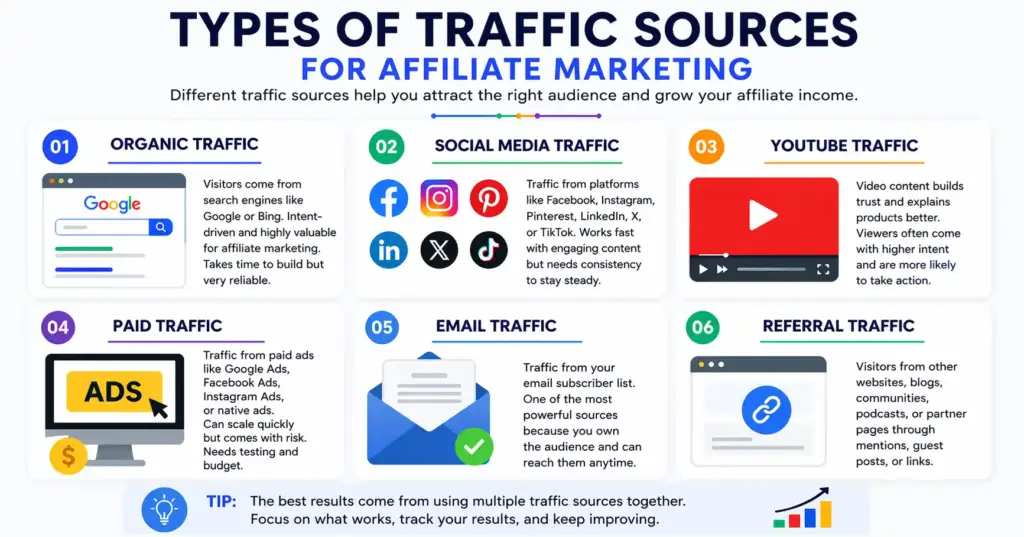
Here are the main traffic sources for affiliate marketing:
- Organic traffic comes from search engines like Google or Bing. People type in a question or keyword, find your page, and visit it naturally. This is one of the best traffic sources for affiliate marketing because it is intent-driven. If someone searches for “best WordPress payment plugin,” they are already close to making a decision. Organic traffic usually takes time to build, but it can become a very reliable source of visitors.
- Social media traffic comes from platforms like Facebook, Instagram, Pinterest, LinkedIn, X, or TikTok. This works well when you can create short, helpful content that points people back to your site, YouTube channel, or landing page. Social media marketing works faster than SEO, but it is usually less stable unless you post consistently.
- YouTube traffic is valuable because video lets you explain, demonstrate, and review products in a way that builds trust quickly. If someone watches your comparison video or tutorial, they often arrive on your affiliate link with a stronger intent than a casual social media user.
- Paid traffic comes from ads, such as Google Ads, Facebook Ads, Instagram Ads, or native ads. This can scale quickly, but it also comes with risk. If your funnel is weak or your tracking is poor, you can burn money fast. Paid traffic is usually better once you already know which offer, page, or angle converts.
- Email traffic comes from your subscriber list. This is one of the most underrated traffic sources in affiliate marketing because you own the audience. You are not depending entirely on search algorithms or social platforms.
- Referral traffic comes from other websites, blogs, communities, podcasts, or partner pages that send visitors to your content. This can happen through guest posts, collaborations, mentions, or resource pages.
Instead of relying solely on ads or search rankings, brands are now working with influencers who already have their audiences’ trust. Click here to discover the best Amazon influencers to follow and learn how they drive traffic.
How to get traffic for affiliate Marketing: Top methods
Now let’s get into the actual methods. If you’re a beginner and want to know how to get traffic for affiliate marketing, start with the free methods first, then add paid options later if needed.
Write SEO content around buyer intent keywords
SEO is still one of the strongest ways to get free traffic for affiliate marketing.
The key is not writing random posts. Write affiliate marketing content around keywords people search for when they are close to buying.
Examples include searches like best [product type] for [use case], [product] review, [product A] vs [product B], how to use [product], best alternatives to [product], and is [product] worth it.
These keywords usually bring visitors who already have a problem and are looking for a solution.
Start by choosing a niche you understand, then find keywords with clear buying intent. Create one article per topic, answer the searcher’s question directly, add affiliate links where they make sense, optimize the page title, headings, and internal links, and update old posts when rankings or products change.
The mistake most beginners make is trying to rank for broad terms too early. “Affiliate marketing” is hard to rank for. A tighter topic like “best WordPress plugins for Amazon affiliates” is much more realistic.
Build product review and comparison content
Reviews and comparisons are some of the highest-converting content formats in affiliate marketing.
Why its works well?
Because people reading these pages are often deciding between options.
Useful content types include product reviews, product comparisons, best-of lists, pros and cons breakdowns, “is it worth it” articles, and alternatives articles.
A post comparing two tools like “Thirsty Affiliates vs AzonPress” can attract readers who are nearly ready to buy. If your content is clear, honest, and useful, that traffic can turn into clicks more easily than a generic blog post.
Use YouTube to reach high-intent viewers
If you are wondering about YouTube affiliate marketing to increase traffic, this is one of the strongest channels for beginners and intermediate creators alike.
People use YouTube to learn, compare, and watch product demos. That makes it a perfect fit for affiliate content. Good video ideas include product reviews, tutorials, how-to videos, unboxings, comparison videos, top tools in your niche, and beginner guides.
The process is simple. Pick one problem your audience has, make a video that solves it clearly, mention the affiliate product naturally in the solution, add your affiliate link in the description, use a strong thumbnail and title, and link back to a related blog post or landing page.
You do not need to be a professional creator. You just need to be clear, useful, and consistent.
Use social media the smart way
Social media traffic for affiliate marketing can work, but only if you use the platform with a plan.
Do not just post links and hope for sales. That usually fails. Instead, use social content to start conversations, build trust, and move people toward your website or email list.
Good social content formats include quick tips, before-and-after examples, short tutorials, carousel posts, short videos, behind-the-scenes content, and mini case studies.
The best approach is to choose one or two platforms only, create content that fits the platform, send people to a blog post, lead magnet, or video, and stay consistent for at least a few months.
Pinterest can work especially well for evergreen blog content, while LinkedIn can be useful in business and software niches.
Get access to our exclusive offers and pro tips!
Build an email list early
If you want more control over your affiliate traffic, start building an email list as soon as possible.
Email allows you to bring people back to your content again and again. It is not the flashiest traffic source, but it is one of the most valuable.
Simple ways to grow your list include offering a free guide or checklist, creating a content upgrade inside a blog post, using an exit pop-up, offering a resource library, or giving a simple lead magnet related to your niche.
Once someone joins your list, you can send new blog posts, product recommendations, tutorials, buyer guides, and limited-time offers.
Guest post and build backlinks
If your site is new, backlinks and referral traffic can help your pages get discovered faster.
You do not need to chase huge websites. Start with smaller niche sites, blogs, and communities where your audience already spends time.
You can do this through guest posts, expert quotes, niche roundups, community answers, creator collaborations, and pitching your article as a useful resource. The point is not only SEO. It is also getting in front of the right people.
Join communities
Join communities where your audience already hangs out. If you are looking for free traffic for affiliate marketing beginners, communities can be a solid starting point.
That includes Facebook groups, Reddit communities, Quora, niche forums, Discord groups, and online communities in your niche. But be careful. If you spam affiliate links, you will get ignored or banned.
A better approach is to answer questions honestly, share helpful advice, link to your content only when relevant and allowed, and build credibility before promoting anything.
Community traffic is slow at first, but it can become very targeted.
Run paid ads
Run paid ads once you know what converts. Paid traffic for affiliate marketing can work, but it is not the best place to start if you are new.
Ads make more sense when you already know which offer converts, which page gets clicks, which keyword, angle, or audience responds well, and how much a lead or click is worth.
Paid traffic options include Google Ads, Facebook Ads, Instagram Ads, Pinterest Ads, and native ads.
If you do try paid traffic, begin with a small budget and track everything carefully. Test one thing at a time.
Convert traffic into affiliate sales
Getting traffic is only half the job. The other half is turning that traffic into clicks and commissions.
This is where a tool like AzonPress helps.
AzonPress is built to help WordPress affiliate marketers create a conversion-friendly product table, manage affiliate links, and present recommendations in a cleaner way. That matters because even good traffic can underperform if your pages are messy, hard to scan, or weak on trust.
The plugin makes product displays easy without relying on complex setups, also simplifies how you showcase products, and makes it easier to turn traffic into clicks and commissions.
Key features of AzonPress include:
- Zero API integration: No need to deal with Amazon API restrictions or approvals—add and manage products manually with full control.
- Customizable comparison tables: Create clean, user-friendly tables that help visitors compare products and make faster decisions.
- Best-seller lists & product grids: Display products in visually appealing layouts that increase engagement and click-through rates.
- Flexible layout customization: Adjust styles, columns, and designs to match your website without touching code.
- Link management system: Organize, update, and manage all your affiliate links from one place.
- Geotargeting & geo-redirection: Automatically send users to the correct regional Amazon store based on their location.
- Advanced reporting: Track clicks and performance to understand what content and products are working best.
- Gutenberg integration: Easily build and insert affiliate blocks using the WordPress block editor.
- Shortcode support: Add product displays anywhere on your site with simple shortcodes.
- Mobile-responsive design: Ensure your product displays look great and function smoothly on all devices.
Manage links, create product tables, and comparison tables, and increase your affiliate revenue
Final thoughts
If you want to know how to get traffic for affiliate marketing, the answer is not one magic trick. It is a mix of smart content, consistent promotion, and choosing the right traffic sources for your stage.
For beginners, the best path is usually to start with SEO content, add one social or video channel, build an email list, use referral and community traffic where relevant, and add paid traffic only after you understand what converts.
And once that traffic arrives, make sure your WordPress site is ready to turn visits into clicks and commissions. That is where AzonPress can help by making affiliate content easier to manage, cleaner to present, and better optimized for conversions.
If your content is helpful and your traffic is targeted, affiliate marketing gets a lot less random and a lot more predictable.


Frequently asked questions
Here are some commonly asked questions on “how to get traffic for affiliate marketing”.
1. How do beginners get traffic for affiliate marketing?
Beginners should start with SEO and content marketing. Create helpful blog posts around buyer-intent keywords, then promote them on one platform like Pinterest or YouTube while building an email list.
2. What is the best free traffic source for affiliate marketing?
Organic traffic from search engines is usually the best free source. It brings people actively searching for solutions, which means higher chances of clicks and conversions over time.
3. How long does it take to get traffic in affiliate marketing?
It depends on your strategy. SEO can take a few months to show results, while social media or paid ads can bring traffic faster. Consistency is the key growth factor.
4. Can you do affiliate marketing without a website?
Yes, you can use platforms like YouTube, social media, or email marketing. However, having a website gives you more control, better SEO opportunities, and long-term traffic stability.
5. Why am I not getting traffic to my affiliate links?
Common reasons include targeting the wrong keywords, lack of SEO optimization, inconsistent promotion, or focusing on low-intent content that doesn’t attract people ready to take action.



Read Similar Blogs
We build lasting partnerships to boost and manage revenue growth



Leave a Reply