


10 Best Affiliate Marketing Courses (Free & Paid Options) in 2026


I’ve lost count of how many affiliate marketing courses I’ve clicked into over the years.
Most of them I watched half of before quietly closing the tab. A few turned out to be a sales page for a bigger, more expensive course hiding one level up. But some were genuinely helpful too.
If you’re at the point of typing “best affiliate marketing course” into Google, you’ve probably already noticed the problem: everyone’s list looks the same, ranked by whoever pays the highest commission, not by what actually teaches you something.
Don’t worry, I’m not about to write another “10 courses, good luck” roundup. I’ve done the hard work for you: trawled the internet to curate, vet, and categorize the best affiliate marketing courses out there.
So let’s jump straight in.
My top picks for affiliate marketing courses
Before getting deeper, here’s a quick overview of my top picks for affiliate marketing courses that are genuinely helpful.
| Course | Best For | Price | Skill Level | Free Option |
|---|---|---|---|---|
| Ahrefs Academy: Affiliate Marketing Course | Free SEO fundamentals | Free | Beginner | Yes |
| Coursera: Affiliate Marketing Course (Simplilearn) | Structured overview + real certificate | Included with Coursera Plus | Beginner | No |
| Udemy: Complete Guide to Affiliate Marketing for Advertisers | Budget-friendly, Amazon Associates | ~$15–$20 | Beginner | No |
| Affilorama: Affiliate Marketing Lessons | Free, structured self-paced training | Free | Beginner–Intermediate | Yes |
| Voluum: Affiliate Academy | Free, credentialed paid-traffic training | Free | Beginner–Intermediate | Yes |
| Creative IT Institute: Affiliate Marketing Training | Live classroom training | BDT 25,000 offline / BDT 12,000 online | Beginner | No |
| Great Learning Academy: Affiliate Marketing | Free primer, huge learner base | Free (certificate has a separate fee) | Beginner | Yes |
| ClickBank Spark | ClickBank-specific training | $23.50/mo intro (rebills $47/mo), or $297 one-time | Beginner–Intermediate | First month only |
| Adam Enfroy: Affiliate Marketing For Beginners in 2026 | Free YouTube full-length training | Free | Beginner | Yes |
| Miles Beckler: $100K/Year Affiliate Marketing Guide | Content/SEO-first approach | Free | Beginner | Yes |
Before I break down each course, let’s quickly cover the basics of what these courses actually teach, so you know exactly what you’re signing up for before you commit any time or money.
Affiliate marketing course at a glance
An affiliate marketing course teaches you how to earn commissions promoting other companies’ products, usually through a blog, YouTube channel, or social platform. Most cover the same core ground: niche selection, choosing affiliate programs, building a content platform, keyword research, writing content that converts, and tracking what’s actually making money.
What you’ll actually learn:
- Affiliate marketing basics: Merchants, affiliate networks, commission structures, cookie tracking the vocabulary everything else builds on.
- Niche and product research: Finding demand that’s real, evaluating competition, and picking affiliate programs worth your time instead of the highest commission on paper.
- Content creation: Reviews, comparisons, buying guides the formats that drive affiliate clicks, not just pageviews.
- SEO and organic traffic: How search engines surface affiliate content, and what separates a page that ranks from one that doesn’t.
- Conversion optimization: Link placement, comparison tables, CTAs, and trust signals- where you put things matters as much as what you write.
- Analytics and tracking: Knowing which content, programs, and links are actually making money, not guessing.
Are affiliate marketing courses worth it?
A good course can shorten your learning curve. It can’t guarantee income.
Courses can help with:
- Structured, sequential learning instead of scattered YouTube videos
- Avoiding the mistakes most beginners make in month one
- Access to a tested workflow instead of building one from scratch
- Community accountability
Courses can’t guarantee:
- Commissions, traffic, or rankings
- A specific income timeline
- Results without consistent implementation
The value isn’t in finishing the course. It’s in what you actually build after.
Get access to our exclusive offers and pro tips!
10 best affiliate marketing courses for instant success
Now, you already have an idea of what affiliate marketing courses cover. Now let’s look into what each course teaches, what it costs, and whether it’s actually worth your time.
1. Affiliate marketing course for beginners (Ahrefs Academy)

- Best for: Free SEO fundamentals
- Price: Free
- Skill level: Beginner
- Format: 16 lessons across 5 modules, 1h 49m total
- Certificate: No
- Free option: Yes
Taught by Sam Oh, Ahrefs’ VP of Marketing, this course is built specifically for people who want a sustainable side income or a way to diversify revenue, not passive-income hype. It walks through what affiliate marketing actually is, the elements of a site that converts, how to pick a niche, and how to evaluate affiliate programs and networks. The back half covers keyword research techniques built for affiliate content specifically, content templates, and link-building basics for affiliate sites.
Pros:
- Completely free, no signup or email gate required
- Backed by Ahrefs’ SEO credibility; Sam Oh is a known name in the space
Cons:
- Narrow scope: SEO and content only, nothing on paid traffic or social platforms
- Too short to be your only education if you’re serious about building a real site
Our verdict: The best zero-risk starting point on this list. Try it before spending money on anything else.
2. Coursera: Affiliate Marketing Course (by Simplilearn)
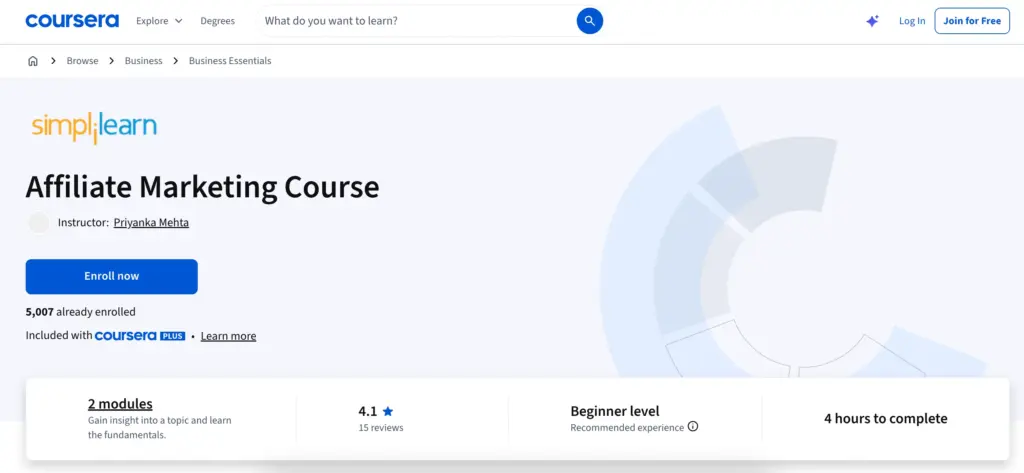
- Best for: A quick, structured beginner overview with a real certificate
- Price: Included with Coursera Plus subscription
- Skill level: Beginner
- Format: 2 modules, 24 videos + 4 readings
- Certificate: Yes
- Free option: No
Taught by Priyanka Mehta through Simplilearn, this is a genuinely affiliate-specific course, not a broader digital marketing detour like some other Coursera options. It starts with the fundamentals: what affiliate marketing is, key players, tracking methods, and payment models, then moves into working with platforms like Amazon Associates and ShareASale, building relationships with affiliate partners, and promoting through email, social media, and blogs. The second module is a hands-on assessment where you apply what you learned rather than just watching more videos. Over 5,000 people have taken it, with a 4.1-star average.
Pros:
- Actually affiliate-specific, unlike several other “affiliate marketing” credentials on Coursera that are broader digital marketing courses in disguise
- Short enough to finish in one sitting, about 4 hours total
- Covers the full loop: platforms, promotion, tracking, and payouts, not just theory
Cons:
- Only 15 reviews so far, so the rating isn’t backed by much volume yet
- Requires a Coursera Plus subscription rather than being free standalone
Our verdict: One of the better beginner-friendly, genuinely affiliate-focused options if you want a structured course.
3. Complete Guide to Affiliate Marketing for Advertisers (Udemy)
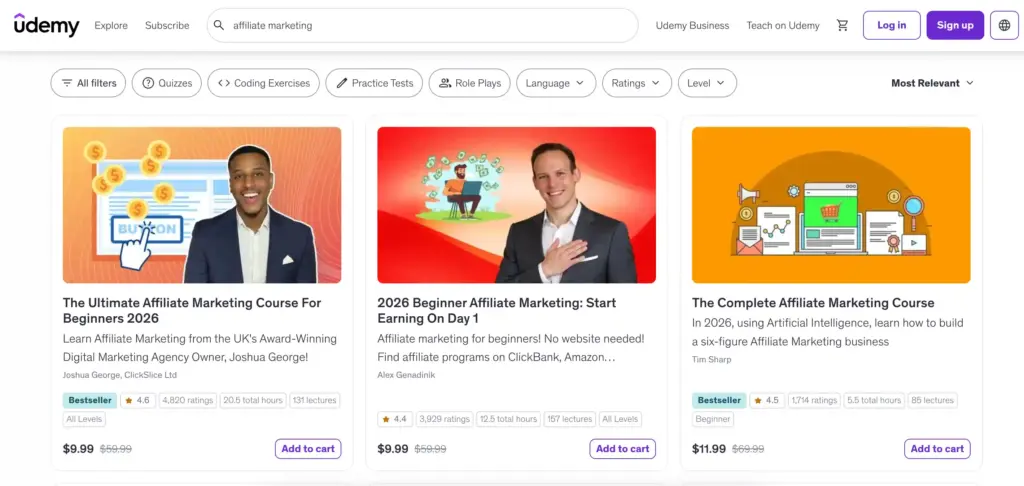
- Best for: Budget-friendly, Amazon Associates basics
- Price: $15–$20 on sale (Udemy runs frequent discounts)
- Skill level: Beginner
- Format: Practical, tutorial-style video course
- Certificate: Yes
- Free option: No
A hands-on walkthrough covering landing page setup, domain tracking, and how to choose between affiliate networks, including Amazon Associates specifically, which makes it one of the more directly relevant options here if you’re building an Amazon-focused site.
Pros:
- Practical and tutorial-driven rather than theory-heavy
- Directly addresses Amazon Associates setup, not just generic affiliate concepts
- 30-day money-back guarantee, lifetime access
Cons:
- Depth is limited given the short, budget format
- No community or ongoing instructor support
Our verdict: For anyone building an Amazon-focused site, this is the most immediately relevant course on the list for the price.
4. Affiliate Marketing Lessons (Affilorama)
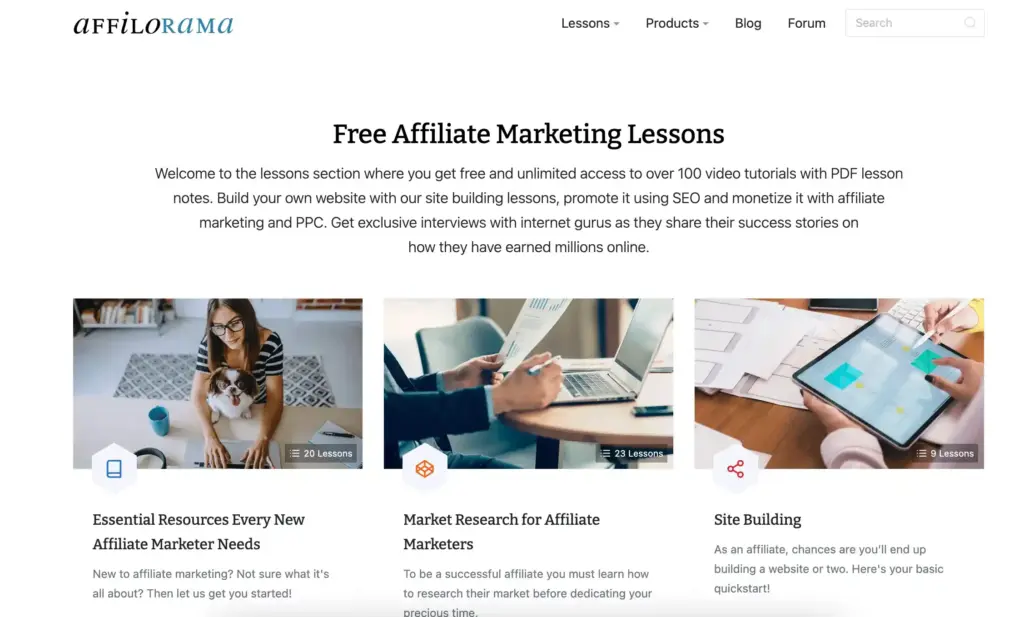
- Best for: Free, structured, self-paced training with real depth
- Price: Free
- Skill level: Beginner to intermediate
- Format: 127+ video lessons across 5 categories, each with PDF lesson notes
- Certificate: No
- Free option: Yes, fully unlimited access.
Affilorama has been running since 2006, which makes it one of the longer-standing free affiliate marketing resources still active. The lessons are organized into five progressive categories: Introduction (20 lessons) for absolute beginners, Market Research (23 lessons) on evaluating a niche before committing time to it, Site Building (9 lessons) for the technical basics, Content Creation (32 lessons), the largest section, covering writing and content strategy, and Website Promotion (43 lessons) on driving traffic once a site exists. Every video comes with downloadable PDF notes, which is a nice touch for anyone who prefers reading over rewatching.
Pros:
- Completely free with no sign-up paywall blocking the content
- PDF notes accompany every lesson, useful for reference later
Cons:
- Older platform, so some content and design references may feel dated in places
- No certificate or completion tracking
Our verdict: One of the more comprehensive free options on this list by lesson count alone. If you want structured, sequential free training rather than a single video or article, this is a strong pick.
5. Affiliate Academy (Voluum)
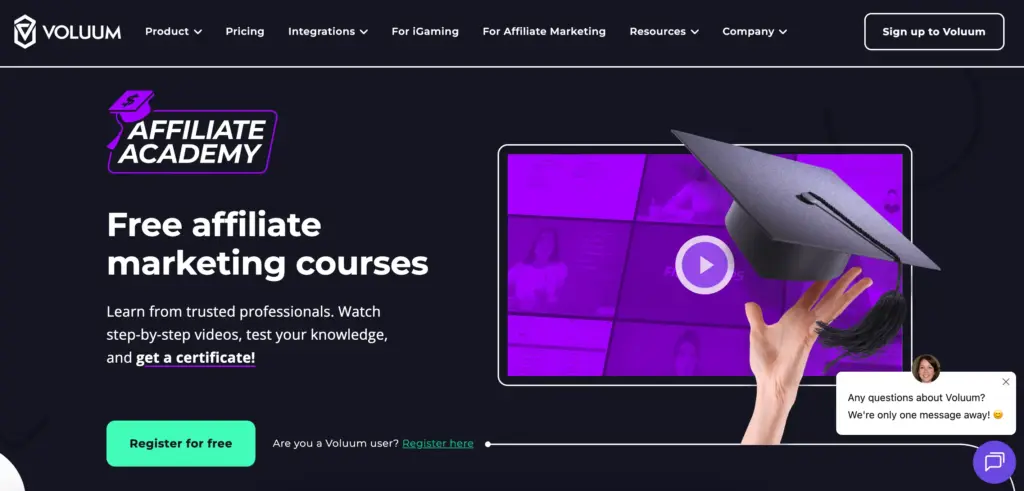
- Best for: Free, credentialed training built by an ad-tracking platform
- Price: Free
- Skill level: Beginner to intermediate
- Format: 3 courses totaling 38 videos, 42 reading materials, and 25 knowledge tests
- Certificate: Yes, certificate of completion for each course, backed by Voluum
- Free option: Yes, no signup fee
Voluum, the ad-tracking platform, built this academy in partnership with affiliate networks Mobidea, PropellerAds, and Zeydoo, which shows how practical and platform-specific the training gets.
Course 1: How to Start Affiliate Marketing (12 videos, 9 knowledge tests) walks total beginners through niches, ad formats, offers, landing pages, traffic sources, and the affiliate mindset across 12 chapters.
Course 2: Set Up Your First Campaign (16 videos, 8 tests) is a step-by-step walkthrough of registering with affiliate platforms, integrating them, and building a tracked campaign funnel in Voluum itself.
Course 3: Optimize Your Campaigns (10 videos, 8 tests) covers A/B testing, bid strategy, automation rules, and writing ads and landing pages that convert better. Each course ends with a final test and a shareable, LinkedIn-ready certificate.
Pros:
- Built by people who make the tracking software, so the technical steps are accurate and current
- Certificate of completion plus partner discounts (Mobidea, PropellerAds, Zeydoo) on signup
- Free with no time limit; access doesn’t expire once you register
Cons:
- Courses 2 and 3 assume you’re using Voluum specifically, plus an affiliate program and traffic source account less useful if you’re building organic/SEO-first rather than paid traffic
- Leans toward performance/paid-traffic affiliate marketing rather than blogging or SEO content
- Requires free registration to access lessons, unlike some fully open resource hubs
Our verdict: One of the stronger free, structured options especially for anyone leaning toward paid traffic and performance marketing rather than organic content. Less of a fit if your reader base is SEO/blog-first, since two of the three courses are built specifically around Voluum’s own tracking workflow.
6. Affiliate Marketing Training Course (Creative IT Institute)
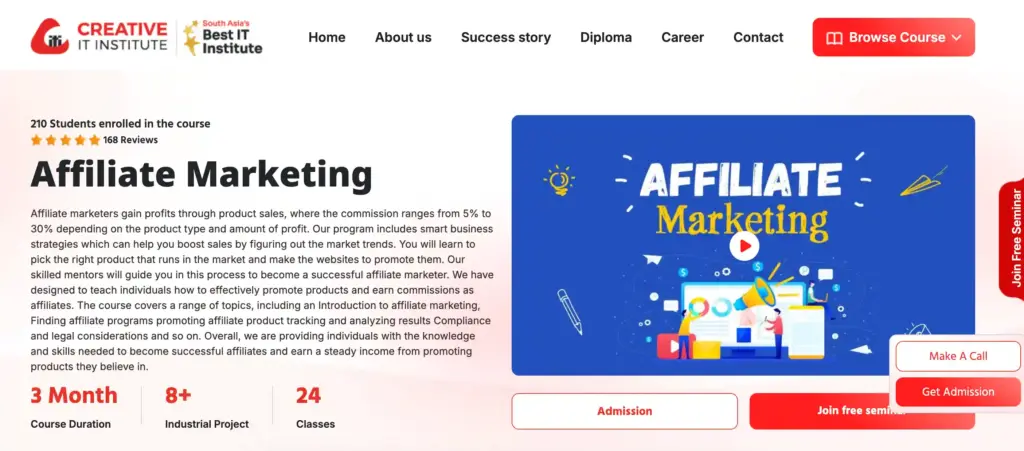
- Best for: Bangladesh-based learners wanting live, instructor-led classroom training
- Price: BDT 25,000 (offline, on-campus) or BDT 12,000 (online live batch)
- Skill level: Beginner
- Format: 3 months, 24 classes, live batches (online or in-person), plus a virtual internship
- Certificate: Course completion certificate (standard for the institute’s programs)
- Free option: No, but free seminars are available before enrolling
This is a local, Dhaka-based institute offering live-instructor training rather than a self-paced video library a different model entirely from the international options on this list. The curriculum covers the basics of affiliate marketing, finding and evaluating affiliate programs, promoting products, tracking and analyzing results, and compliance/legal considerations. It also folds in tool training on SEMrush and Meta Business Portfolio, and includes 8+ “industrial projects” plus a virtual internship component. Over 200 students have enrolled with 168 reviews.
Pros:
- Live, structured classes with real instructor access, not just recorded video
- Includes hands-on tool training (SEMrush, Meta Business) most affiliate courses skip
Cons:
- Priced and scheduled around a 3-month, fixed-cadence format, less flexible than self-paced options
- No public curriculum breakdown by module/lesson beyond the general topic list
Our verdict: Worth considering if you’re based in Bangladesh and want structured, live classroom training with job support.
7. Affiliate Marketing (Great Learning Academy)
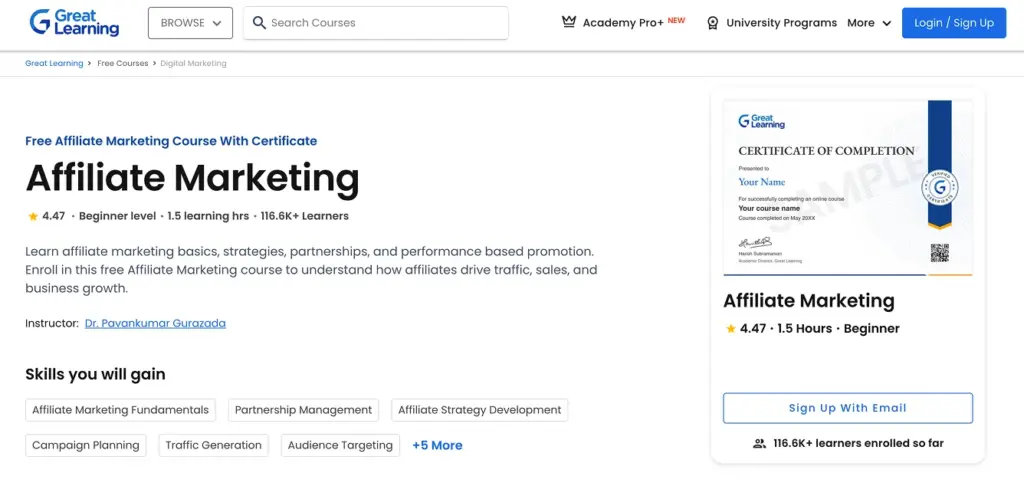
- Best for: A quick, no-cost primer with strong learner volume behind it
- Price: Free to take; the completion certificate carries a separate non-refundable fee
- Skill level: Beginner
- Format: Self-paced video course, 1.5 hours total, with quizzes
- Certificate: Yes.
- Free option: Yes, the course content itself is free; only the certificate costs extra
Taught by Dr. Pavankumar Gurazada, a digital marketing academic with a Ph.D. from IIM Lucknow and industry experience in retail and B2B sales management, this is a short, foundational course covering affiliate marketing basics, partnership models, and performance-based promotion. It’s rated 4.47 out of 5, with over 116,000 learners enrolled a genuinely large sample size compared to most other free courses on this list. Content covers campaign planning, traffic generation, audience targeting, conversion optimization, and commission models at an introductory level.
Pros:
- Backed by real academic credentials: a published author and Ph.D. holder, not an anonymous “guru”
- Huge learner base (116K+) with a strong, consistent rating
Cons:
- The certificate isn’t free.
- At 1.5 hours, it’s a primer, not a deep dive, with no hands-on campaign building.
- General digital-marketing framing rather than deeply affiliate-specific tactics.
Our verdict: A solid, credible short primer if you want the basics validated by an actual academic rather than a self-proclaimed guru; just budget separately if you want the certificate to show for it.
8. Spark by ClickBank
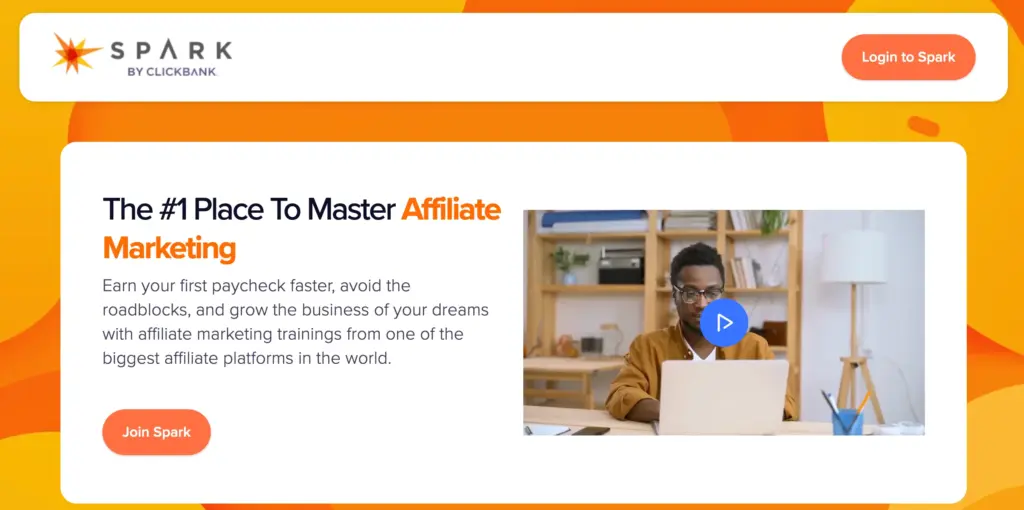
- Best for: ClickBank-specific training
- Price: Starts from $23.50/month
- Skill level: Beginner to intermediate
- Format: 200+ hours across multiple courses (paid ads, blogging/SEO, social)
- Certificate: No
- Free option: No, limited to the first month
Spark is ClickBank’s own in-house training platform, launched as the successor to ClickBank University. Since ClickBank has paid out over $6.8 billion in commissions since 1998, Spark’s whole pitch is teaching you to work the platform you’d actually be earning from. Course tiers separate “Side Hustle” content from “Career Starter” content, and a paid community add-on (Campfire) gives access to other affiliates working the same network.
Pros:
- Genuinely large library (200+ hours) covering both paid traffic and organic/blogging approaches, not just one method
- Built and taught by ClickBank’s own team and top affiliates, with direct incentive to help you succeed since they earn when you do
- Monthly plan available, so you’re not locked into a high upfront cost to start
Cons:
- Tied specifically to ClickBank’s ecosystem, less useful if you’re working other networks
- Requires additional spend on email tools and hosting to fully use the training
Our verdict: Makes sense specifically if you’re building around ClickBank as your primary network, less useful as general affiliate education otherwise.
9. Affiliate Marketing For Beginners by Adam Enfroy
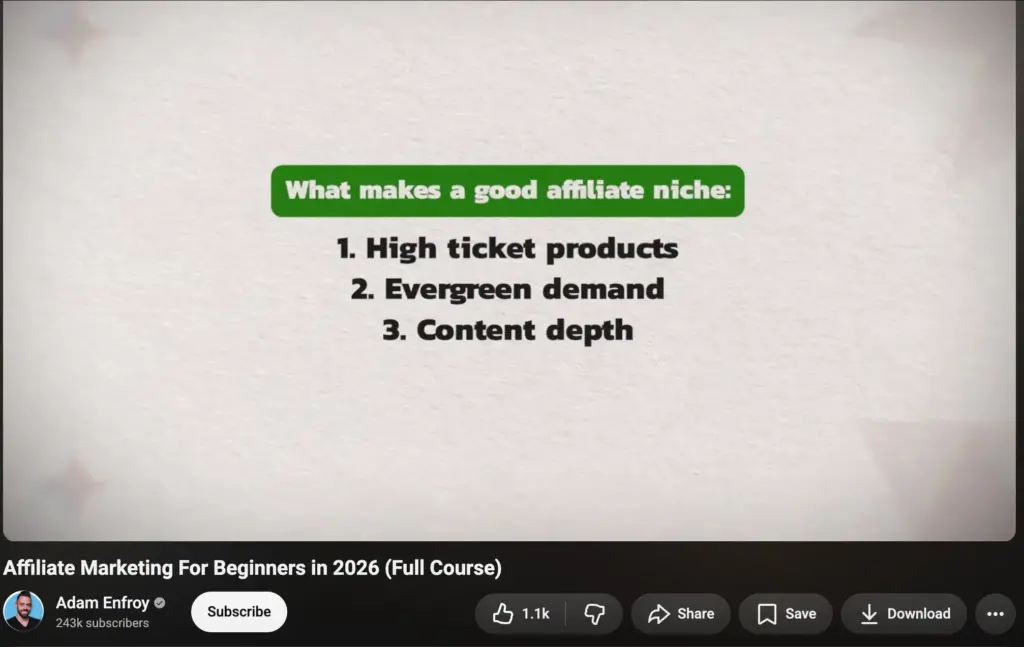
Best for: Free, YouTube-native full-length training
Price: Free
Skill level: Beginner
Format: Single long-form YouTube video, self-paced
Certificate: No
Free option: Yes, fully
Adam Enfroy built his own blog into a seven-figure business primarily through affiliate marketing before turning that experience into paid courses (Blog Growth Engine) and a large content library. This YouTube upload is his free, full-length version, likely functioning as both standalone training and a funnel into his paid programs, which is worth knowing going in.
Pros:
- Completely free, no signup required to watch
- Comes from someone with a documented affiliate income track record, not just theory
- Long-form format means more depth than a typical 10-minute YouTube explainer
Cons:
- As a single video (not a structured course platform), there’s no built-in progress tracking, community, or updates once published
- Likely designed partly to funnel viewers toward Enfroy’s paid Blog Growth Engine course, worth flagging that framing if you mention it
Our verdict: A solid free option from a credible source, but treat it as an on-ramp rather than a complete education, especially if it’s steering toward a paid upsell.
10. $100K/Year Affiliate Marketing (Miles Beckler)
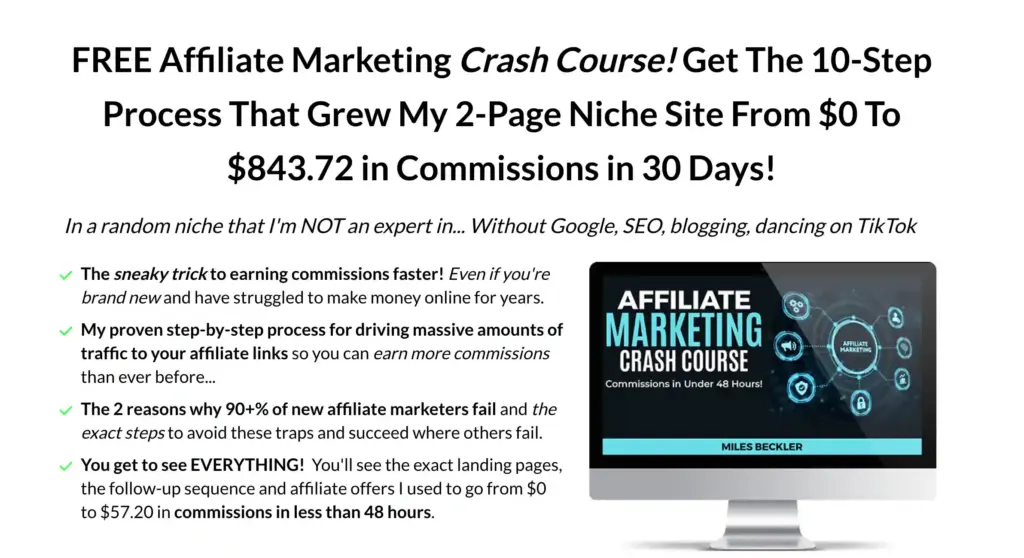
- Best for: Content-first affiliate marketers who want to understand what Google actually rewards
- Price: Free
- Skill level: Beginner
- Format: Single long-form YouTube video, self-paced
- Certificate: No
- Free option: Yes, fully
Miles Beckler built this guide around the part most affiliate courses gloss over: the content itself. After a quick overview of how affiliate marketing works, it moves straight into niche selection, then spends the bulk of its time on what actually makes affiliate content perform, how to structure it, what makes it “enticing” rather than just informative, and specifically what Google looks for when deciding which content to rank. That last piece is the differentiator: rather than treating SEO as a separate module bolted on at the end, it’s woven into the content-creation process from the start.
Pros:
- Content- and SEO-focused rather than a broad, scattered overview.
- Practical framing around what search engines reward, not just generic “write good content” advice.
Cons:
- Single video format; no structured modules, community, or progress tracking
- Narrower scope than an end-to-end course; doesn’t go deep on traffic sources beyond organic/content, or on paid promotion
Our verdict: A strong pick specifically for the content-writing side of affiliate marketing, less useful if you’re looking for a full business blueprint covering niche research, monetization, and traffic strategy all in equal depth.
How to choose the best affiliate marketing course
Before committing to any course, read the actual syllabus, not the testimonials. Sales pages love vague promises: “master the system,” “unlock your potential.” A real curriculum names modules, lesson counts, and what you’ll be able to do after each one.
Check if the instructor actually built something with this method: Sam Oh helped shape Ahrefs’ own affiliate content strategy before teaching it. Miles Beckler and Adam Enfroy both grew their own sites into real income before turning around and teaching it. A quick search for the instructor’s name plus “case study” or “site” tells you fast whether they’re demonstrating or just narrating.
Look for something you actually build, not just watch: A course where you set up a real tracking pixel, write a real comparison table, or launch a real campaign teaches you something a lecture can’t. If every module ends with “and that’s how it works,” not “now go do this,” you’ll finish the course without having done anything.
Check the last update date: Amazon’s affiliate API changed. Google’s algorithm shifted multiple times in the last two years. A course still teaching 2022 tactics as current will cost you time chasing strategies that no longer work. Check the sales page footer or course dashboard for a “last updated” stamp before buying.
Know the refund window before you click buy, not after: Udemy offers a 30-day, no-questions-asked guarantee. ClickBank Spark backs its paid tiers with the same. Free courses obviously sidestep this entirely, but for anything you’re paying for, confirm the window before you commit, not after.
Don’t let price be your proxy for quality: A $15 Udemy course that covers Amazon Associates setup step-by-step can get you further than a pricier option built for people who already understand the basics. Match the course to where you actually are, not to what sounds most serious.
Courses aren’t the only way to learn affiliate marketing. Check out these 27 affiliate marketing books if reading suits you better.
You’ve learned affiliate marketing, now what?
Congratulations, you’ve picked a course (or three) and worked through the fundamentals.
Now what?
Now comes the part that actually makes the whole thing pay off: getting products in front of readers in a way that looks good and converts.
This is where most people stall out. You understand niches, keywords, and content structure, but pasting raw Amazon links into paragraphs doesn’t convert well, and manually updating prices and images every time something changes on Amazon’s end is a losing battle.
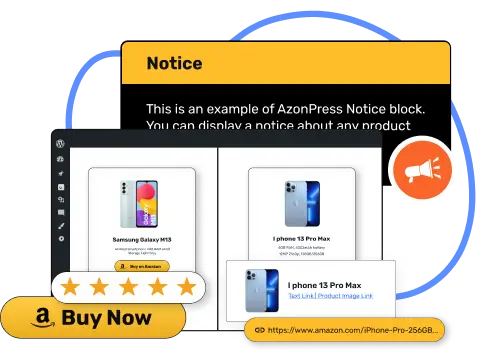
That’s what AzonPress is built for. Once you’ve applied what you learned and started publishing, AzonPress lets you pull in Amazon products and display them as clean product boxes, grids, or comparison tables. Prices, images, and availability stay synced automatically, so you’re not manually updating product cards every week.
If you’re just starting, you can even build custom product tables without touching the Amazon API at all, which matters if you’re still waiting on Associates approval but want your site looking populated and professional from day one.
The course teaches you the strategy. What you put on the page after that is what turns readers into buyers.
Wrapping up
Whichever course you pick, free or paid, SEO-first or paid-traffic-first, the actual work starts after you close the last tab. Courses teach you the map. Walking it is still on you.
If there’s one thing worth repeating: don’t collect courses. Pick one that matches where you actually are right now, finish it, and build something with what you learned before you go looking for the next one.
And once you’ve got real content going and products to showcase, try AzonPress to turn those Amazon picks into clean, converting product displays instead of plain links buried in paragraphs.





Read Similar Blogs
We build lasting partnerships to boost and manage revenue growth



Leave a Reply