

Is Selling on Amazon Profitable? Experts’ Tips for Success


Selling on Amazon is a common social media buzzword. Every other reel is someone’s “I quit my job for this”, and it’s easy to assume the door’s wide open for anyone who wants in.
Thousands of new sellers join Amazon every year. But what does that actually mean? Is selling on Amazon really profitable for the people signing up?
This guide breaks down exactly what sellers really keep after Amazon takes its cut, what separates a 5% margin from a 25% one, and the specific moves experienced sellers make to stay on the right side of that line.
So, let’s get started.
TL;DR
Is selling on Amazon profitable: Reality check
Yes, selling on Amazon can be profitable, but revenue and profit are two very different numbers, and confusing them is the single most common reason new sellers feel blindsided six months in.
Amazon’s appeal is obvious: over 2.5 million active sellers are already there because the platform hands you built-in traffic and buying intent that would otherwise take years and a real marketing budget to build from scratch. Someone searching on Amazon isn’t browsing; they’re usually ready to buy. That’s a real advantage most other sales channels can’t match.
But that traffic doesn’t guarantee profit. It guarantees a chance to sell, and what happens after the sale fees, fulfillment, ads, returns determines whether that sale actually made you money. Two sellers can generate identical revenue and end the month with completely different bank balances, because one priced with real margin in mind and the other didn’t.
Here’s a simple example. Say you generate $10,000 in monthly sales:
- Product costs: $3,000
- Amazon fees (referral + FBA): $1,500
- Fulfillment and storage: $1,000
- Advertising: $1,200
- Returns and miscellaneous: $300
- Estimated profit: $3,000
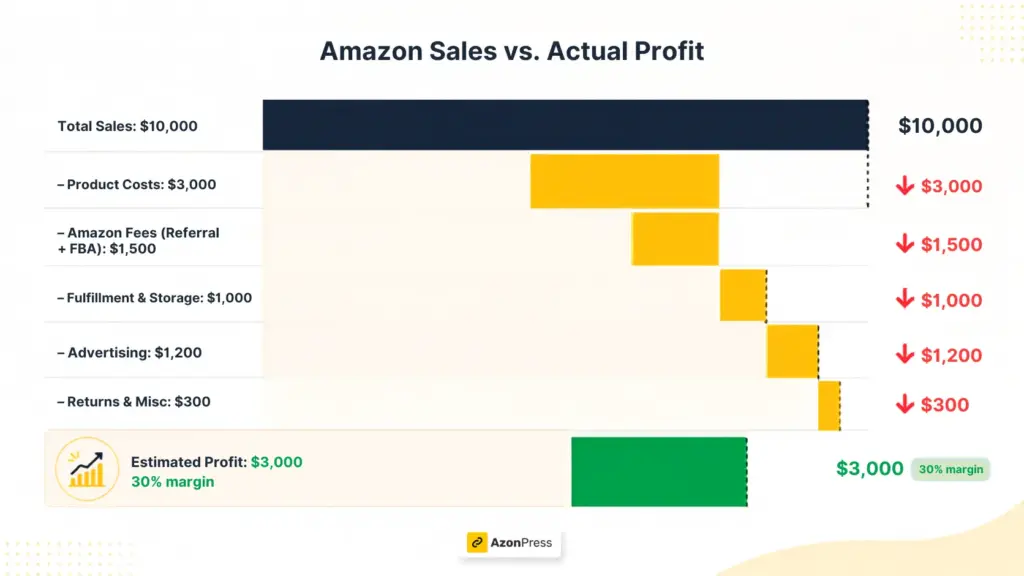
That’s a 30% net margin, a genuinely good outcome. But notice how much of that $10,000 never touched your pocket. A product generating $10,000 in sales doesn’t mean the seller made $10,000; it means they made whatever was left after every one of those line items, and that’s the number that actually matters.
This is an illustrative example, not a guaranteed margin; your own numbers depend entirely on category, sourcing, and how efficiently you run ads.
How much can you make selling on Amazon?
There’s no single “average Amazon seller income” figure that means much, because the range is driven by variables that differ wildly from one seller to the next:
- Product price and sales volume
- Profit margin (which itself depends on category and sourcing)
- Number of products in your catalog
- Business model (private label vs. wholesale vs. arbitrage)
- Advertising spend and efficiency
- Sourcing cost and supplier terms
- Competition level in your category
- Seasonality
What the data does show is a fairly consistent tiered structure across the seller base.
- Beginner sellers (0–6 months) typically generate $500–$2,000 in monthly revenue, with net profit often under $500 as they’re still learning fee structures and ad efficiency.
- Established sellers (6+ months) make up the largest group, about 40% of all active sellers earning $1,000–$25,000 monthly at 15–20% margins.
- High-volume sellers (the top 20%) generate $25,000–$50,000 monthly, often running multiple product lines. The top 10% clear $50,000+ monthly, usually 12+ months in with reinvested profit.
Across all sellers, 57% maintain margins above 10%, and 28% clear above 20%, but roughly 13% aren’t profitable yet, mostly newer sellers still working through the learning curve.
Take these as a realistic planning range, not a promise: your actual number depends entirely on the variables above, and no honest source can tell you your income before you’ve picked a product.
What determines Amazon seller profitability?
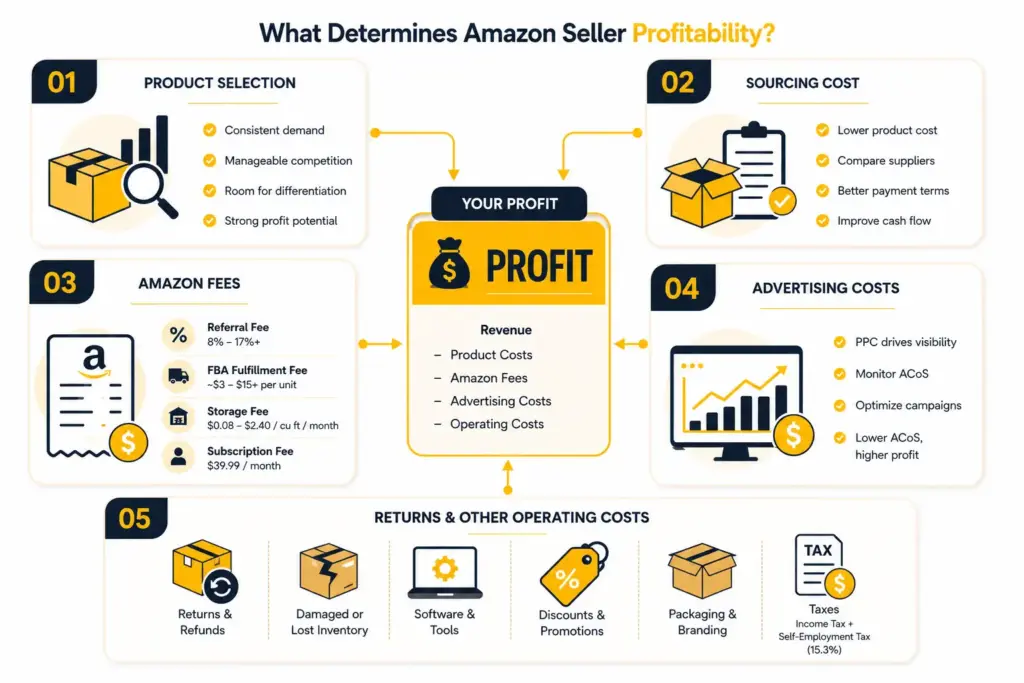
Profitability isn’t one variable; it’s the sum of several you control and a couple you don’t. Here’s what actually moves the needle.
Product selection
Demand alone doesn’t make a product profitable. A product can have thousands of monthly searches and still be a bad choice if competition is fierce, differentiation is weak, or the category’s fees eat too much of your margin.
The products that work best usually have consistent demand, a selling price high enough to absorb fees and ads with room left over, and some reason a buyer would pick yours over the ten other nearly identical listings on the page.
Product sourcing cost
Your cost of goods is the one line item you have the most direct control over, and small improvements here compound across every unit you sell. Ordering in larger volume commonly reduces per-unit cost 10–20%, and testing 2–3 suppliers for the same product often reveals a 15–30% cost difference for identical quality. Negotiating better payment terms (30–60 days instead of paying upfront) also frees up cash flow you’d otherwise have tied up in inventory.
Amazon fees
This is where most beginners underestimate their true cost stack.
- Referral fee: Amazon’s commission on the sale itself, charged on your total sale price. Most categories sit at 15%, but the range runs 8 -17%+ depending on category apparel uses a tiered structure (5% up to $15, 10% from $15 – 20, 17% above $20), and there’s a $0.30 minimum fee per unit that quietly turns an 8% fee into an effective 20%+ rate on anything priced under about $4.
- FBA fulfillment fee: Roughly $3 -15+ per unit depending on size and weight tier, charged whether or not the product ever sells for full price.
- Storage fee: $0.08–$2.40 per cubic foot monthly, with steep long-term storage penalties after 365 days sitting in an Amazon warehouse.
- Subscription fee: $39.99/month for the Professional plan (recommended past 40 sales/month), or $0.99 per item on the Individual plan.
Each of these hits your margin at a different point in the sale, which is exactly why “revenue minus product cost” gives you a wildly inflated sense of what you’re actually keeping.
Advertising costs
PPC (pay-per-click) is often the difference between a profitable product and a break-even one, and it needs to be evaluated against your contribution margin, not treated as a flat cost. New sellers commonly run 35–50% ACoS (Advertising Cost of Sales) while they’re still learning what converts.
Experienced sellers bring that down to 15–25%, and well-optimized campaigns run 10–20%. If your ACoS sits above your product’s margin, you’re paying Amazon to lose money on every ad-driven sale a mistake that’s easy to miss if you’re only checking total sales and not per-product profitability.
Returns and other operating costs
Beyond the obvious fees, a handful of smaller costs add up fast if you don’t track them: return and refund processing, damaged or lost inventory, discounts and promotions you run to boost rank, affiliate marketing plugin, packaging and branding materials, and taxes sellers owe regular income tax on profit plus self-employment tax (15.3%) if they’re operating as a sole proprietor, which is a real enough hit that many sellers form an LLC specifically to manage it.
Get access to our exclusive offers and pro tips!
Which Amazon selling models are most profitable?
Your business model sets your margin ceiling before you’ve sold a single unit, and no model here is automatically profitable. Execution, margins, and demand still decide the outcome; this table is a starting point for comparing your options, not a guarantee.
| Business Model | Investment | Profit Potential | Main Challenge |
| Private label | Medium–high ($3,000–$10,000+) | High (20–35% margin) | Product development & competition |
| Wholesale | Medium–High ($2,000–$5,000) | Medium (10–20% margin) | Supplier relationships & margins |
| Retail arbitrage | Low ($500–$2,000) | Low–Medium (5–15% margin) | Scalability |
| Online arbitrage | Low–Medium ($500–$2,000) | Low–Medium (5–15% margin) | Finding profitable products |
| Handmade | Low–Medium | Medium–High | Production capacity |
| Dropshipping | Low | Low–Medium | Margins & policy compliance |
| Print on demand | Low | Low–Medium | Competition |
What are the biggest costs of selling on Amazon?
Before you launch, run the full cost stack, not just the ones that are obvious upfront:
- Amazon selling fees: Referral fee (8–17%) plus the $39.99/month Professional subscription
- Product/sourcing costs: Unit cost plus shipping to Amazon’s warehouse
- FBA fees: $3–15+ per unit based on size and weight
- Storage fees: $0.08–$2.40 per cubic foot, worse during Q4 and after 365 days
- Shipping: Both inbound to Amazon and any outbound you handle yourself under FBM
- Advertising: PPC campaigns, typically 10–30% of revenue for competitive products
- Returns and refunds: Return processing plus the cost of damaged or unsellable returned inventory
- Software and tools: Product research and repricing tools like Helium 10, Jungle Scout, or Keepa
- Branding and packaging: Inserts, custom packaging, and brand registry costs if you’re going private label
- Taxes: Income tax on profit, plus self-employment tax if you’re a sole proprietor
This is exactly why revenue and profit diverge so much on Amazon specifically; there are simply more line items between a sale and your bank account than most new sellers expect going in.
How to calculate your potential Amazon profit?
Run your specific product through Amazon’s own FBA calculator before committing to inventory, not a rough mental estimate. If the projected margin lands under 15% before advertising is even factored in, treat that as a signal to renegotiate your sourcing cost or reconsider the product, not something you’ll fix once sales start coming in.
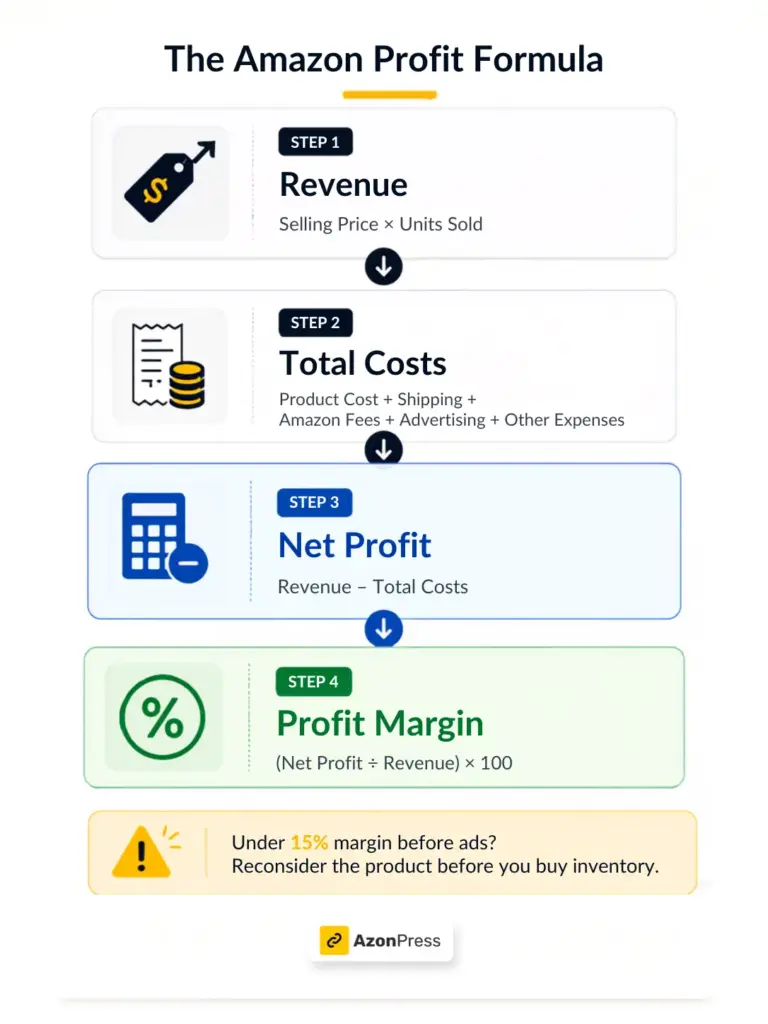
Run this formula before you buy inventory, not after:
Amazon profit = Revenue − product costs − Amazon fees − fulfillment − advertising − other business expenses
Calculate revenue: Selling price × number of units sold.
Calculate total costs: Add up product cost, shipping, Amazon’s referral and FBA fees, advertising spend, and any other operating costs (software, packaging, returns).
Calculate net profit: Revenue minus all of the above.
Calculate profit margin: Profit Margin = (Net Profit ÷ Revenue) × 100
10 expert tips to make selling on Amazon profitable
Profitable sellers don’t just get lucky with product picks; they follow a set of habits that protect their margin day to day. Here’s what that looks like in practice.
1. Choose products based on profit potential, not just demand: High search volume means nothing if the category’s fees and competition leave no room for margin. Run the numbers before you fall in love with an idea.
2. Calculate every cost before buying inventory: Include the hidden ones, the $0.30 referral fee floor, long-term storage penalties, return processing not just the obvious ones like product cost and shipping.
3. Avoid competing only on price: A race to the bottom on price erodes margin for everyone in that niche. Differentiate through better quality, bundling, stronger branding, product improvements, or a genuinely better customer experience instead.
4. Keep your inventory under control: Overstocking ties up capital and triggers storage penalties; understocking kills your rank. Start with 30–60 days of stock and scale based on actual sell-through, not projections.
5. Optimize your product listings: Stronger titles, higher-quality images, clearer bullet points, and A+ content directly improve conversion rate, which lowers your effective cost per sale even if your ad spend stays flat.
6. Manage PPC strategically, not passively: Don’t treat advertising as a fixed cost of doing business. Monitor whether each campaign is generating profitable sales, add negative keywords monthly to cut wasted spend, and adjust bids weekly based on actual performance.
7. Monitor your profit margins regularly, not just revenue: Revenue growth means nothing if your margin is quietly shrinking underneath it. Check margin per product, not just total sales, on a regular cadence.
8. Reduce unnecessary costs: Periodically review sourcing, packaging, shipping, and the software subscriptions you’re paying for. Small savings across several line items add up the same way small fee increases do.
9. Build a real brand, not just a listing: A recognizable brand reduces how much you have to compete purely on price, and it builds the kind of repeat-buyer trust that arbitrage and generic wholesale products rarely earn.
10. Reinvest profits carefully, not blindly: Successful sellers put early profit back into inventory, a second product line, or better marketing deliberately, based on what’s actually working, rather than scaling everything at once because the first product did well.
Is Amazon FBA still profitable?
Yes, but FBA itself doesn’t make an unprofitable product profitable, and that distinction matters more than people expect.
FBA’s real advantages are genuine: Amazon handles storage, packing, shipping, and most customer service; your products qualify for Prime eligibility (which meaningfully boosts conversion), and returns are largely automated on Amazon’s end rather than yours. For a lot of sellers, that convenience is worth the fee.
But FBA fees and storage costs stack directly on top of your referral fee, and if your product’s margin was thin to begin with, FBA can turn a marginal product into a losing one. The right way to evaluate it isn’t “should I use FBA” in the abstract; it’s calculating your contribution margin with FBA fees included before you commit inventory to it. A product with a healthy 25%+ margin usually absorbs FBA fees comfortably. A product already sitting at 12% often can’t.
Common reasons Amazon sellers lose money
Most seller failures trace back to a handful of avoidable mistakes, not bad luck:
- Choosing a product without real demand research
- Underestimating Amazon’s fee structure, especially the $0.30 referral floor and storage penalties
- Ignoring advertising costs until ACoS quietly exceeds the product’s margin
- Overestimating demand and overordering inventory as a result
- Overstocking and paying long-term storage fees on units that don’t move
- Competing purely on price in an already crowded category
- Poor product listings: weak titles, low-quality images, thin descriptions that hurt conversion and force more ad spend to compensate
- Low-quality products that generate high return rates, which eat margin twice: once on the refund, once on the damaged inventory
- Failing to monitor margins per product, only tracking total revenue
- Scaling inventory or ad spend before actually confirming product-market fit
Almost every one of these is a math or research failure, not a market failure, which is also why they’re avoidable with the right groundwork before launch.
Is selling on Amazon worth it in 2026?
Actually, It’s not a yes or no answer. It comes down to how much work you’re willing to put in before you even list that first product.
The buyers are still there. That part hasn’t changed. What’s changed is everyone else selling next to you. A plain product with nothing different about it just doesn’t move the way it used to. And you can’t rely on organic ranking to carry a new listing anymore; ads are part of the cost of doing business now, not something you add later if things slow down.
If I were starting from scratch today, I’d spend less time picking a product and more time figuring out what makes mine worth choosing over the next seller’s better sourcing, a product people actually remember, something. That’s where sellers are still winning right now.
At last, if you ask me again, is selling on Amazon profitable?
I’ll say yes, for the sellers who take the fees and the numbers as seriously as they take the product itself. Know your margin before you know your first sale. Everything else in this guide comes back to that one habit.


Frequently asked questions
Here are some frequently asked questions regarding “Is selling on Amazon profitable?”
1. Is selling on Amazon profitable for beginners?
Yes, but expect thinner margins early, typically 5–10% in your first 6 months while you’re still learning fee structures and ad efficiency. Profitability usually improves to 15–20% once you’ve worked past that initial learning curve.
2. How much profit can you make selling on Amazon?
It varies widely by tier: beginner sellers often net under $500/month, established sellers (6+ months in) typically clear $150–$5,000/month at 15–20% margins, and high-volume sellers can exceed $5,000/month. Your specific outcome depends on product, category, and business model.
3. What is a good Amazon seller profit margin?
15–20% net margin is considered healthy for most categories. Below 10% is risky since Amazon’s fees and occasional returns can erase it entirely, while above 25% usually signals a differentiated product or a lower-competition niche.
4. How much money do I need to start selling on Amazon?
A minimal setup runs $1,000–$2,000 (inventory, the $39.99/month Professional plan, basic tools). $3,000–$5,000 gives more realistic room for a second inventory run and a PPC budget. Private label sellers should budget closer to $5,000–$10,000 for a competitive launch.
5. Can you make $1,000 a month selling on Amazon?
Yes, that falls within the established-seller range ($1,000–$25,000 monthly revenue), which represents about 40% of active sellers. Reaching it typically takes several months of consistent listing optimization and ad management rather than happening immediately.



Read Similar Blogs
We build lasting partnerships to boost and manage revenue growth





Leave a Reply