


High Ticket Affiliate Marketing For Beginners Guide
TL;DR:
High ticket affiliate marketing means promoting expensive products or services that pay big commissions per sale. Promote expensive, high value products. Drive high intent traffic. Build trust. Convert fewer buyers for bigger payouts.
What to do:
>> Focus on niches where people spend serious money such as SaaS, finance, hosting, education, and cybersecurity
>> Target bottom of funnel keywords like reviews, comparisons, and “best for” queries
>> Build authority with in depth content and honest recommendations
>> Prioritize SEO and email to create compounding assets
>> Choose programs with strong commissions, long cookie windows, and recurring payouts
What to expect:
>> Slow results in the first 6 to 12 months
>> Lower conversion rates but higher earnings per sale
>> Wide income range, with top performers earning six to seven figures annually
What if you could make $500 from a single affiliate sale commission instead of hustling to make $5 a hundred times over?
That’s the core idea behind high ticket affiliate marketing, and it’s exactly what separates people who treat affiliate marketing as a side income from those who turn it into a full-time business.
I’ve spent a significant amount of time researching this space, speaking to affiliates across niches, and breaking down what actually works.
And I’ll tell you this upfront: most beginners get into affiliate marketing by promoting low-ticket products and wonder why they’re barely making rent. High-ticket is a completely different game. The rules are different, the effort is different, and so is the reward.
That’s why I’ve written this article explaining high ticket affiliate marketing for beginners. If you want to know what it actually means, how it works, and how you can realistically get started, this guide will walk you through everything from scratch.
Let’s get started.
What is high ticket affiliate marketing?
High ticket affiliate marketing definition: High ticket affiliate marketing means promoting expensive products or services that pay big commissions per sale. Instead of earning a few dollars per sale like with low-ticket items, you might earn $200, $500, or more per conversion because the product price is high.
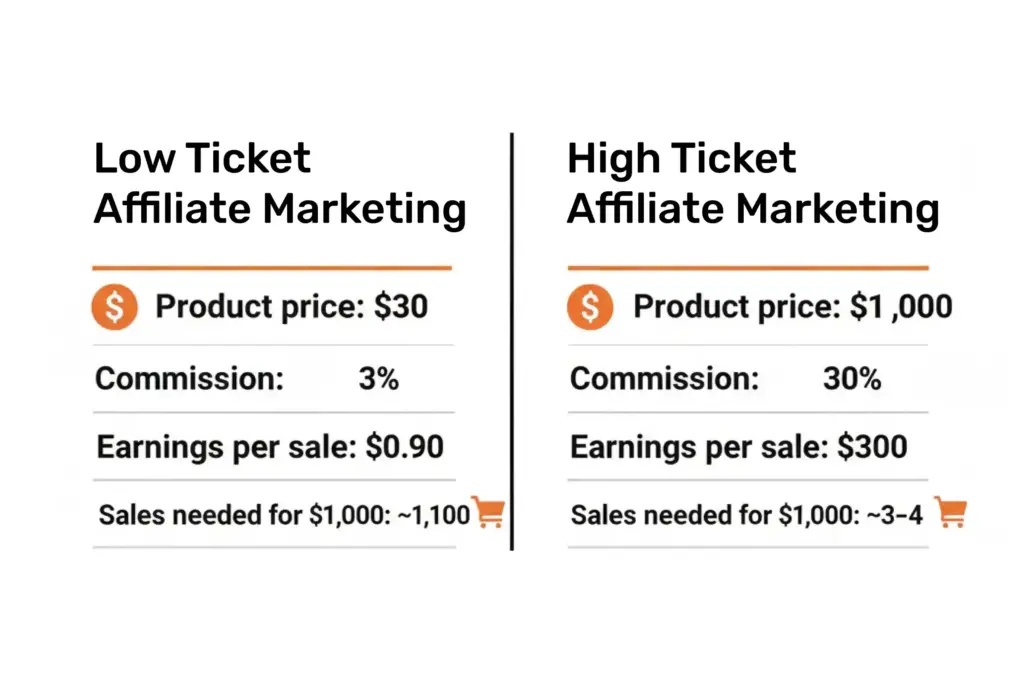
In standard affiliate marketing, you might promote a $30 book on Amazon Associates and earn a 3% commission, which comes out to roughly $0.90. To make $1,000 a month that way, you’d need well over a thousand sales.
High ticket affiliate marketing flips that math entirely. When you promote a high-ticket affiliate product priced at $1,000 and earn a 30% commission, that’s $300 from a single sale. Promote a $5,000 software subscription at 20%, and you walk away with $1,000 from one referral. That’s the fundamental idea. Fewer sales, bigger commissions.
The products or services in this space tend to be things like premium SaaS tools, online education programs, managed hosting platforms, financial products, high-end coaching programs, or luxury services.
These are products with genuine value, often targeting businesses or professionals rather than casual consumers. This isn’t some new or fringe concept either.
According to a Hostinger study, the global affiliate marketing industry is valued at$18.5 billion and projected to grow to $31.7 billion by 2031. High-ticket affiliate programs are one of the fastest-growing segments within that space.
How does high ticket affiliate marketing work
The mechanics are the same as any form of affiliate marketing, but the stakes and strategy are different. At its core, high ticket affiliate marketing follows this simple process:
- Join a high ticket affiliate program.
- Get your affiliate account and unique tracking link.
- Drive traffic to those offers.
- Convert your audience into buyers.
- Earn high ticket commissions per sale.
First, the signing up. You sign up for a high ticket affiliate program offered by a company. They give you a unique affiliate link. You share that link with your audience through your blog, YouTube channel, social media, newsletter, or paid ads.
When someone clicks your link and makes a purchase, you earn a commission. That commission, in high-ticket programs, can range from $100 to several thousand dollars per sale.
And then comes tracking. The company uses cookies attached to your affiliate link to track who came from your referral. Cookie durations vary by program. Some programs offer 30-day windows, while others, like HubSpot’s, offer 180-day cookies.
This matters because high-ticket buyers don’t always purchase immediately. They research, compare, and come back days or weeks later. A longer cookie duration protects your commission during that decision period.
There’s also the question of commission structure. Some programs pay a flat fee per sale. Others pay a percentage of the product price.
And a growing number offer recurring commissions, meaning you earn every month as long as the customer you referred stays subscribed. That recurring model is powerful. One good referral today can quietly pay you for the next two years.
What makes high-ticket work different from promoting cheap affiliate products is the buyer’s mindset. Someone spending $500 or $5,000 is not making an impulse purchase. They’re doing their homework. They need trust, they need thorough information, and they need to feel confident in the person recommending the best selling product. That’s why content quality and authority matter so much in high ticket affiliate marketing.
High ticket affiliate marketing salary
According to PayScale data from 2025, affiliate marketers in the United States earn an average base salary of around $56,000 per year. And according to ZipRecruiter, the average high-ticket affiliate marketer earns roughly $47,500 annually.
But these averages are heavily impacted by the large number of part-timers and beginner affiliate marketers who earn little to nothing in their first year. The reality is that income distribution is wide.
Around 57% of affiliate marketers earn under $10,000 annually. But 15% earn between $80,000 and $1 million per year.
And the top performers, people who have been at it for more than 3 years with an established audience and proven systems, earn well over $100,000 monthly.
Experienced affiliates earn roughly 9.45 times more than beginners, according to industry data. That gap exists because authority, trust, and a well-built content library compound over time. It’s not about shortcuts. It’s about building something real.
Here’s what realistic expectations look like:
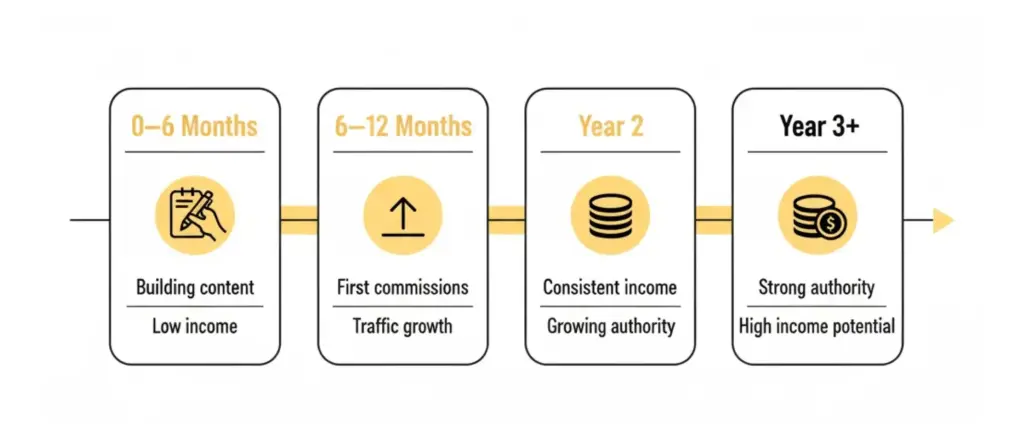
- In your first 6 to 12 months, you might earn little to nothing while you build content and traffic.
- By year two, if you’ve been consistent, a few thousand dollars per month from high ticket commissions is genuinely achievable.
- By year three, the income can become substantial, especially if you’re in a recurring commission program.
The upside of high-ticket is that you don’t need massive traffic to earn good money. One well-placed article that ranks on Google and converts even 2 to 3 readers per month into $500 commission sales is worth $1,000 to $1,500 monthly from a single piece of content.
How to start high ticket affiliate marketing
Here’s the part where I don’t give you a ten-step process that overwhelms you before you even begin.
High ticket affiliate marketing for beginners comes down to 3 core steps. Get these right and everything else follows:
Step 1: Pick a niche you can build authority in
High-ticket buyers don’t buy from strangers. They buy from people who clearly know what they’re talking about. If you can’t demonstrate expertise, you won’t convert.
How to choose a niche?
Think about the intersection of what you know, what people spend serious money on, and what has available affiliate programs. You don’t have to be a decade-long expert. You need to know more than your reader and be committed to learning as you go.
Best niches to consider:
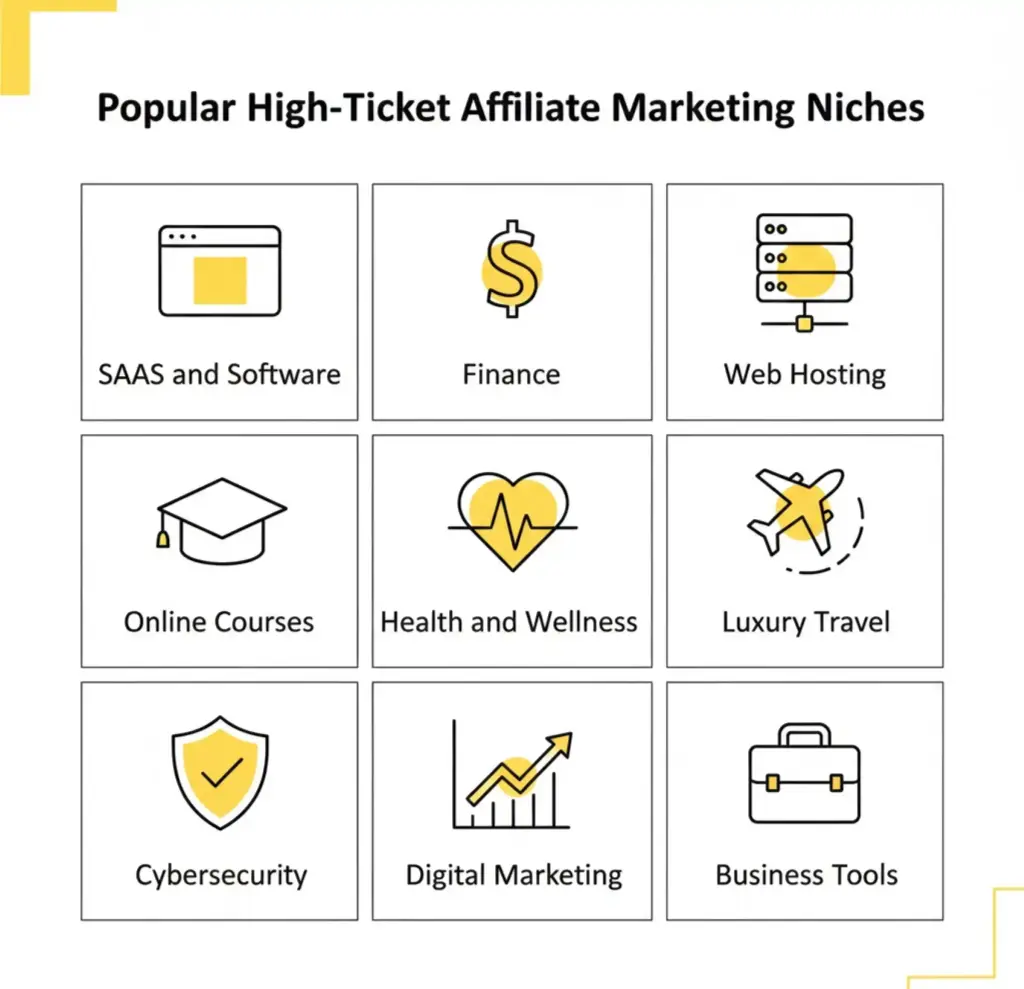
SaaS and software tools, personal finance, online business education, managed web hosting, digital marketing tools, health and wellness programs, luxury travel, and cybersecurity. I’ll break these down more fully below.
The mistake to avoid:
Chasing commission rates instead of genuine interest. If you’re promoting something you don’t understand or care about, your content will feel hollow, and your audience will sense it immediately.
Step 2: Find and join the right high ticket affiliate programs
What to look for?
Commission rate (aim for at least 20% or $100+ flat per sale), cookie duration (the longer the better), product quality (you’re staking your reputation on this), recurring vs. one-time commission, and payout reliability.
Where to find them:
You can find high ticket affiliate programs by looking directly at company websites in your niche (many have an “affiliates” or “partners” page), searching the best affiliate networks like ShareASale, Impact, PartnerStack, and CJ Affiliate, or checking curated lists of highest paying affiliate programs for your category.
Examples of high ticket affiliate programs:
- Kinsta (up to $500 per sale plus 10% recurring)
- HubSpot (30% recurring for up to a year)
- WP Engine ($200 minimum per referral)
- Liquid Web (commissions up to $7,000 per sale)
- Shopify ($58 to $2,000 depending on plan)
- SEMrush (recurring commissions on a premium SEO tool).
Many of the best programs are free to join and have no minimum sales requirement to maintain your affiliate account. Always confirm this before applying.
Note: Amazon Associates, while excellent for volume, pays low commissions (typically 1 to 4.5%) and is better suited to supplementary income rather than a high-ticket strategy on its own.
Step 3: Create content that converts high-intent buyers
What “high intent” means:
A person searching “best managed WordPress hosting for agencies” is much closer to buying than someone searching “what is web hosting.” The first person knows what they want and is comparing options. That’s who your content should be written for.
Content types that work:
In-depth product reviews, comparison articles (Product A vs. Product B), “best of” lists in your niche, tutorial content showing how to use the product, and case studies showing real results. These formats attract readers who are already in research mode.
The role of trust:
Every piece of content you publish is an opportunity to demonstrate that you know your subject and that you’re honest. Mention both the strengths and the weaknesses of what you promote. Readers who feel you’re being straight with them are far more likely to click your affiliate link than readers who sense they’re being sold to.
Distribution:
Publish primarily on a blog you own (so you control your traffic), support that with YouTube if possible, and build an email list from day one. These are assets that compound. Social media alone is too volatile to rely on.
Get access to our exclusive offers and pro tips!
High ticket affiliate marketing niches
I’ve seen that not every niche supports high-ticket commissions equally. Here are the categories where high ticket affiliate programs are most common and most lucrative:
- SaaS and Software Tools consistently top the list. SaaS programs often offer 20 to 70% recurring commissions. Tools like CRMs, email marketing platforms, SEO software, and project management tools sit in this space. These are products businesses pay for month after month, which means your commissions keep arriving long after you wrote the content.
- Online Business Education and Courses are another strong area. Courses and masterminds that sell for $1,000 to $10,000 often offer affiliates 30 to 50% commissions. If you’re in the business, marketing, or personal development space, this is worth exploring.
- Finance and Investment Products offer some of the highest per-lead and per-sale payouts anywhere in affiliate marketing, often $50 to $200 per qualified lead and substantially more per conversion. Think credit cards, investment platforms, insurance, and financial planning tools.
- Managed Web Hosting is a niche dominated by programs like Kinsta, WP Engine, and Liquid Web that pay serious commissions to affiliates who bring in business clients and developers.
- Health, Fitness, and Wellness programs with high-ticket coaching programs, premium supplements, or medical services can generate large commissions, though you’ll need to be careful about compliance and claims.
- Luxury Travel is a growing area. Travel companies offering high-end experiences, business travel management, or luxury accommodations can pay substantial commissions per booking.
- Cybersecurity and Enterprise Software is emerging fast. With businesses taking security more seriously, affiliate programs in this space are paying well for quality leads.
How do you succeed at high ticket affiliate marketing?
This is where most guides give you a generic list of tips. I’m going to go deeper, because success in this space is about understanding the principles behind what works, not just following surface-level advice.
Master SEO and make it your foundation
Based on the AuthorityHacker survey, 78.3% of 2,000 affiliate marketers use SEO as their primary traffic source. And for high-ticket affiliate marketing, it makes complete sense.
SEO brings in people who are actively searching for what you offer. That’s fundamentally different from interrupting someone on social media.
Start with keyword research. Use tools like Ahrefs or SEMrush to find keywords with clear buying intent. Phrases like “best [product category] for [use case],” “[Product] review,” or “[Product A] vs [Product B]” signal a reader who is ready to make a decision.
Build your content around these keywords and optimize each page properly. Over time, a well-optimized affiliate site compounds. Pages ranked on page one of Google can bring consistent, free traffic for years.
Don’t neglect technical SEO either. Page speed, mobile responsiveness, and internal linking all affect your rankings. A slow or poorly structured site will underperform no matter how good your writing is.
Invest heavily in content marketing
Content is how you demonstrate authority, build trust, and attract traffic. In high-ticket affiliate marketing, content is everything. Think of every article, video, or newsletter as a salesperson working for you around the clock.
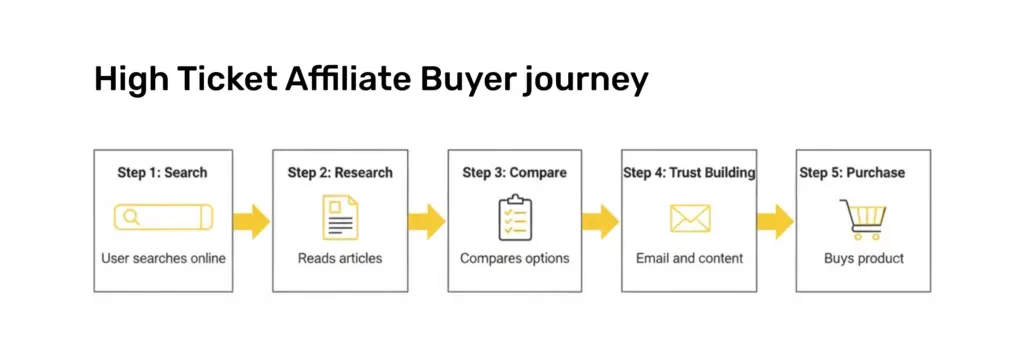
The goal of your content is not just to inform. It’s to answer the specific questions a buyer has at each stage of their decision process. Someone new to a topic needs an overview. Someone deeper in their research needs comparisons and pros-and-cons breakdowns. Someone on the verge of buying needs to see reviews, case studies, and a clear understanding of what they’ll get.
Build a content library systematically. Cover the informational angle of your niche, then the comparison angle, then the review angle. Over time you’ll have an interconnected set of pages that captures buyers at multiple stages.
Build a personal brand and own your authority
In high-ticket affiliate marketing, people don’t just click a link because the article is good. They click because they trust the person who wrote it. Building a personal brand means consistently showing up with expertise, having a clear point of view, and being recognizable in your niche.
This doesn’t require you to be famous. It requires you to be known and trusted within your specific audience. Use your real name, share your real experiences, and take positions. Audiences respond to opinions and expertise far more than they respond to generic information anyone could have written.
Choose products you’d actually recommend
This sounds obvious, but it gets ignored all the time. Promoting a high-ticket affiliate product you haven’t used, don’t believe in, or know has serious flaws will eventually damage your reputation. And in high-ticket affiliate marketing, your reputation is your business.
Before promoting any high-ticket affiliate program, try to get access to the product. Many companies offer free trials or demo accounts for affiliates. Use the product, form a real opinion, and share both sides honestly. Readers can tell the difference between a genuine recommendation and a paycheque dressed up as advice.
Build and leverage an email list
Your email list is the most valuable asset in your affiliate business. Unlike social media platforms or search rankings, your email list is something you own. No algorithm can take it away from you.
Use your content to capture email subscribers. Offer a lead magnet relevant to your niche, something genuinely useful like a comparison guide, a checklist, or a mini-course. Once someone is on your list, you can build the relationship over time, share content, and eventually promote high-ticket affiliate programs to a warm audience that already trusts you.
A small email list of engaged subscribers outperforms a large social media following of passive scrollers every time, especially when you’re promoting something that costs $500 or more.
Understand the Sales Cycle and be patient
High-ticket buyers take time. Someone considering a $2,000 software subscription or a $3,000 coaching program is not going to buy after reading one article. They’ll read your review, check a few other sources, come back, subscribe to your email, see your follow-up content, and eventually convert.
Build your content strategy around this reality. Create content for every stage of the buyer journey. Track what content leads to conversions, not just what generates the most traffic. And configure your affiliate links so you understand where your conversions are actually coming from. Patience is not optional in this space. It’s a strategy.
Diversify across multiple programs and traffic sources
Relying on a single affiliate program is a risk. Programs change their terms, reduce commissions, or shut down entirely. Relying on a single traffic source (say, only Google organic) is also a risk. Algorithm updates can devastate rankings overnight.
Smart affiliate marketers build across multiple high ticket affiliate programs in their niche and cultivate traffic from at least two or three channels: organic search, an email list, and either YouTube or social media. This isn’t about spreading yourself thin in the beginning. It’s about building in resilience as you grow.
Track your data and double down on what works
Gut feeling is not a strategy. Every decision in your affiliate business should be backed by data. Which pages get traffic? Which of those convert? Which affiliate products actually sell versus which ones look good on paper? Which traffic sources are actually driving revenue?
Use tools like Google Analytics, your affiliate dashboard, and your affiliate network’s reporting to understand what’s working. Then do more of it. Kill what doesn’t convert. Refine what almost converts. This disciplined approach to optimization is what separates affiliates who plateau from those who scale.
Benefits of high ticket affiliate marketing
Why choose high ticket affiliate marketing over the classic Amazon affiliate marketing?
- Higher earnings from fewer sales
The most obvious benefit is the math. Promoting high-ticket affiliate programs means each conversion is worth significantly more. A single sale can pay you more than a hundred low-ticket conversions.
This isn’t just about absolute income. It means you can build a profitable affiliate business with a relatively modest audience. A blog with 5,000 monthly visitors converting even a fraction of them into high-ticket buyers can generate a healthy full-time income. - Recurring revenue builds long-term stability
Many of the best high-ticket affiliate programs in the SaaS and software space pay recurring commissions. This means the affiliate business you build today continues paying you months and years from now.
Over time, your baseline monthly income grows with every new customer you refer. This compounding effect is one of the most powerful things about digital and affiliate marketing done well, and it’s far more common in high-ticket programs than in low-ticket retail promotions. - Less time spent on volume-chasing
Low-ticket affiliate marketing is often a volume game. You need enormous traffic to make meaningful money at $2 or $5 commissions per sale.
High-ticket affiliate marketing lets you focus on quality. You can invest more time in fewer, better pieces of content. You can be more selective about who you target. You can focus on traffic that converts rather than traffic that just visits. - Better products mean stronger recommendations
High-ticket affiliate products tend to be premium offerings backed by serious companies. They have better support, better product quality, and better reputations. That makes them easier to recommend authentically.
When you’re proud of what you’re promoting and believe it genuinely helps your audience, that comes through in your content, and it builds credibility over time. - Scalable income with a strong asset base
Because high-ticket affiliate marketing is largely content and SEO-driven, the work you do today continues to generate income without proportional additional effort. A well-ranked article is an asset. A growing email list is an asset.
Unlike a job where you trade time for money, a well-built affiliate business generates returns that grow even when you’re not actively working. That’s real passive income, though it takes real upfront effort to create.
Limitations of high ticket affiliate marketing
Though high ticket affiliate marketing is super lucrative, there are some limitations that you should consider before jumping in.
- It takes time to see results, and the reality is harsher than most tell you
This is a long game. Earning consistent high ticket commissions requires authority, rankings, and sustained output over months, often longer than a year. If you need income in the next 30 to 60 days, this is not the right path. It rewards patience and consistency far more than most people expect. - Conversion rates are lower than anyone likes to admit
Conversion rates on high-ticket products are really, really low. You might promote a $1,500 product for months, generate warm leads regularly, and still only close one or two sales over the course of a year. For someone starting from scratch with no audience and no reputation in a niche, that’s a real challenge that requires sustained commitment before any significant return shows up. - Diversification is nearly impossible, and that’s a real risk
With low-ticket affiliate marketing, you can promote dozens of products across a broad audience. If one program drops its commissions or shuts down, the others keep paying. High-ticket affiliate marketing doesn’t give you that flexibility easily. The pool of high-ticket affiliate programs in any given niche is smaller. And when you’re deep in a high-ticket niche, your content, your SEO, and your audience are often built around a small set of products. That concentration is a meaningful risk. - Competitive niches are hard to break into
Getting traction requires either exceptional content, a tightly focused sub-niche angle that larger sites haven’t fully covered, or a serious investment in SEO and link building. This doesn’t make it impossible, but it does mean you need a clear and patient strategy rather than just publishing and hoping traffic finds you. For beginners, this competitive reality is one more reason why results are slow to arrive. - High-ticket buyers have a much longer decision cycle
Someone buying a $15 product might decide in minutes. Someone considering a $2,000 software subscription or a $3,000 coaching program is going to take weeks, sometimes months. This is a fundamentally different business rhythm than promoting products that convert quickly and often. For beginners especially, the psychological weight of long feedback loops, where you put in weeks of effort and see nothing, is something worth preparing for honestly before you commit to this model.
Conclusion
High ticket affiliate marketing for beginners is not a “get rich quick” scheme. It is a legitimate business model that rewards those who are willing to do the heavy lifting of building trust and providing real value.
The key is to start today. Pick a niche, build your hub, and start helping people solve their most expensive problems.
In the world of high ticket affiliate marketing, the only thing standing between you and those $1,000 commissions is the courage to aim higher.
Godspeed.
Manage links, create product tables, and comparison tables, and increase your affiliate revenue
Frequently asked questions
Here are answers to some frequently asked questions about high ticket affiliate marketing that a beginner affiliate marketer might ask:
Is high ticket affiliate marketing legit?
Answer: Yes. It’s a real affiliate model where you earn commissions on expensive products. Be cautious of hype or pyramid schemes and promote genuine offers only.
Can beginners do high ticket affiliate marketing?
Answer: Yes, but success takes time and learning. Beginners can start with niche research, audience building, and choosing reputable programs.
Is high ticket affiliate marketing hard?
Answer: It’s harder than low-ticket affiliate marketing because you need trust, strong content, and patience due to smaller audience and longer decision cycles.
What is the best platform for high ticket affiliate?
Answer: There’s no single best platform; many affiliates use blogs, YouTube, and email to promote offers from networks or company sites.
How do I become a high ticket affiliate marketer?
Answer: Choose a niche, join reputable high-ticket affiliate programs, build an audience, and create content that drives targeted traffic to your offers.
What are high ticket affiliate marketing products?
Answer: These are expensive products or services that pay large commissions, often software, courses, coaching, hosting, or other premium offers.
How do I find high ticket affiliate programs?
Answer: Search affiliate networks and company partner pages, use niche keywords plus “affiliate program,” or follow curated lists of high-ticket offers.





Read Similar Blogs
We build lasting partnerships to boost and manage revenue growth



Leave a Reply