

Affiliate Marketing vs Digital Marketing: Differences & Overlap


Affiliate marketing vs digital marketing: which should I use?
I get asked this a lot, usually by someone who’s just started an Amazon affiliate site and is trying to figure out where affiliate marketing “fits” next to everything else they’re supposed to be doing: SEO, email, social.
Here’s the short answer: affiliate marketing isn’t a competing category to digital marketing. It’s one channel inside it. The confusion usually comes from people treating “affiliate marketing” as its own separate universe, when it’s really the monetization layer sitting on top of the digital marketing work you’re already doing.
In this guide I’ll break how to use both together to grow your business website.
First, let’s start with the basics
What is affiliate marketing?
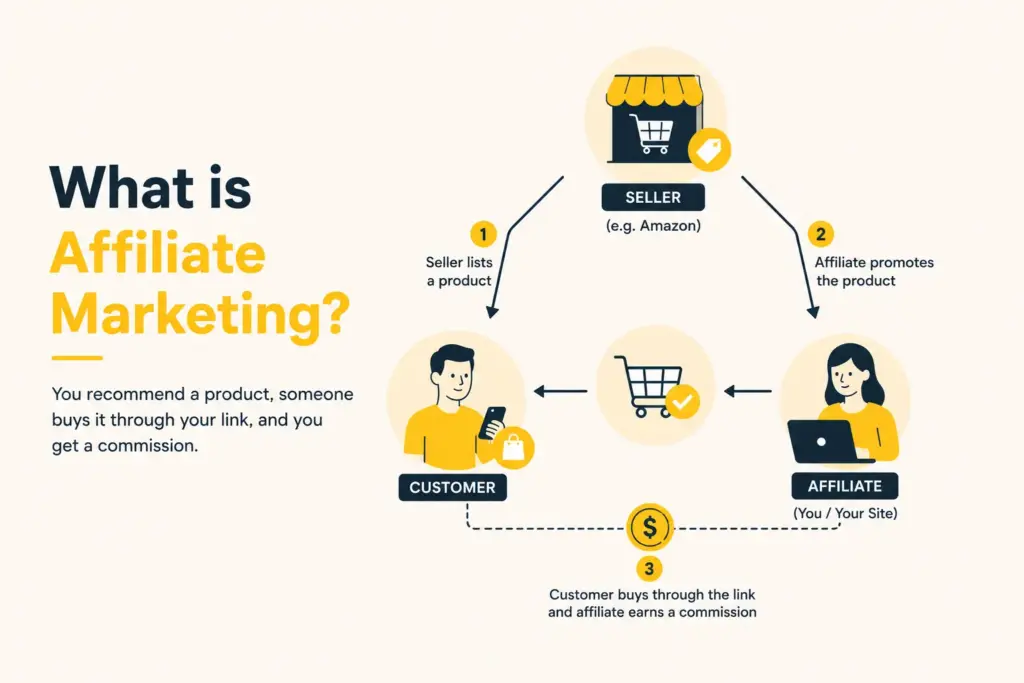
Affiliate marketing is a performance-based arrangement between three parties: a seller (say, Amazon), an affiliate (you), and the customer. You recommend a product, someone buys it through your link, and you get a commission.
That’s it.
The return is what makes it attractive to businesses: affiliate marketing delivers an average of $12-15 in revenue for every $1 spent a 1,200-1,500% return. No upfront ad spend, no wasted budget on impressions that don’t convert. That’s why Amazon, Shopify, and thousands of smaller brands lean on it instead of, or alongside, paid ads.
It’s grown into a real industry, is estimated at around $17 billion currently, on track to reach $27.78 billion by 2027, and it already drives 16% of all online orders in the US. Adoption is high too: 81% of advertisers and 84% of publishers now run or participate in affiliate programs.
For most Amazon affiliate sites, content affiliate marketing is the model that matters; everything else on this list is either a different platform’s structure or a secondary channel worth knowing about rather than building around.
Core models of affiliate marketing:
- Pay-per-sale (PPS): Commission when your link leads to an actual purchase
- Pay-per-lead (PPL): Paid when someone signs up, not necessarily buys
- Pay-per-click (PPC): Paid per click, regardless of what happens after
- Content affiliate marketing: Reviews and comparisons with links built in
- Influencer affiliate marketing: Trackable links shared through an existing audience
- Email affiliate marketing: Recommendations sent straight to a trusting inbox
- Coupon & deal sites: Commission earned whenever a discount code gets used
- Two-tier affiliate marketing: Earning from your sales and the affiliates you bring in.
What is digital marketing?
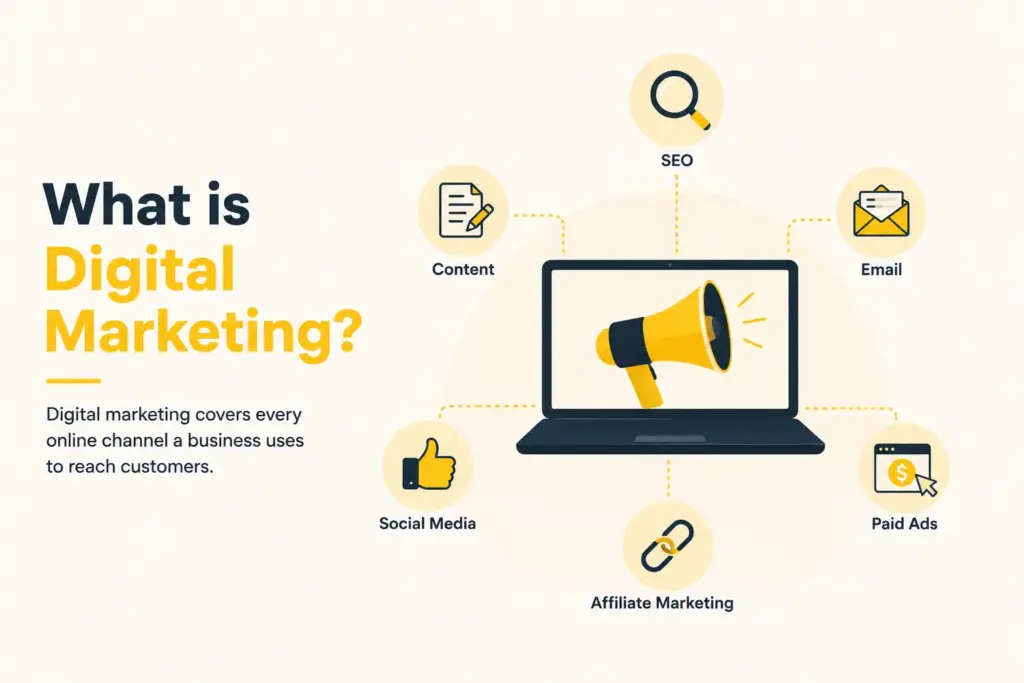
Digital marketing covers every online channel a business uses to reach customers: SEO, content, email, social, paid ads, and affiliate marketing all fall under this umbrella.
The global digital ad market is on track to hit $786.2 billion in 2026, heading toward $1.16 trillion by 2030, and that scale is why most businesses now treat digital as the default rather than a supplement to traditional marketing.
The channel mix matters more than the total spend, though. 49% of marketing professionals say organic search delivers the best ROI of any channel, and content marketing generates three times more leads than outbound marketing while costing 62% less.
Email is the standout, though it returns $36 for every $1 invested, the highest ROI of any digital channel, roughly four times what a well-run Google Ads campaign typically delivers.
For an affiliate site specifically, this plays out as a fairly small, practical toolkit: SEO is the primary traffic engine, content is the format your affiliate links actually live inside, email brings visitors back without relying on search traffic every time, social extends reach for visual niches, and paid ads are optional useful for faster traffic, but they eat into affiliate margins if you’re not careful about the math.
Core components of digital marketing:
- SEO: Ranking in search results without paying for the spot
- Content marketing: Blogs, videos, and guides that do the actual convincing
- Social media marketing: Building reach on Instagram, LinkedIn, and X
- Email marketing: Direct, automated campaigns to people who already opted in
- PPC: Paid visibility through Google Ads and Meta Ads
- Influencer marketing: Borrowing an audience’s trust through creator partnerships
- Marketing automation & AI: Personalizing campaigns at a scale no one could do by hand.
Is affiliate marketing the same as digital marketing?
Well, It’s not the same, but yes, it’s part of one another.
Digital marketing is the umbrella term for every online channel; SEO, email, social, paid ads, content, and affiliate marketing all fall under it.
Affiliate marketing is one specific channel inside that umbrella, and the only one that’s purely commission-based: you get paid only when your link produces a sale, not for traffic, impressions, or effort.
That distinction is what makes it a $17 billion industry on its own, separate from the broader $786 billion digital ad market it sits inside. A brand running digital marketing might spend on SEO, email, and ads all at once, absorbing the cost regardless of outcome.
A brand running an affiliate program pays nothing until an affiliate actually drives a sale, which is exactly why Amazon, Shopify, and thousands of smaller merchants treat affiliate as the low-risk layer of their broader digital marketing spend, not a replacement for it.
Affiliate marketing vs digital marketing: Here’s how they actually differ:
| Key factors | Digital marketing | Affiliate marketing |
| Scope | Broad: covers SEO, email, ads, social, content | Narrow: one performance-based channel |
| Payment model | Fixed cost, budget-based (ad spend, tools, salaries) | Commission-based, paid only on conversion |
| Who executes it | Brand itself, or an in-house/agency team | Third-party affiliates promoting someone else’s product |
| Risk | Upfront spend regardless of outcome | Low risk, you only pay for results |
| Control | Full control over messaging and channels | Less control; affiliates choose how they promote |
| Goal | Brand awareness, traffic, engagement, long-term growth | Direct sales or leads through a tracked link |
So no business actually picks one or the other. If you’re running an affiliate site, you are doing digital marketing; affiliate marketing is just the piece that pays the bills.
Where they overlap
SEO, content, and email aren’t split into separate toolboxes one for digital marketing, one for affiliate marketing. They’re the same tools, just doing double duty.
Take a blog post that ranks for “best budget headphones.” Writing and optimizing that post for search is digital marketing. The affiliate links inside it, earning commission on every sale, is affiliate marketing. Same post, same traffic, two outcomes at once.
That’s the overlap: content built for SEO becomes the vehicle for affiliate revenue. If you’re only focused on one side — ranking without monetizing, or monetizing without ranking you’re leaving half the value on the table.
Get access to our exclusive offers and pro tips!
How to use affiliate marketing & digital marketing together
I already mentioned that it’s part of one another. Here’s the actual sequence, with the specifics that make it work.
1. Start with content, not links: Every affiliate promotion needs a home. Before you place a single affiliate link, build the content asset first a product roundup, a comparison post, a how-to guide. This is where digital marketing and affiliate marketing actually meet: SEO decides what gets found, and affiliate links decide what gets monetized once someone arrives.
If you’re promoting Amazon products, for example, a “best budget laptops under $500” post ranks on its own SEO merit. The affiliate links are just what pays the bills once the traffic shows up.
2. Use SEO to pick what to promote: Most affiliate marketers reverse this. They pick a product first, then try to force content around it. Flip it: run keyword research first, find topics with commercial intent (buying guides, “best of” lists, comparisons, “vs” posts), and then choose which products fit naturally into that search demand.
This is the digital marketing layer doing the heavy lifting, you’re not guessing what to promote, you’re following actual search behavior.
3. Layer email marketing on top of your content: A blog post gets one visit. An email list gets repeat visits. Once someone lands on your affiliate content, capture them with a lead magnet relevant to that content — a buying checklist, a comparison chart, a discount alert. Then nurture them with a sequence that includes more affiliate recommendations over time.
This turns a one-time affiliate click into a recurring revenue channel instead of a single transaction.
4. Promote content on social: Sharing a bare affiliate link on social media rarely converts. Sharing the content that contains the link performs better, because it gives context before the ask. Post the comparison, the review, the “why I switched to X” story and let the content do the persuading before the link does the converting.
5. Retarget people who clicked but didn’t buy: This is where paid digital marketing comes in. Set up a retargeting pixel on your affiliate content pages. Someone who read your comparison post but didn’t click through to Amazon is a warm lead a retargeting ad reminding them of the product (or a related one) recovers sales you’d otherwise lose.
6. Track performance like a marketer, not just an affiliate: Don’t just watch commission totals. Track which content pieces drive clicks, which keywords bring qualified traffic, and which email sequences convert best. This is standard digital marketing measurement applied to affiliate revenue instead of ad spend.
Over time, this tells you where to double down: which content format works, which products convert, and which channel (SEO, email, or social) actually drives revenue rather than just traffic.
How both work together: In procedure
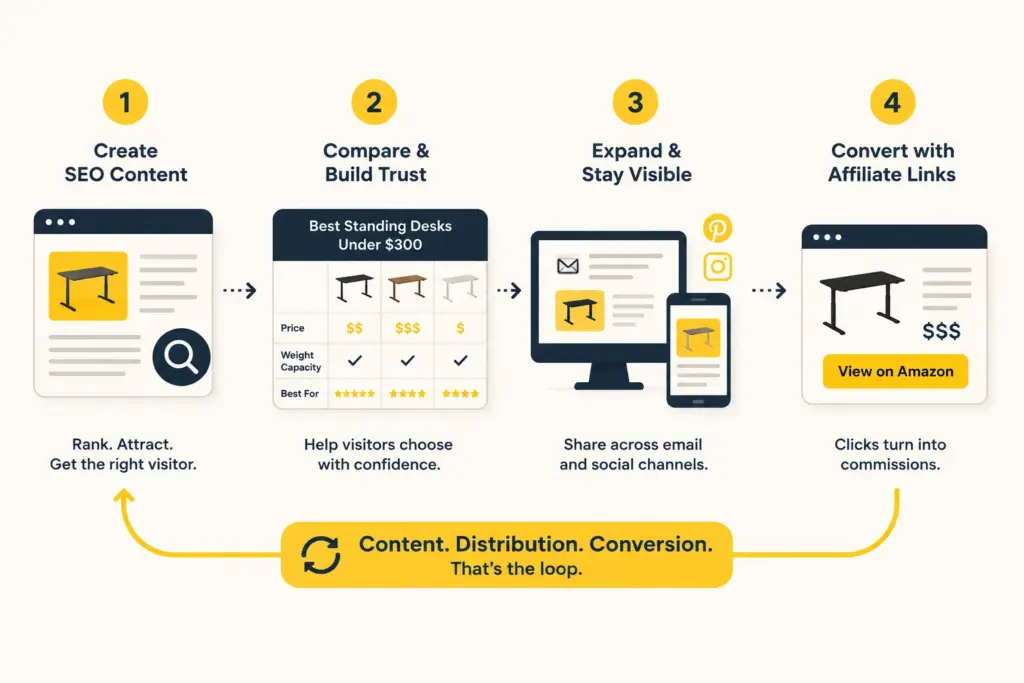
Say you’re running a home office gear review site. Here’s what “using both” actually looks like in practice, not in theory:
Step 1: Write content around a real keyword
You publish a genuinely useful comparison post “Best Standing Desks Under $300” targeting a keyword with real search volume. That’s digital marketing doing its job: SEO-driven content strategy bringing the right visitor in.
Step 2: Structure the page to convert
Instead of a wall of plain-text Amazon links, you build a comparison table showing each desk’s price, weight capacity, and standout feature side by side.
I use AzonPress for this on our own affiliate content; it pulls in product details and lets you build a clean comparison table without hand-coding one for every post, which matters when you’re maintaining dozens of these pages, and prices keep changing.
Step 3: Extend the post beyond the day it’s published
You add the post to your email newsletter’s next send and post the “top pick” to Pinterest or Instagram, where product roundups tend to get saved and shared long after the publish date.
Step 4: Let the affiliate layer do the one job it’s meant to do
The affiliate links inside that table are what actually get clicked and convert because the content, the traffic, and the reach were already in place before the link mattered at all.
That’s the whole loop. Content brings the visitor, distribution brings them back, and the affiliate layer converts the ones already reading in good faith. Skip any one of those four steps and the other three don’t matter much.
Affiliate marketing vs digital marketing: Where to start
You’re already doing both the moment you publish a review post with a link in it. The real question is where to start, and the answer is always digital marketing first: one buyer-intent comparison post, built around a real keyword, before a single affiliate link.
Content brings people in, distribution brings them back, and affiliate links convert the ones already reading in good faith. Skip the first two, and no amount of link placement saves the third.
If you’re starting from scratch: open a new tab to write your first comparison post, not to sign up for an affiliate program. The links can wait a week. The content can’t.
Frequently asked questions
Here are some frequently asked questions regarding “affiliate marketing vs digital marketing”.
1. Which strategy is more cost-effective for small businesses?
Affiliate marketing is usually cheaper to start, no ad spend or inventory, you pay commission only after a sale. Digital marketing overall can get costly, especially with paid ads, but builds assets you fully own.
2. Is affiliate marketing part of digital marketing?
Yes. Affiliate marketing is a performance-based channel that operates within the broader field of digital marketing, alongside SEO, email, and social.
3. Is digital marketing better for building a brand than affiliate marketing?
Generally, yes. Digital marketing builds assets you own your site, list, audience. Affiliate marketing builds trust in your recommendations, but brand equity mostly sits with the products you promote, not you.
4. What’s the difference between digital marketing and affiliate marketing?
Digital marketing is broad and includes multiple channels and payment models. Affiliate marketing is narrower, performance-based, and paid only when a sale or lead happens through a specific link.
5. Is digital marketing better for building a brand than affiliate marketing?
Generally, yes. Digital marketing builds assets you own: your site, list, audience. Affiliate marketing builds trust in your recommendations, but brand equity mostly sits with the products you promote, not you.





Read Similar Blogs
We build lasting partnerships to boost and manage revenue growth



Leave a Reply