


Affiliate Marketing vs Referral Marketing: The Key Differences


Imagine two people helping you sell your product.
One is a stranger on the internet who found your affiliate program, wrote a detailed review, and sent you 500 clicks monthly. The other is your happiest customer who texted their best friend and said, “You need to try this.”
Both bring you sales. But everything else about them, how they work, why they do it, and what makes them tick, is completely different.
That’s the heart of the affiliate marketing vs referral marketing debate. And if you’re running a business, a blog, or an e-commerce store, knowing the difference is essential. It could change how you grow.
Let’s break it all down and clearly see the difference between referral and affiliate.
Key takeaways of Affiliate Marketing vs Referral Marketing:
- Affiliate marketing and referral marketing are not the same thing. Affiliates are third-party promoters (bloggers, creators, marketers) who earn commissions, while referrers are your actual customers sharing their experience with people they know and get rewards.
- Trust is the biggest differentiator. Affiliate marketing builds audience trust through content, but referral marketing carries personal trust, which consistently drives higher-quality leads and better conversion rates.
- Scale vs. Quality is the core tradeoff. Affiliate marketing gives you reach and volume. Referral marketing gives you warmth, loyalty, and lower customer acquisition costs.
- Choose according to your business condition. Need rapid growth? Go affiliate. Want trust-based conversions and stronger retention? Build a referral program.
- Different cost structures in each model. Affiliates get paid per sale or lead. Referral rewards (discounts, credits) tend to cost less and often bring in customers with higher lifetime value.
- The smartest move is using both together. Let affiliates drive traffic and discovery at the top of the funnel, then let your referral program convert happy customers into advocates.
What is affiliate marketing?
Affiliate marketing is a performance-based strategy where businesses partner with third-party promoters (called affiliates) to market their products or services. In return, affiliates earn a commission for every sale, lead, or action they drive.
The core mechanism is straightforward: a business gives an affiliate a unique tracking link, the affiliate promotes it to their audience, and when someone clicks and converts, the affiliate gets paid.
Here’s what makes affiliate marketing stand out:
Performance-based payouts: You only pay when results happen. No sale, no commission. This makes it a low-risk option for businesses.
Scalable reach: One affiliate might have an audience of 10,000. Another might have 2 million YouTube subscribers. The reach potential is massive.
Content-driven by nature: Most affiliates promote through blogs, YouTube videos, SEO articles, social media content, or paid ads. Think of Amazon affiliate marketers writing “best product” roundups. That’s affiliate marketing in action.
It’s a world built on traffic, content, and conversions at scale.
What is referral marketing?
Referral marketing is a strategy where existing customers refer new customers to your business, usually in exchange for a reward, discount, or simply out of genuine love for your product.
The core mechanism here is different: a happy customer shares your product with someone they already know and trust. That person signs up, or buys, and often both sides get rewarded.
What makes referral marketing unique:
Trust-based promotion: The person doing the promoting isn’t a marketer. They’re a real customer with real experience. That authenticity is powerful.
Incentivized or organic: Some referral marketing programs offer rewards like discounts, store credits, or free months. Others happen purely organically when customers love a product enough to talk about it.
Relationship-driven: Referrals travel through personal networks, friends, family, and colleagues. The connection between the referrer and the new customer already exists, which changes everything about how the message lands.
Affiliate marketing vs referral marketing: key differences
Affiliate marketing is a form of marketing where third-party promoters (bloggers, publishers, creators, YouTubers) drive sales to your business in exchange for a commission.
On the other hand, referral marketing is a growth model where your existing customers, users, or members recommend your product to people they know and earn an incentive, such as a discount, credit, or reward, etc.
At first glance, both strategies seem similar. Someone promotes your product, someone else buys it. But dig a little deeper, and you’ll find they work very differently, attract different types of people, and produce different kinds of results.
Here’s a clear, side-by-side look at the key differences between affiliate marketing vs referral marketing.
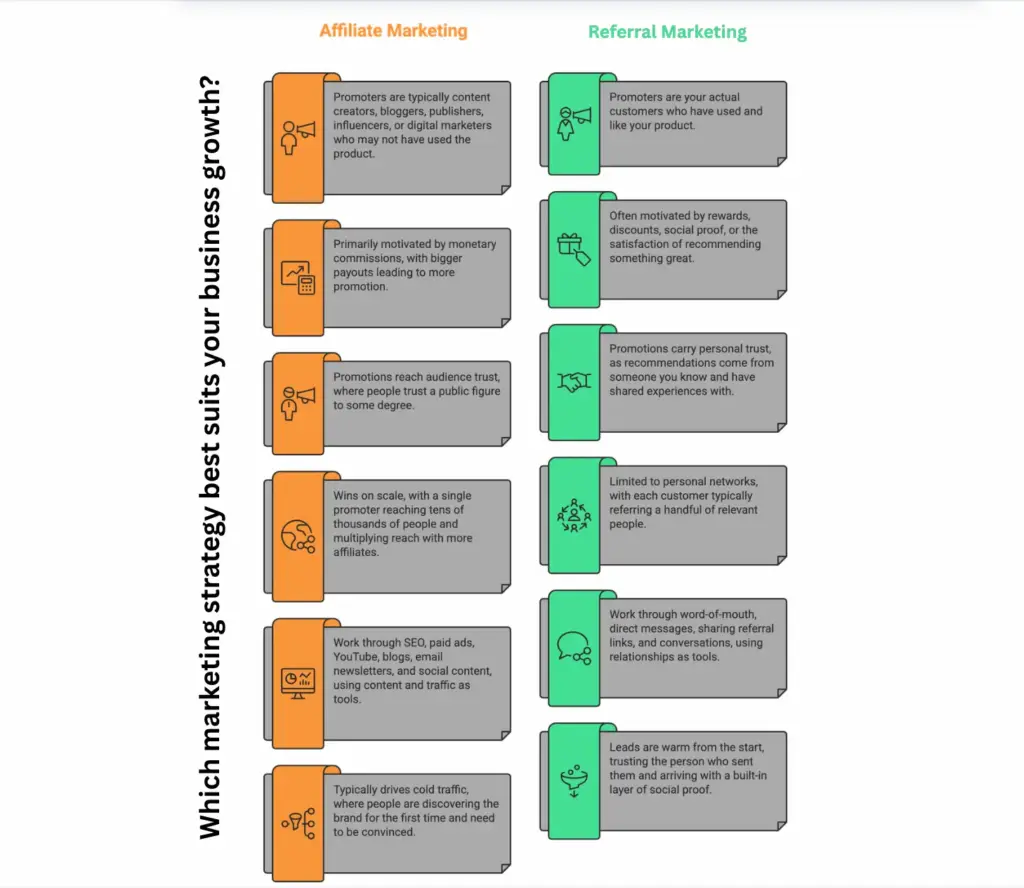
1. Who is promoting
In affiliate marketing, the promoters are typically content creators, bloggers, publishers, influencers, or digital marketers. They may have never used your product. Their job is to reach an audience and drive traffic.
Many Amazon affiliate marketers, for example, write product reviews purely to earn commissions, and there’s nothing wrong with that. It’s a legitimate business model.
In referral marketing, the promoters are your actual customers. They’ve used your product, they like it, and they’re telling people they know. There’s no media kit, no content strategy. Just a genuine recommendation.
2. Motivation & incentives
Affiliates are motivated primarily by monetary commissions. The bigger the payout, the harder they’ll promote. This is why affiliate vs referral marketing differ so much in energy. One is driven by business goals, the other by personal experience.
Referrers, on the other hand, are often motivated by rewards, discounts, or social proof. The satisfaction of recommending something great. Even when there’s no reward, people refer because they genuinely want to help someone they care about.
3. Trust & credibility
This is where referral marketing really shines.
Affiliate promotions reach audience trust. Someone follows a blogger or YouTuber and trusts their recommendations to some degree. But it’s still a public figure promoting to a crowd.
Referral promotions carry personal trust. Your friend tells you about something. You know this person. You’ve shared meals with them. That level of trust is almost impossible to replicate through paid content. It’s one of the biggest benefits of referral marketing.
4. Reach & scalability
Affiliate marketing wins on scale. A single affiliate with a high-traffic blog or large YouTube channel can introduce your brand to tens of thousands of people overnight. Add 100 affiliates to your program, and that reach multiplies fast.
Referral marketing is limited to personal networks. Each customer typically knows a handful of relevant people to refer. It’s slower and more contained, but what it lacks in reach, it makes up for in quality.
5. Marketing channels
Affiliates work through SEO, paid ads, YouTube, blogs, email newsletters, and social content. They’re digital marketers at heart. Their tools are content and traffic.
Referrers work through word-of-mouth, direct messages, sharing referral links, and conversations. Their tools are relationships. A referral marketing strategy doesn’t need a content calendar. It needs happy customers.
6. Conversion behavior
Affiliate marketing typically drives cold traffic. People who are discovering your brand for the first time through a piece of content. They need to be convinced. They’ll compare, research, and sometimes bounce.
Referral leads are warm from the start. They already trust the person who sent them. They’re arriving with a built-in layer of social proof
Referral marketing examples consistently show higher conversion rates than most paid acquisition channels, and that’s not a coincidence.
7. Cost structure
One of the main differences between affiliate marketing vs referral marketing is their cost structure.
With affiliate marketing, you’re typically paying per sale or per lead. It scales with performance, which is great, but commission rates can add up quickly as volume grows.
With referral marketing, you’re paying in rewards: discounts, gift cards, credits. These costs are often lower than traditional customer acquisition costs (CAC), especially when you consider the quality and lifetime value of referred customers.
When to use affiliate marketing
Affiliate marketing makes sense when you’re focused on growth and reach.
It’s the right move when you want to:
- Scale fast: You need a large volume of new customers quickly and have the margins to support commissions.
- Reach new audiences: Affiliates already have audiences you don’t have access to.
- Drive content-led acquisition: Your product is well-suited to review articles, tutorials, or comparison content.
- Grow an eCommerce store or SaaS product: Both categories thrive with the right affiliate program vs referral program setup.
If you’re an Amazon seller, a software company, or a blogger-turned-product-creator, an affiliate program is probably already on your radar. And for good reason.
When to use referral marketing
Referral marketing makes sense when you’re focused on quality and loyalty.
It’s the right move when you want:
- Higher trust conversions: You want leads who arrive already warm and ready to buy.
- Customer-driven growth: You’d rather grow through your best customers than through paid promoters.
- Strong retention loops: Referred customers tend to stay longer, spend more, and refer others themselves.
If you’re a small business owner, a subscription-based service, or anyone where customer relationships matter, referral marketing consistently points in the same direction.
Lean into your existing customers. They’re your most underused growth engine.
Get access to our exclusive offers and pro tips!
Affiliate program vs referral program: which is better?
So, if you’re thinking about referral program vs affiliate program, which one is better, the honest answer would be, it depends on what you’re trying to achieve.
Neither is universally better. They’re built for different goals.
| Factors | Affiliate Program | Referral Program |
|---|---|---|
| Primary goal | Growth & traffic | Trust & loyalty |
| Best for | Scale | Retention |
| Cost model | Commission-based | Reward-based |
| Promoters type | Bloggers, influencers, or marketers | Existing happy customer |
| Cost for Business | Higher (commission payouts) | Lower (small discounts/rewards) |
| Lead quality | Variable | Consistently high |
| Tracking system | affiliate tracking links or cookies, | Referral links or codes |
If you’re in a high-growth phase and need volume, an affiliate marketing vs referral marketing comparison leans toward affiliate.
If you’re past the early growth stage and want to deepen customer loyalty and reduce CAC, referral wins.
However, most successful businesses eventually need both.
Can you use the affiliate program and referral program together?
Absolutely, and the smartest brands do.
Here’s how they work together beautifully:
Affiliates bring the traffic. They create content, rank on Google, run ads, and introduce your brand to new audiences at scale. They’re your top-of-funnel engine.
Referrals convert through trust. Once someone becomes a customer, your referral marketing program kicks in and turns them into an advocate.
They bring in people who already trust them, leads that convert faster and stay longer.
The strategy insight is simple: use affiliates to grow your customer base, then use referrals to activate it.
One fuels discovery. The other fuels loyalty. Together, they create a growth loop that’s hard to beat.
Wrapping up
So, affiliate marketing vs referral marketing: what’s the verdict?
They’re not rivals. They’re teammates with different strengths.
Affiliate marketing gives you scale, reach, and content-driven growth. Referral marketing gives you trust, loyalty, and high-quality leads. The difference between referral and affiliate isn’t about which is better. It’s about which one fits where you are right now.
Use affiliate marketing to expand your audience and referral marketing to deepen trust. That combination is hard to beat.





Read Similar Blogs
We build lasting partnerships to boost and manage revenue growth


Leave a Reply