

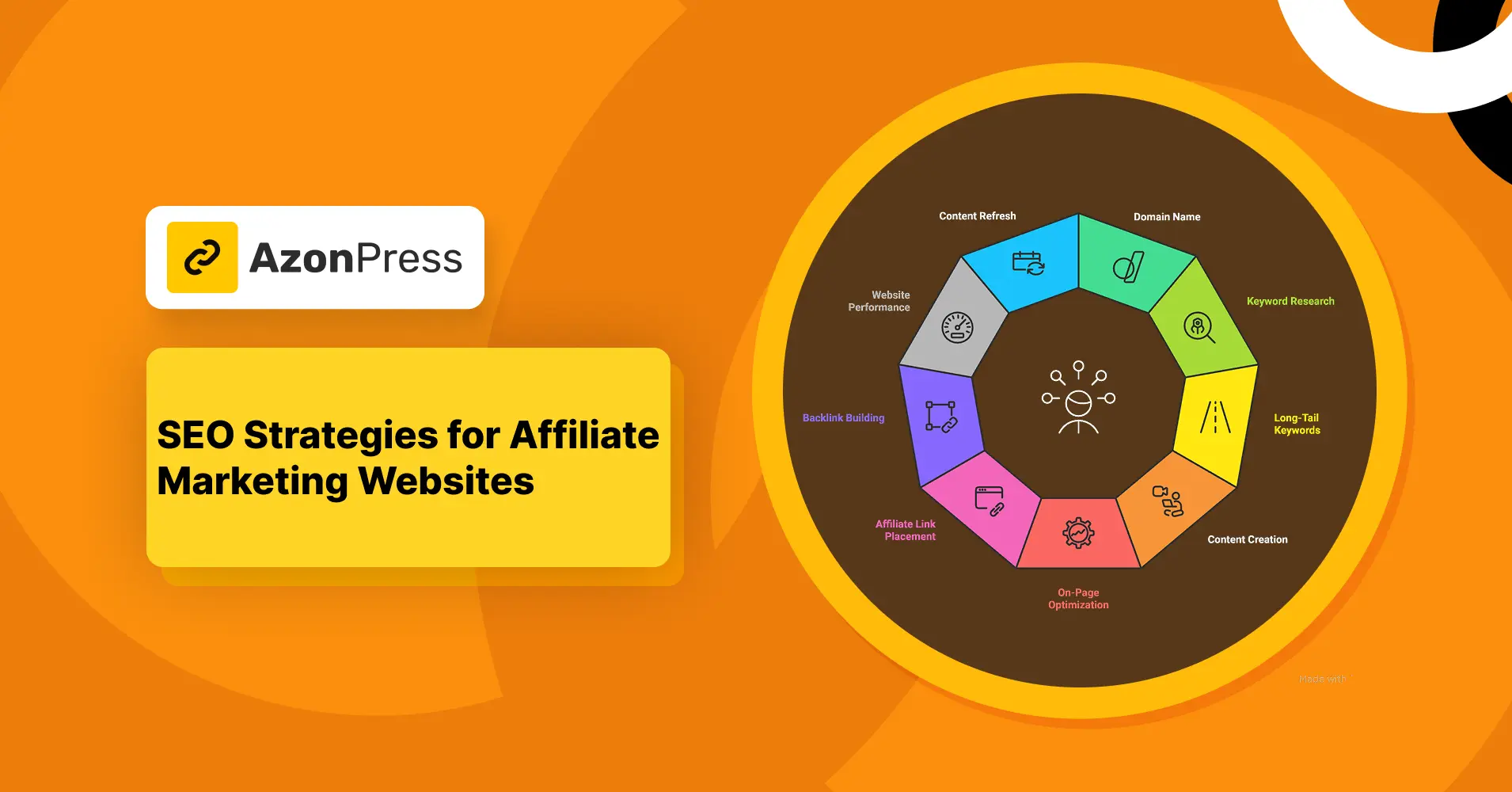
Effective SEO Strategies For Affiliate Marketing Websites


If you want to earn commission through promoting and selling others’ products, you’ll need to have an affiliate website. But a website won’t work if there is no steady flow of traffic.
This traffic represents your potential customers, and they can come from various sources such as email, paid ads, and direct referrals.
Beyond these sources, your organic traffic decides the future. And this traffic comes from doing proper SEO for affiliate marketing.
Only SEO can enhance your website’s visibility and credibility on search engines, which drives traffic and leads to increased conversion.
So, in this article, I’ll share some effective SEO strategies for affiliate marketing websites that helped me boost my ROI by 32%.
What is SEO for affiliates?
When I first started with affiliate marketing, I thought SEO was just about stuffing keywords everywhere. But it’s not. It’s a complete process where you optimize your affiliate website properly so it ranks higher against search results in the SERP (search engine results page).
SEO for affiliate marketing is basically getting your website to show up when people search for stuff on Google. It’s that simple.
Like, when someone searches “best budget laptops for students” or “honest review of XYZ product,” you want your site to pop up on that first page or even in the top 3 results.
To do so, you have to compete with Amazon and review sites with huge traffic and massive ad budgets. That’s exactly why your SEO approach needs to be smart and appropriate.
Why SEO matters for affiliate marketers?
You can throw money at social media or Google Ads. Spending $500 makes you $1500 in return. That’s awesome! But the next month, spending the same amount barely gives you $100 sells.
That’s the truth of paid advertising. It’s not sustainable and can drain your budget fast. One month you’re profitable, the next month ad costs spike, and suddenly you’re in the red.
It’s not fun, I’ve been there.
On the other hand, organic traffic through SEO is different. Once your affiliate website ranks well, without any constant investment, you can generate organic traffic.
I’ve got articles I wrote a year ago that still bring me 200-500 visitors monthly. I’m not paying a cent for that traffic. It just… shows up. Every. Single. Day.
Yes, it takes time upfront, but the long-term payoff is worth it.
These are the people who are actively looking for specific information or solutions.
When someone found your coffee maker review because they Googled “coffee maker that doesn’t taste like plastic.” THAT’S the person who’s gonna buy through your affiliate link.
This intent-driven traffic converts much better than random social media visitors or cold traffic from ads.
Plus, ranking high on Google builds trust. People naturally assume that top-ranking websites are more credible and authoritative. This trust translates directly into higher click-through rates on your affiliate links and better conversion rates.
For Amazon Associates and other affiliate programs, SEO isn’t optional anymore. It’s the foundation that determines whether your affiliate business thrives or struggles to make a few dollars a month.
My Amazon Associates earnings from organic traffic convert at like 8-12%, while my paid traffic was lucky to hit 3%. You can do the math; it’s not even close.
What SEO strategies are effective for affiliate marketing websites?
So, here comes the real question: “What SEO strategies are effective for affiliate marketing websites?”
When you search for effective SEO strategies for affiliate marketing websites or the best affiliate marketing strategies for beginners on Google, the top results you get have done a great job in their SEO.
However, most ideas or suggestions you find are generic and haven’t been practically tested
Let me share the actual strategies I use on my affiliate website. Not the stuff I read in some $200 course, but things I’ve tested, messed up, fixed, and finally got right.
Choose a good, niche-relevant domain name
One of the first SEO tips for affiliate marketing is choosing a good, niche-relevant domain name.
Your domain name is going to stick with you, so don’t rush this decision as I did with my first site (let’s not talk about that disaster).
Pick something that tells people what you’re about without boxing yourself into a tiny corner.
Don’t name your website “BestKitchenBlenders2023.com“. Every year, that domain looks more outdated. Your domain needs to make sense in at least five to ten years, not just today.
Instead, “KitchenGearLab” gives you more flexibility. Under this domain, you can review and promote blenders, food processors, or whatever else fits your niche without rebranding every time you expand.
Keep it simple enough that someone could remember it after hearing it once. Don’t use hyphens and a number in the domain name.
If you have to spell it out letter by letter every time you tell someone, that’s a red flag.
And yeah, having a keyword in there can help a tiny bit, but don’t stress about it too much. Google cares way more about your actual content than whether your domain is an exact match.
Choosing a proper domain name is one of the great affiliate marketing strategies for beginners.
Visit Hostinger or Namecheap to find a suitable domain name and verify its availability.

Perform proper affiliate keyword research
This is where I see beginners mess up constantly. They either go after “best laptops” (impossible to rank for) or “best gaming laptops for left-handed graphic designers born on Tuesdays” (zero search volume).
You need to find that sweet spot. Not too competitive, not too dead.
Put yourself in your reader’s shoes. What would you actually search on Google if you were looking for a product? Not what sounds good for SEO, but what a real human would search.
I spend probably 4-5 hours per article just doing keyword research. I know that sounds crazy. But finding the right keyword is the difference between getting 10 visitors a month and 1,000.
For Amazon Affiliates specifically, focus on buyer keywords. Things like “review,” “vs,” “worth it,” or “best” usually mean someone’s close to pulling out their wallet. That’s your target audience.
I’d rather rank #1 for a keyword with 500 searches than rank #47 for a keyword with 50,000 searches. The first one makes me money. The second one doesn’t even get seen.
Get access to our exclusive offers and pro tips!
Focus on long-tail keywords
If you ask me, “What SEO strategies are important for affiliate marketing websites?” I’ll say pick up the right keyword first.
Any affiliates who want to learn SEO for affiliate marketing, first they should learn how to pick the right keyword. Especially long-tail keywords.
Honestly, it’ll definitely make a significant impact.
It’s considered one of the most important affiliate marketing strategies for beginners. It’s your secret weapon.
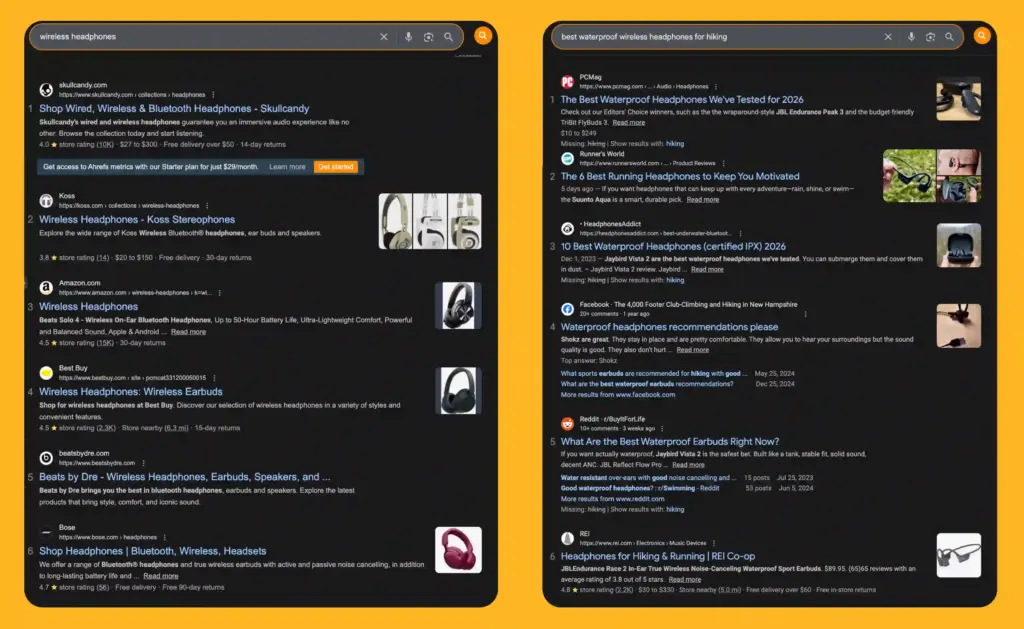
When you target broad terms such as “wireless headphones,” it’s got you nowhere. Plus too much competition. It’ll be a never-won game.
But, if you go with a longer, more specific keyword like “best waterproof wireless headphones for hiking”, it might have a lower search volume, but the attracted visitors are highly targeted. They know exactly what they’re looking for. So, the conversion rate will be higher.
Additionally, the competition for long-tail keywords is usually much lower, which means you can rank more easily and faster.
Here’s my strategy: choose your niche, find one main keyword, and then create 10-15 related long-tail keyword variations around it. This will create a web of content that catches people at different stages of their search journey.
Create high-quality, value-driven content
Content is still king in SEO and affiliate marketing. But not just any content, your content needs to actually help people make better decisions.
I’ve seen too many affiliate sites that use short copied product descriptions from Amazon that make no sense with an affiliate link slapped on. That doesn’t work anymore, and it shouldn’t.
Don’t just write “This product is amazing! Five stars! Click my link! People are smart; they’ll instantly catch those 200 words of fluff.
Instead, write a comprehensive guides that answer every question someone might have before they buy. If you’re reviewing a product, first buy it and test it for at least a week or two.
If you want to improve your SEO strategies for an affiliate marketing website, write value-driven content.
It should be better than the other top 10 results for your target keyword. Ask yourself: how can I create something more helpful, more thorough, or more engaging?
Include original images (not those generic Amazon photos everyone uses), comparison charts, pros and cons, video content, and personal insights.
Explain what it is good for? What’s it NOT good for? Who should buy it? Who should look at something else instead?
These elements make your content stand out and give readers reasons to trust your recommendations.
On-page optimization & metadata optimization
Let’s talk about some technical stuff now. It’s the side of your content creation and one of the most effective SEO strategies for affiliate marketing websites.
For greater visibility and click-through, you must optimize the on-page content. The question is, how do you optimize them?
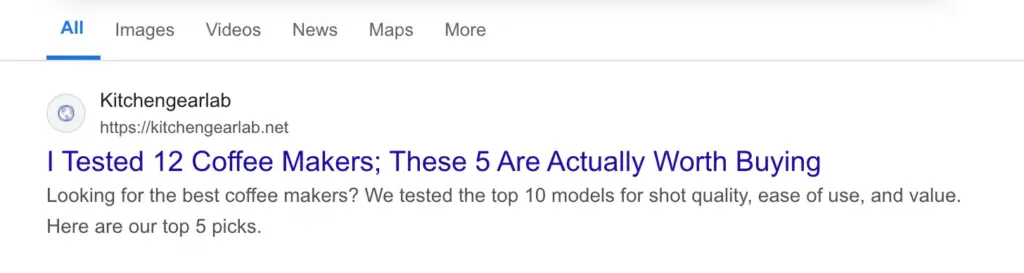
Write your meta title under 50 to 60 characters, simply have the focus keyword in the title, and make it clickable. Because your title tag is that blue link people see on Google.
- Bad title: “Best Coffee Makers – Coffee Maker Reviews – Top Coffee Makers 2026.”
- Good title: “I Tested 12 Coffee Makers; These 5 Are Actually Worth Buying.”
See how the second one makes you curious? That’s what gets clicks.
And the meta description? It’s your first pitch. It’s the snippets of your content that will show up on search engines. These are super important for both organic traffic and PPC.
You’ve got about 160 characters to make someone click your result instead of the other ten. I usually tease the best info from my article. “Looking for the best coffee makers? We tested the top 10 models for shot quality, ease of use, and value. See our top 5 picks.”
Install and activate a WordPress SEO plugin and input your metadata directly from the WordPress post editor.
For images, just rename them to something that makes sense instead of “IMG_8473.jpg”. Also, don’t forget to add alt text describing the image.
Honestly, that’s it for on-page SEO for affiliate marketing. Don’t overthink it.
Use contextual affiliate links strategically
Let me give you a great SEO tip for affiliate marketing: use contextual links.
Placement of your affiliate links can literally double your earnings. Don’t just dump all your links at the top of your article. People need to trust you first.
I usually put my first link after I’ve explained what makes the product good, once I’ve earned the reader’s interest.
Throughout a longer article, I’ll have 4-6 affiliate links placed wherever they naturally fit. If I’m talking about battery life and mention checking the current price, that’s a perfect spot for a link. It flows with the conversation.
Comparison tables are absolute money-makers for affiliate marketing. People love being able to quickly scan options and see which one fits their needs. Plus, you can naturally include affiliate links for each product.
And always disclose your affiliate relationship. The question is where? The best place to put a clear disclosure is at the top of every review.
Like this, “This article contains affiliate links. If you buy through these links, I may earn a commission at no extra cost to you.” Being upfront actually builds trust. People appreciate honesty.
Build backlinks through outreach & guest posting
Getting other sites to link to you matters a lot, even though everyone wishes it didn’t.
The more backlinks you get, especially from reputable websites, the more you build your authority as an affiliate website on Google. This, in turn, increases your chances of ranking higher in search results.
Backlinks are always considered one of the most effective SEO strategies for affiliate marketing websites.
The best backlinks just happen naturally when you create something people want to reference. If your content provides real value, more likely that other sites link to you automatically.
Guest posting also works for SEO and affiliate marketing. But you shouldn’t spam about it. Only pitch guest posts when you genuinely have something valuable to share with that site’s audience. That approach actually gets accepted way more often.
Sometimes I reach out to people who are linked to similar content. Not like “hey link to me bro” but more “Hey, noticed you linked to [article] in your post about [topic]. I created something similar, but with updated 2025 data and a free downloadable guide. Thought you might find it useful for your readers.”
Maybe 1 in 10 responds. That’s fine. It’s a numbers game.
Don’t buy links from weird websites. Google will eventually catch you, and it’s not worth the risk. I know someone who bought a “premium link package” and got his whole site penalized. He lost 90% of his traffic overnight. Not worth it.
Here I’ve got a reference for you: Affiliate Link Building Strategies: That Actually Work
Optimize your website performance
A slow website is killing your commissions. I’m serious.
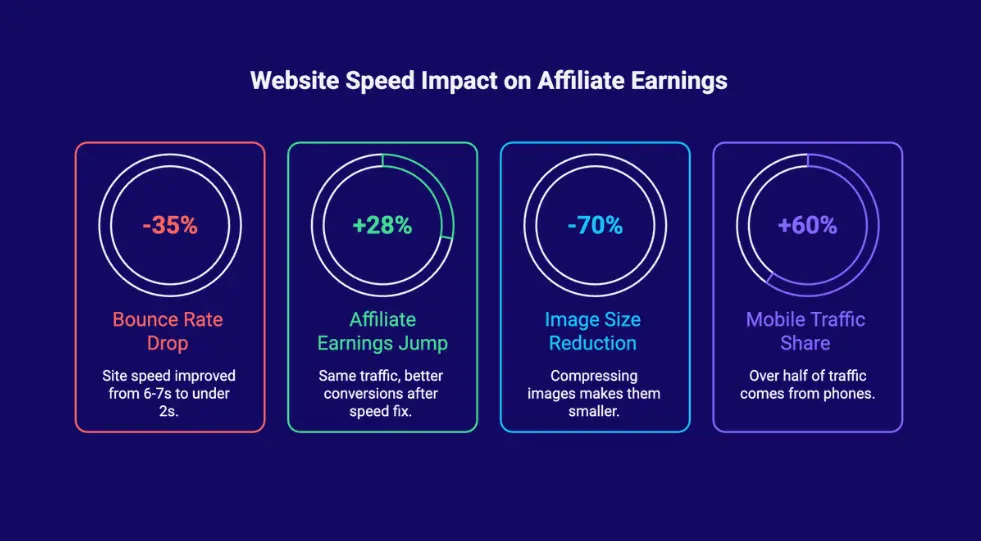
Last year, my affiliate site was taking 6-7 seconds to load. I kept wondering why my bounce rate was so high. I didn’t even think it mattered much. Then I finally fixed the speed issues, got it down to under 2 seconds, and my bounce rate just dropped by 35%
Also, my affiliate earnings jumped by 28% in a month. Same traffic, better conversions.
Hosting matters more than you think. I used to cheap out with $4/month hosting. My site crashed twice during high traffic days. Switched to better hosting for $25/month and haven’t had a problem since. That $21 difference pays for itself ten times over.
Images are the usual problem. I used to just upload photos straight from my phone, like 2-4 MB per image. Now I compress everything through TinyPNG or Squoosh first. Makes them 70% smaller with no difference you can see.
Mobile optimization isn’t optional anymore. Over 60% of my traffic comes from phones. If your site looks weird or loads slowly on mobile, you’re literally throwing away more than half your potential earnings.
I check my site speed at least once a month using Google PageSpeed Insights. It’s free and tells you exactly what’s slowing you down.
Monitor, update, and refresh content regularly
Publishing an article isn’t the end; it’s actually just the start.
Every Monday morning, I check Google Search Console. Which articles are showing up on Google but not getting clicks? Those need better titles. Which ones are stuck on page 2? Those probably just need a little push to hit page 1.
Every few months,s I go back through older posts and update them. New products come out. Prices change. Amazon updates its features. If someone lands on your 2022 review with outdated info, they’re leaving immediately.
I had an article about wireless earbuds stuck at position 14 for like eight months. Frustrating. Then I spent maybe an hour updating it with 2025 models, new photos, current prices, and boom, jumped to position 5 within two weeks. That moved it from 30 clicks monthly to 250.
Also, watch for articles that used to do great but dropped off. This happens to everyone. Usually, you can refresh this way more easily than writing new stuff, and the results are just as good.
Best SEO tools for affiliate marketing
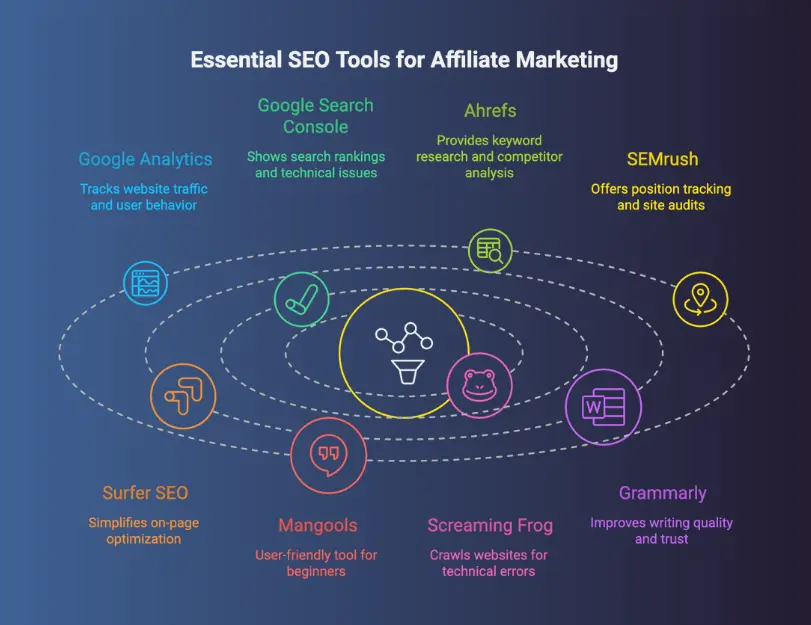
So, if you want to learn how to do SEO for affiliate marketing, you need some tools for this. I’ve burned money on way too many tools, testing what actually works. Here are some SEO tools for affiliate marketing I actually use:
Google Analytics – A free tool that tracks and analyzes website traffic, providing insights into user behavior, demographics, and how visitors interact with your site.
Google Search Console – GSC is free, and you NEED this. Not optional. Shows you what you’re actually ranking for (often stuff you didn’t even target), what technical problems are hurting you, and exactly how people find your site. Set this up before anything else.
Ahrefs – Ahrefs is a bit expensive, not gonna lie. $99/month for the cheapest plan. But if you’re making money with affiliate marketing, it pays for itself fast. I use it for finding keywords, stalking competitors (seeing exactly what they rank for), checking backlinks, and tracking my rankings.
The Site Explorer tool alone is worth it; I can see every keyword my competitors rank for and steal their best ideas.
SEMrush – SEMrush is similar price-wise but does some things better. I love their Position Tracking feature, which shows me exactly how my rankings move daily for specific keywords. Their Site Audit has saved me from several major screw-ups that would’ve tanked my traffic.
Surfer SEO – It made on-page optimization so much easier. You put in your keyword, and it basically tells you exactly what to do, how long the article should be, what related terms to include, how many headers, all that stuff.
Since I started using it, my new articles rank faster. It’s like having someone who knows SEO sitting next to you while you write.
Mangools – Mangools is way cheaper (starts at $29/month) and perfect for beginners. The keyword research tool is so simple compared to Ahrefs’ overwhelming interface. I recommend this to everyone just starting out because you don’t need all the advanced features yet.
Screaming Frog – This sounds scary, but it just crawls your website looking for problems. Broken links, missing descriptions, duplicate stuff, finds it all. The free version works for up to 500 pages,s which is plenty for most affiliate sites.
Grammarly – Grammarly seems random on an SEO tools list, but trust me on this. Bad writing kills trust instantly. Nobody’s buying through your affiliate link if your review is full of typos and weird sentences.
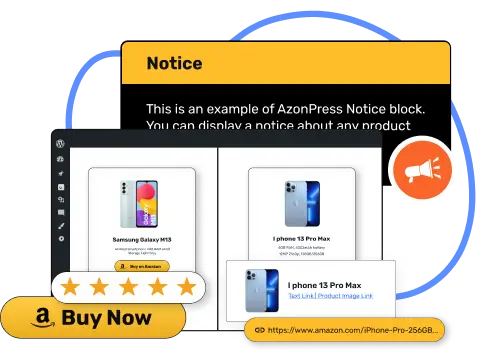
Manage links, create product tables, and comparison tables, and increase your affiliate revenue
Wrapping up
Look, I’m not going to tell you that SEO and affiliate marketing are easy or that you’ll be making $10,000 a month in 90 days. Anyone promising that is selling you something.
What I will tell you is this: these are SEO strategies for affiliate marketing websites.
They worked for me, they’ve worked for dozens of other affiliate marketers I know, and they’ll work for you if you actually implement them consistently.
The 32% ROI boost I mentioned at the start? That took me about seven months of steady work. Not overnight success, but sustainable growth that’s till going up.
The difference between affiliate marketers who make decent money and those who quit after three months usually comes down to patience and consistency. You can’t just write five articles, wait two weeks, then give up when you’re not rich yet.
Whether you’re doing Amazon Associates or promoting other stuff, this applies. The basics stay the same.
Start today with something small. Update one article. Research five new keywords. Fix your slowest-loading page. Something. Anything.





Read Similar Blogs
We build lasting partnerships to boost and manage revenue growth


Leave a Reply