

Competitor Analysis for Affiliate Marketing
Here’s something most affiliate marketers won’t admit: they’re losing rankings and commissions to competitors they’ve never properly studied.
Maybe you’ve looked at the top-ranking article for your target keyword, skimmed the structure, and roughly followed it. Or maybe you decided to just “write better content” and trust that Google would figure it out.
I’ve seen both approaches play out. Neither works consistently.
The affiliates who scale treat competitor analysis for affiliate marketing like a repeatable system, not a one-time curiosity. They run it before writing a single word. They run it quarterly to protect rankings they’ve already earned. And they pull actionable insights out of it every single time.
This guide will show you exactly how to do that.
By the end, you’ll know who your real competitors are (hint: it’s not Wirecutter), what to actually look for in their content and SEO, how to build a working research framework you can repeat, and how to find at least one gap you can act on this week.
Let’s get into it.
What is competitor analysis in affiliate marketing?
Competitor analysis for affiliate marketing is the systematic process of identifying other affiliates in your niche and studying what products they promote, how they rank, what content they produce, and how they convert their audience, so you can find the gaps and opportunities they’re leaving on the table.
That definition matters because it’s different from general market research. Market research tells you about the industry. Competitor analysis tells you about the specific people you’re fighting for the same Google rankings and the same readers’ trust.
And here’s the part people get wrong: this is not about copying.
If you copy a competitor’s structure, you’ll always be one step behind. They wrote first, they published first, and Google already knows who the original is. What you’re looking for is what they missed, what they got wrong, and where the audience they share with you is still underserved.
Direct vs. indirect competitors: What’s the difference?
Before you start researching, you need to know who you’re actually researching.
A direct competitor is an affiliate promoting the same product to the same audience. If you run a blog about budget travel gear and you’re both targeting “best travel backpacks under $100,” you’re direct competitors.
An indirect competitor is more nuanced. It could be someone targeting the same audience but promoting different products. Or someone promoting the same product to a completely different reader segment.
Both matter for your strategy, just in different ways. Direct competitors show you how to win on your current content. Indirect competitors show you adjacencies like products, keywords, and channels your direct competitors are ignoring.
Why competitor analysis is non-negotiable for affiliate marketers
Amazon Associates is the largest affiliate network globally, with hundreds of thousands of active affiliates. Many of them are promoting the exact same products as you.
Without a research process, you’re guessing at keywords, picking products based on commission rate alone, and writing content that 50 other sites have already published.
Here’s what systematic competitor analysis for affiliate marketing actually gives you:
- Differentiation. You find the angles, channels, and content formats your competitors haven’t touched. That’s where your growth comes from.
- A smarter content strategy. You stop writing into a void and start writing toward proven demand that competitors are imperfectly serving.
- Audience understanding. Your competitors’ top content tells you exactly what your shared audience cares about before you spend 10 hours writing something nobody asked for.
How to identify your affiliate competitors?
Most affiliates make the mistake of treating major authority sites as their competitors. They’re not. You can’t outrank Wirecutter on domain authority alone, and you shouldn’t try.
Your real competitors are the sites that rank in positions 1 through 20 for the keywords you’re actually targeting. Here’s how to find them.
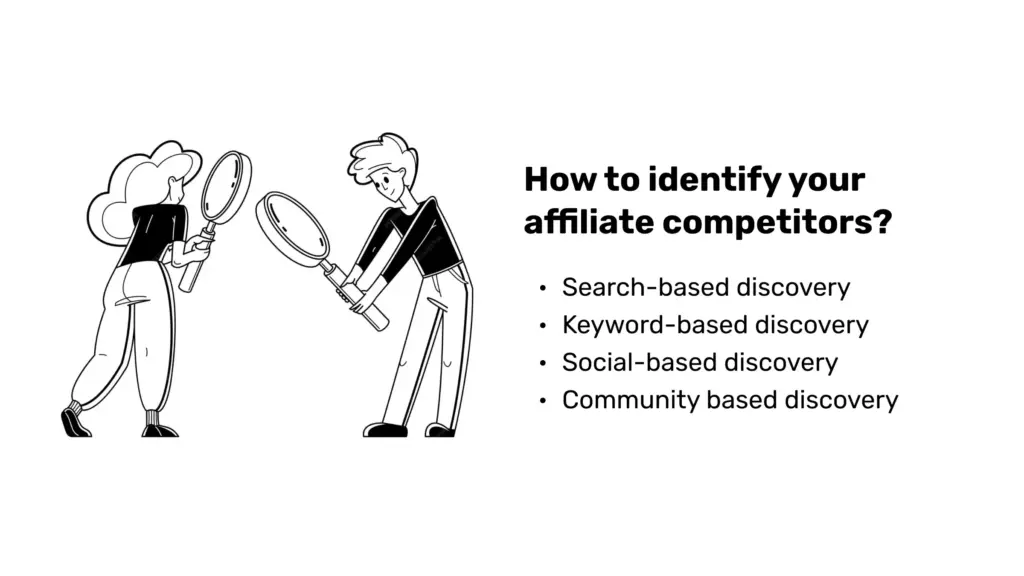
Search-based discovery
Start with Google. Search for the products you promote using review and comparison queries: “best [product category],” “[product name] review,” “[product A] vs [product B].”
Look at the results. Are any of them affiliate sites with clear review structures, comparison tables, and affiliate disclaimers in the footer? Those are your people.
You can also narrow it down with advanced search operators. Try intitle:”product name” intitle:review -site:amazon.com to filter out marketplace pages and surface affiliate content specifically.
Keyword-based discovery
Once you have a list of target keywords, plug them into Ahrefs or SEMrush and look at who’s ranking in the top 10. Check whether those pages are affiliate sites. Look for review structures, product comparison blocks, and outbound links with affiliate parameters.
You can also use Google Search Console if you already have traffic. Filter your top pages and check which queries you’re appearing for, then search those queries manually to see who’s outranking you.
Social and community discovery
Affiliate sites don’t always announce themselves on Google. Some of your toughest competition is built on YouTube, in Facebook groups, or through email lists you’ve never seen.
Search your niche topics on Reddit; especially r/juststart and niche-specific subreddits. Watch who’s being recommended and whose content keeps coming up. Check Facebook Ad Library for anyone running paid ads to affiliate content in your niche.
These are affiliates with real momentum. Pay attention.
Read: Where To Promote Affiliate Links For Free (24 Platforms)
Step-by-step competitor analysis framework for affiliates
Once you have a list of 3 to 5 real competitors, it’s time to go deep. Here’s the exact framework I use.
Step 1: Analyze the products they promote
Open your competitor’s top pages and catalog what they’re actually promoting. Are they focused on physical products, digital downloads, SaaS tools, or Amazon product categories? Are they spreading across dozens of products or going deep on a few?
For each product they promote, note:
- Commission rate (visible on the merchant’s public affiliate page)
- Cookie window length
- Search volume for the main product keyword
- Roughly what position your competitor is ranking at
Put this in a spreadsheet. I call it a product-opportunity matrix, and it becomes the backbone of my quarterly reviews.
What you’re looking for: products with decent commission rates and search volume where your competitor is ranking with weak or thin content. That’s your opening.
Step 2: Reverse-engineer their SEO strategy
Plug your competitor’s domain into Ahrefs Site Explorer and pull their top pages by organic traffic. This tells you which content is actually driving their results, not which content they’re most proud of.
For each top page, look at:
- The keyword cluster they’re targeting (branded, informational, commercial)
- Their total backlink count and the quality of those links
- Their domain rating vs. yours
- Page-level technical signals: load speed, mobile optimization, internal linking
SEMrush’s content gap tool is useful here, too. You can plug in your domain and a competitor’s domain side by side and see every keyword they rank for that you don’t. That list is a direct pipeline of article ideas.
Step 3: Audit their content strategy
This is where I spend the most time, because content is where most affiliates either win or lose.
For each top-performing competitor page, document:
- Article format (review, comparison, listicle, tutorial)
- Approximate word count
- Use of tables, video embeds, pros/cons blocks, product comparison widgets
- Publishing frequency (check their blog archive for a pattern)
- Content freshness (when was this last updated?)
Then look for gaps. Which questions in your niche are they not answering? Which sub-topics do they mention briefly but never cover properly? Which product categories in your niche have zero competitor coverage?
Those gaps are your editorial calendar for the next three months.
Step 4: Study their promotional channels
Content is only one piece. Where else is your competitor building an audience?
Subscribe to their email list and track what they send: welcome sequences, product recommendations, promotional cadence. This reveals their conversion funnel in a way that a site audit never will.
Check their social media profiles. What platforms are they active on? What content formats get engagement? Are they repurposing their articles into YouTube videos, TikToks, or Instagram Reels?
And check for paid ads. Facebook Ad Library is free and lets you see every active ad an advertiser is running. If a competitor is spending money on paid traffic for affiliate content, they’ve already validated that content converts.
Step 5: Find who’s promoting your competitors
This step is underused but powerful.
In Ahrefs, pull your competitor’s backlink profile and filter for links that contain affiliate parameters in the URL, things like ref=, aff=, or hop.clickbank. This shows you other affiliates who are already promoting your competitor’s target products.
You can also do this manually. Search intext:”competitorname” intitle:review -site:competitorname.com in Google to find third-party content referencing your competitor.
Some of those sites are potential outreach targets. Others are competitors you hadn’t identified yet.
Get access to our exclusive offers and pro tips!
Best tools for affiliate competitor analysis
You don’t need all of these. But you should know what each one does.
SEO and backlink tools
Ahrefs is the core tool for most serious affiliate researchers. Site Explorer, Content Gap, and Keywords Explorer do most of the heavy lifting. If I could only have one paid tool, it would be this.
SEMrush is strong for keyword overlap analysis and their content gap report runs fast. Their ad research features are better than Ahrefs if paid research matters to you.
Moz is useful for quick domain authority benchmarking when you’re deciding whether a competitor is realistically beatable in the short term.
Content and trend research
BuzzSumo shows you the most shared content by topic or competitor domain. It’s a fast way to see what resonates before you write.
Google Trends is free and underrated. Use it to check seasonal demand for the products you’re evaluating. A product with flat interest all year is safer than one that spikes in December and dies in January.
AnswerThePublic and AlsoAsked surface question-based keyword opportunities. These are especially useful for building out FAQ sections that capture featured snippets.
Traffic and audience tools
SimilarWeb breaks down a competitor’s traffic sources: what percentage comes from organic search versus social, email, or paid. This tells you where they’re strongest and where you might have an edge.
Facebook Ad Library is free and shows every active ad any advertiser is running. If a competitor is putting money behind affiliate content, study that ad creative carefully.
Free methods that still work
Google advanced search operators cost nothing and surface data most affiliates never look at. Some of my favorites:
- site:competitor.com to see every indexed page they have
- intitle:review inurl:amazon to find affiliate review pages quickly
- related:competitor.com to discover similar sites in your niche
Reddit mining is also genuinely useful. Search your product category on Reddit and read what real users say about the products in your niche. Those opinions are unfiltered audience research, and they reveal objections your competitor’s polished review probably didn’t address.
How to turn competitor insights into your affiliate strategy
Research without action is just procrastination with better notes. Here’s how to actually use what you find.
Fill the content gaps they’re missing
When I run a competitor audit, I always look for keywords where competitors rank between positions 5 and 20. That range means there’s real demand, but the content ranking for it isn’t strong enough to lock up the top spots permanently.
Write a better, more structured version of their content. Add the FAQs they skipped. Build the comparison table they referenced but never included. Record a walkthrough video of what they described in text. Cover the use case they mentioned briefly but never explored.
Pick better products based on competitor data
If a competitor is ranking for a product keyword with thin content and a weak backlink profile, that’s a product opportunity. You can go deeper, rank faster, and capture commissions they’re leaving on the table.
On the flip side, if a competitor has 500+ referring domains pointing to their review of a product you were considering, that’s a signal to find an adjacent product instead. You won’t outrank them on raw authority. Find the product slightly further down the funnel, or in a sub-niche they haven’t touched.
Always compare the commission rate and cookie window alongside the competition level.
A product with a 30% commission and weak competition beats a product with a 50% commission and an entrenched competitor every time.
Outperform on user experience
This is an area most affiliate sites completely neglect.
If your competitor’s top review page is a wall of text with no comparison table, no pricing widget, and a CTA buried at the bottom, you can win on UX alone.
Add comparison tables that update dynamically. Add star ratings, pros/cons blocks, and product image grids. Make your content scannable. Optimize for mobile load time. Add a summary box at the top for readers who want the answer before committing to the full article.
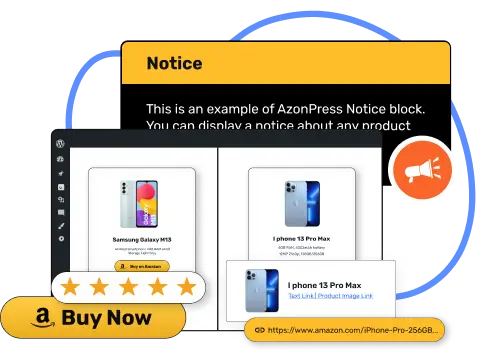
Tools like AzonPress make this part easier. You can build structured product comparison blocks for Amazon products, with auto-updated pricing so your content stays accurate without manual edits.
When competitors are still hard-coding prices that go stale in 48 hours, you’re building a page that stays reliable long-term. AzonPress also adds schema markup support, which helps your product listings show up better in the SERP, especially for review queries.
Beat them at the conversion layer
Most affiliate content is written in an informational tone for commercial intent queries. Your competitor explains the product, lists the features, and then adds a generic “Check Price on Amazon” button at the end.
You can do better.
Study where your competitor places their CTAs and test alternatives, mid-article CTA after the key benefit, a comparison table with individual product links, a sticky sidebar CTA on desktop. Match your content format to where the reader is in the buying process.
Someone searching “best affiliate tracking software” is in research mode. Someone searching “ClickMagick vs Voluum” is three steps closer to buying. Write differently for each intent, and your conversion rate will reflect it.
Common Mistakes to Avoid in Affiliate Competitor Analysis
I’ve made most of these. You don’t have to.
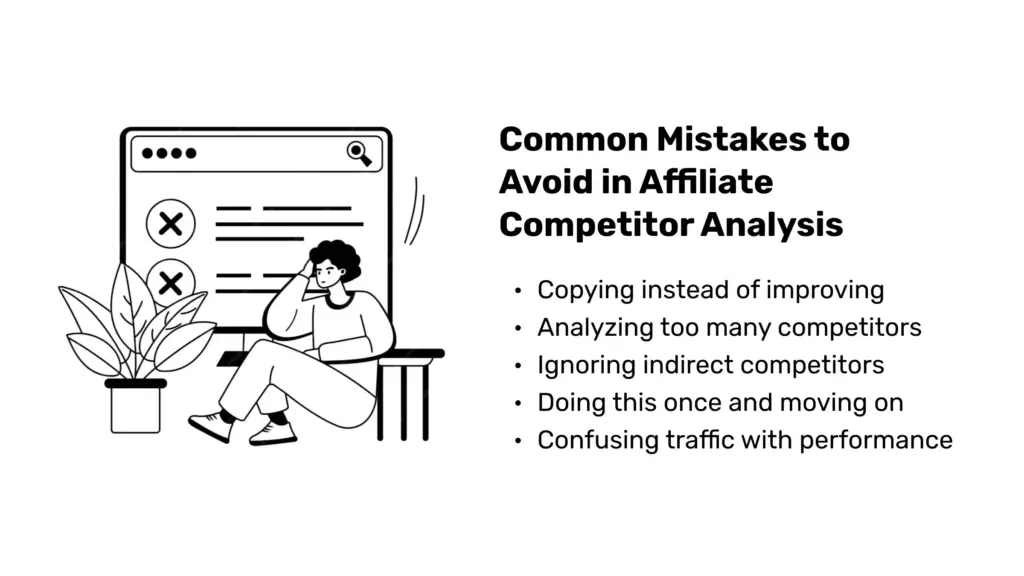
- Copying instead of improving: If you clone a competitor’s article structure, you’ll always rank below them because Google already knows who published first. Your job is to make what they built look incomplete by comparison.
- Analyzing too many competitors: Five is the maximum. More than that and your research becomes unfocused. Pick the 3 to 5 sites that directly overlap with your audience and target keywords, and go deep on those.
- Ignoring indirect competitors: Some of your biggest traffic thieves aren’t affiliates at all, they’re bloggers in adjacent niches who happen to cover your product categories occasionally. They show up in your keyword overlaps, and you don’t even notice.
- Doing this once and moving on: The affiliate landscape shifts constantly. New sites appear, old sites update content, and Google reshuffles rankings with every core update. Build a quarterly review into your workflow. It takes about two hours once you have a system.
- Confusing traffic with performance: A competitor page with 10,000 monthly visitors might convert at 0.5% because the content targets the wrong intent. A page with 2,000 visitors and strong buyer-intent targeting might convert at 4%. Study the content itself, not just the traffic numbers.
Final Thoughts
Competitor analysis for affiliate marketing is not glamorous work. It’s spreadsheets and tabs and a lot of reading content you wish you’d written first.
But it’s the work that separates affiliates who scale from affiliates who plateau.
Start with three competitors. Build the product-opportunity matrix. Run the content and SEO audit. Look for one gap you can act on this week, one article they haven’t written, one product they’ve covered poorly, one question their audience keeps asking that nobody’s answered properly.
That’s your next piece of content.
Do this quarterly, and you’ll stop guessing what to write.


Frequently Asked Questions
Here are answers to some frequently asked questions about competitor analysis for affiliate marketing.
What is competitor analysis for affiliate marketing?
It’s the process of identifying other affiliates in your niche and studying their products, rankings, content, and conversion strategies to find gaps and opportunities they’re leaving behind. It’s not about copying; it’s about finding what they missed.
How do I find my affiliate marketing competitors?
Search your target keywords on Google and check who ranks in the top 10-20. Look for sites with review structures, comparison tables, and affiliate disclaimers. Ahrefs and SEMrush can speed this up significantly.
What tools are best for affiliate competitor analysis?
Ahrefs and SEMrush for SEO and keyword gaps. SimilarWeb for traffic sources. BuzzSumo for top-performing content. Facebook Ad Library (free) for paid strategies. Google search operators work well for manual discovery without any paid tools.
What should I actually look for in a competitor’s content?
Article format, word count, use of comparison tables, CTA placement, publishing frequency, and content freshness. The goal: spot what they covered poorly or skipped entirely.
How often should I run competitor analysis?
Quarterly is the minimum. The affiliate landscape shifts with every Google core update. New sites appear, old ones refresh content, and rankings reshuffle. A two-hour quarterly review is enough once you have a repeatable system.
Manage links, create product tables, and comparison tables, and increase your affiliate revenue



Read Similar Blogs
We build lasting partnerships to boost and manage revenue growth





Leave a Reply