


Affiliate Marketing for Bloggers: A Guide to Monetizing Your Content


A well-ranked affiliate marketing blog can generate income for years!
Many of you may raise an eyebrow and think, “There’s no way that’s real.” In reality its actually happens. That’s the power of affiliate marketing when it’s done right.
As a blogger, you’re not cold-selling to strangers. You’re recommending products to an audience that already trusts you, people who came to your blog because your voice, your experience, and your perspective resonated with them. That trust is worth more than any ad placement or sponsored deal.
In this blog guide, we’ll share a clear, practical roadmap for understanding how affiliate marketing for bloggers actually works. We are not sharing with you an overnight success story or any unrealistic promises, just the real steps that work for real bloggers.
If your blog is getting traffic but not generating income yet, keep reading. That’s about to change.
TL;DR — Affiliate Marketing for Bloggers at a Glance
Affiliate marketing is a monetization model where bloggers earn commissions by recommending products or services through unique tracking links placed inside their content. For bloggers, it’s one of the most practical income streams because it requires low startup costs and offers long-term earning potential.
If you want to get started, here’s the simplified roadmap:
– Choose a clear, focused niche
– Join 1–2 relevant affiliate programs
– Create genuinely helpful content first
– Promote products using AzonPress for clean product displays
– Place affiliate links naturally within context
– Always disclose your affiliate relationships
– Drive targeted traffic through SEO or other channels
– Track performance and optimize what works
The one thing to remember: Affiliate marketing rewards bloggers who help first and sell second. Build trust through honest, useful content, and commissions become the natural outcome, not as the goal.
What is affiliate marketing for bloggers?
Affiliate marketing is simple: you recommend a product or service, someone buys it through your unique link, and you earn a commission.
That’s it.
You’re not selling anything yourself. You’re not managing inventory or handling customer service. You’re acting as the bridge between a reader who needs something and a company that sells it.
Affiliate marketing for bloggers specifically works beautifully because you’re already creating content that answers questions, solves problems, and makes recommendations. Affiliate marketing just adds a revenue layer to what you’re already doing.
For example, you run a food blog, and you always recommend a particular immersion blender in your soup recipes. With an affiliate link, every time a reader clicks that link and buys the blender, you earn a percentage of that sale. You’ve helped your reader find a great product. They buy something they were already looking for. You get paid for each sale made through you refferal links, and the product owners get more new customers. The result is everyone wins.
Types of affiliate content for bloggers
Affiliate marketing works best when your content matches the reader’s intent. As a blogger, you can’t rely on random link placements; you need content formats that naturally support recommendations.
Different types of affiliate content serve different purposes: some help readers compare options, others guide them step-by-step, and still others target individuals who are ready to make a purchase.
By understanding these formats and using them strategically, you can create content that builds trust, answers real questions, and increases conversions without sounding overly promotional.
Here are the types of affiliate content that perform best.
Product reviews
A detailed, honest review of a single product is one of the highest-converting content formats in affiliate marketing. Readers searching for “specific product review” mean they are already interested; they just need someone they trust to help them decide. If you genuinely create helpful content and cover both pros and cons, your conversion rate will reflect it.
Comparison posts
“X vs Y” posts attract readers who are weighing their options. If you blog about productivity tools, a post like “Notion vs Obsidian: Which Is Better for Bloggers?” can rank well in search and convert at a high rate because the reader is already motivated to choose one.
“Best Of” lists
Roundup posts like “Best WordPress Themes for affiliate marketing” or ” Must-Have WordPress Plugins” rank well for high-intent keywords and allow you to include multiple affiliate links in a single post. They’re also easy to update as products change.
Tutorials with tools
When you show readers how to do something using a specific tool, the affiliate link feels completely natural. A post like “How to design your blog’s logo using Canva” includes an affiliate link that’s helpful rather than salesy; you’re pointing readers to exactly the tool they need to follow along.
Resource pages
A dedicated “Tools I Use” or “My Favorite Resources” page is a simple, evergreen way to house your top affiliate links in one place. Many readers actively seek these out, especially when they trust the blogger. Once set up, this page requires minimal maintenance and can be a consistent source of passive income.
Case studies
Sharing your own results with a product or tool, “How I Grew My Email List,” is one of the most persuasive forms of affiliate content. It’s personal, specific, and proves the product actually works. Case studies build trust and tend to have excellent conversion rates.
If you ask me what the best format is for affiliate marketing as a content creator, I’d say start with reviews and tutorials. These formats carry the clearest intent that readers are either evaluating a product or actively trying to solve a problem. That makes affiliate links feel natural, not forced.
Reviews help people decide. Tutorials help people achieve a result using a specific tool. In both cases, your recommendation becomes part of the solution.
Get access to our exclusive offers and pro tips!
Steps to start affiliate marketing as a blogger
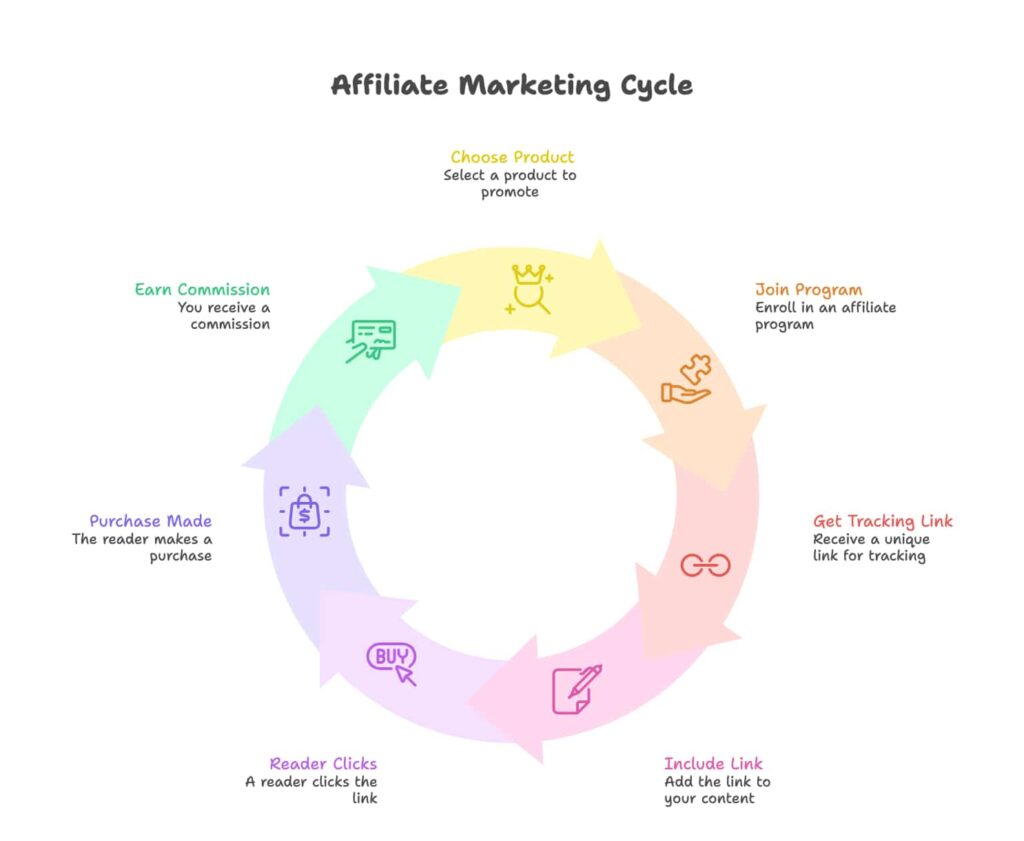
You already know how affiliate marketing works. Now, let’s understand the full cycle of affiliate marketing for bloggers:
Choose your product → Join an affiliate program → You get a unique tracking link → You include that link in your content → A reader clicks it → They make a purchase → You earn a commission.
Most programs track clicks through cookies, meaning even if a reader doesn’t buy immediately, you can still earn a commission if they return and purchase within the cookie window (often 24 hours to 90 days, depending on the program).
The affiliate commission rate itself varies widely. Some programs pay 2–5% on physical products. Others pay 20–50% on digital products or software subscriptions. That range matters a lot when you’re choosing which programs to prioritize.
Step 1: Choose a clear niche
The first thing you have to do before signing up for a single affiliate program, pick the right affiliate marketing niche. This is the foundation on which everything else is built.
A niche isn’t just a topic; it’s a specific audience with specific problems. “Food” isn’t a niche. “Quick weeknight dinners for busy parents” is. “Tech” isn’t a niche. “Productivity tools for remote workers” is. The more clearly you define who you’re writing for, the easier it becomes to choose relevant products, create focused content, and build an audience that actually trusts your recommendations.
Here’s why this matters for affiliate marketing specifically: scattered blogs with no clear direction struggle to convert. When a reader lands on your blog and immediately understands what it’s about and who it’s for, they’re far more likely to engage with your content and act on your recommendations.
Ask yourself these questions to define your niche:
- What do I genuinely know a lot about or care deeply about?
- What does my current audience come to my blog for?
- Are there products and services in this space that people actively buy?
- Is there enough content to write about long-term without running dry?
If you already have an established blog, you don’t need to start over. Just get honest about what your blog does best and double down on that. Clarity beats breadth every time.
Step 2: Join relevant affiliate programs
Once your niche is clear, it’s time to find affiliate marketing programs that match what your readers actually need. The keyword here is relevant. A high commission rate means nothing if the product has nothing to do with your audience.
Start with these options based on your blog type:
- General networks like ShareASale, CJ Affiliate, and Impact give you access to thousands of brands across multiple categories; great for lifestyle, home, finance, and B2B blogs.
- The Amazon Associates program is ideal if you recommend physical products of any kind. It’s easy to join, covers virtually every product category, and your readers already trust Amazon as a place to buy.
- Niche-specific programs run directly by companies like ConvertKit for email marketing bloggers, Semrush for SEO bloggers, or Bluehost for bloggers who write about WordPress often offer higher commissions and longer cookie windows.
A few practical tips when applying:
- Ensure your website has published content before applying. Most programs review your site before approving.
- Read the terms of service for each program. Cookie duration, commission structure, and payout thresholds.
- Start with just one or two programs. Master those before expanding your portfolio.
The goal at this stage isn’t to join everything; it’s to join the right things.
Step 3: Create valuable content first
This is the step most beginners skip, and it’s the reason so many of them fail. Before you think about earning from affiliate links, focus entirely on creating content that genuinely helps your readers.
Because affiliate marketing runs on trust. And trust is built through content that solves real problems, answers real questions, and makes your readers’ lives easier with no strings attached. If every post on your blog feels like a sales pitch, readers will sense it immediately and stop coming back.
The most successful affiliate bloggers follow a simple principle: help first, monetize second.
Content that builds trust and converts well includes:
- In-depth tutorials that walk readers through solving a specific problem
- Honest product reviews that cover both the strengths and the limitations
- Comparison posts that help readers weigh their options without bias
- “Best of” roundups that curate the best tools or products in a category
- Personal case studies that show real results from real experience
Think about the questions your readers are already asking. Then answer those questions better than anyone else on the internet. The affiliate income follows naturally from there.
Step 4: Promote products using AzonPress
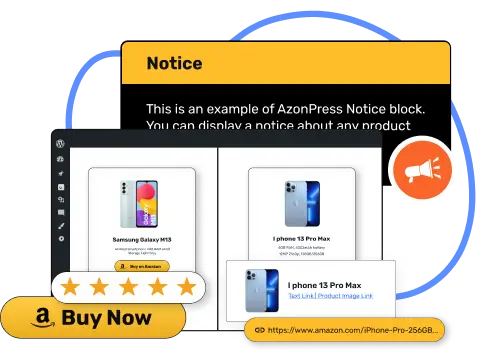
Once you have content and affiliate links, the next challenge is managing and displaying those links effectively, especially if you’re using the Amazon Associates program. This is where a tool like AzonPress becomes genuinely useful.
AzonPress is a WordPress affiliate marketing plugin built specifically for bloggers who want to promote Amazon products without the technical headache. Instead of manually copying and pasting raw affiliate links throughout your posts, AzonPress lets you create beautiful, high-converting product displays directly inside your WordPress editor.
One of its biggest advantages is the Zero API feature, which means you can add affiliate products from Amazon, Etsy, or eBay manually without connecting to the API. This feature allows you not to deal with API keys, request limits, or sudden disruptions; you stay in full control of your product listings while keeping your affiliate setup simple and stable.
Key features of AzonPress include:
- Customizable comparison tables
- Best-seller lists and product grids
- Zero API integration
- Customizable layouts
- Link management
- User-friendly interface
- Smart Gutenberg widgets
- Geotargeting
- Advanced reporting
- Geolocation-based redirection
- Shortcode support
- Responsive and mobile-friendly layouts
Manage links, create product tables, and comparison tables, and increase your affiliate revenue
Step 5: Place affiliate links strategically
Having great affiliate links means nothing if nobody clicks them. Where and how you place your links inside your content has a direct impact on your click-through rate and ultimately your income.
Follow these placement principles:
- Place links contextually. The most effective affiliate links appear naturally within the flow of your content, right at the moment a reader is most interested. If you’re reviewing a product, link to it when you first mention it, not three paragraphs later.
- Don’t make readers scroll to find the link. A significant portion of your audience will never reach the bottom of your post. Include your primary affiliate link early, ideally within the first third of the article.
- Use descriptive anchor text. Instead of “click here,” use the actual product name or a benefit-driven phrase like “this ergonomic chair” or “check the current price.” It reads more naturally and tends to perform better.
- Add a clear call to action for key recommendations. A styled button with eye-catching text, such as “Check Price on Amazon” or “Start Your Free Trial,” gives readers a clear next step and can dramatically improve conversions.
- Don’t overdo it. Three to five well-placed links per post is a healthy range. More than that starts to feel promotional, and readers will disengage. Quality of placement matters far more than quantity of links.
Think of every affiliate link as a signpost. Your job is to place those signposts exactly where your reader is already headed, not to redirect them somewhere they didn’t want to go.
Step 6: Disclose affiliate links (This is non-negotiable)
If there’s one rule in affiliate marketing that has zero grey area, it’s this: you must disclose your affiliate relationships clearly and prominently.
The U.S. Federal Trade Commission (FTC) legally requires bloggers to disclose any material connection to a brand, and earning a commission through affiliate links absolutely counts. Amazon Associates goes a step further and mandates disclosure in its own operating agreement. Failing to disclose isn’t just an ethical lapse; it can get your affiliate accounts terminated and expose you to legal risk.
The good news is that disclosure is simple, and it doesn’t hurt your conversions. In fact, readers tend to respond positively to transparency. It signals that you’re honest, which reinforces the trust that makes affiliate marketing work in the first place.
What a good disclosure looks like:
“This post contains affiliate links. I only recommend products I genuinely believe in.”
Where to place it:
- At the very top of every blog post that contains affiliate links, before the reader encounters any links
- On a dedicated Disclosure or Privacy Policy page linked in your site’s footer
- In any email newsletters where you include affiliate links
Keep it short, plain, and visible. Don’t bury it in fine print, don’t hide it at the bottom of the page, and don’t use confusing legal language. A single clear sentence at the top of your post is all it takes.
Step 7: Drive targeted traffic
Here’s a truth that doesn’t get said enough: affiliate links are only as valuable as the traffic behind them. You can have the best content and the most relevant products in the world, but if the right people aren’t finding your affiliate blog, none of it matters.
The emphasis here is on targeted traffic readers who are actively searching for information about the products or topics you cover. A thousand highly targeted visitors will consistently outperform ten thousand random ones when it comes to affiliate conversions.
The most effective traffic channels for affiliate bloggers:
- Search Engine Optimization (SEO) is the backbone of most successful affiliate blogs. When your content ranks on Google for keywords your readers are already searching, traffic comes in consistently, without any ongoing effort on your part. Focus on long-tail keywords with clear buying intent, like “best laptop for college students under $700” rather than just “laptops.”
- Pinterest is an underrated traffic source for bloggers in niches like food, home décor, personal finance, wellness, and DIY. Well-designed pins linked to your affiliate content can drive significant, sustained traffic.
- Email marketing gives you a direct line to your most engaged readers. A well-nurtured email list converts at a higher rate than almost any other traffic source because those readers have already chosen to hear from you.
- Social media, particularly in niche communities on Facebook Groups, Reddit, or X, can drive targeted traffic when you share content that genuinely helps people rather than just promoting your links.
The long game here is SEO. Build content that answers specific questions your target audience is searching for, optimize it properly, and let it compound over time. That’s how affiliate blogs build sustainable, scalable income.
Step 8: Track and improve
Publishing your content and walking away is one of the most common and costly mistakes affiliate bloggers make. The bloggers who build real income don’t just create and publish. They review, analyze, and optimize on a regular basis.
Every major affiliate program gives you access to a performance dashboard; use it. At a minimum, check your data once a month and track the following data:
- The posts that are generating the most clicks. These are your best performers. Understand why they work and replicate that approach in new content.
- Posts that get traffic but no clicks. This usually means your link placement needs work, your call to action is weak, or the product isn’t a great match for that audience.
- Which clicks are converting into sales? High clicks with low conversions often signal a mismatch between what readers expect and what they find when they land on the product page.
- Posts haven’t been updated recently. Outdated information, broken links, and discontinued products silently kill your conversions. A quarterly content audit keeps everything fresh and functional.
Beyond your affiliate dashboards, track:
- Organic search rankings for your key posts (Google Search Console is free and invaluable)
- Click-through rates on your call-to-action buttons
- Which affiliate programs are performing and which aren’t worth the effort
Think of your affiliate blog as a portfolio of assets. Some posts will overdeliver. Others will underwhelm. Your job isn’t to be right every time; it’s to keep learning from what the data tells you and keep making your content better. That’s the mindset that separates bloggers who earn consistently from those who give up after three months.
These eight steps aren’t a one-time checklist; they’re an ongoing cycle. The more consistently you move through them, the more your affiliate income compounds. Start with step one, execute it well, and build from there. You don’t need to do everything at once. You just need to keep going.
Click here to discover “How To Do YouTube Affiliate Marketing”
Helpful online tools for affiliate marketing for bloggers
You don’t need a dozen tools to run a successful affiliate blog. But having the right ones saves you time, sharpens your strategy, and helps you make decisions based on data rather than guesswork. Here are six essential affiliate marketing tools every blogger should have in their corner.
1. Google Analytics – Traffic & audience insights
Google Analytics is a free platform that shows you exactly who is visiting your blog, where they’re coming from, and how they behave once they land on your pages. For affiliate bloggers, it helps you identify which posts are driving the most traffic, how long readers are staying, and where they’re dropping off. This data tells you which content is worth doubling down on and which pages need improvement. It’s the first tool you should set up before anything else.
2. Google Search Console – SEO performance tracking
Google Search Console is a free tool that shows how your blog is performing in Google’s search results. It tells you which keywords your pages are ranking for, how many clicks and impressions you’re getting, and flags any technical issues that might be hurting your visibility. For affiliate bloggers, it’s particularly useful for spotting posts that are close to ranking on page one. Small optimizations to those posts can lead to significant increases in organic traffic and affiliate clicks.
3. Semrush — Keyword research & competitor analysis
Semrush is a powerful SEO tool that helps you find the right keywords to target in your affiliate content — including search volume, difficulty, and buying intent. It also lets you analyze competitor blogs in your niche to see exactly which keywords they’re ranking for, revealing content opportunities you might be missing. For affiliate bloggers, writing content around high-intent keywords is one of the fastest ways to attract readers who are already close to making a purchase decision. Semrush is a paid tool, but the depth of insight it offers makes it a worthwhile investment as your blog grows.
4. Ahrefs – Backlink analysis & content research
Ahrefs is an industry-leading SEO tool best known for its backlink analysis and content research capabilities. It helps you understand which websites are linking to your blog, discover proven content ideas in your niche, and evaluate the ranking potential of keywords before you invest time writing about them. Its Content Explorer feature is especially useful for affiliate bloggers — you can search any topic and instantly see which content formats and angles are already performing well. Like Semrush, it’s a paid tool, but one that serious affiliate bloggers consistently rely on to grow their organic traffic.
5. Canva – Visual content creation
Canva is a beginner-friendly graphic design tool that lets bloggers create professional-quality visuals without any design experience. For affiliate marketing, it’s useful for creating eye-catching featured images, Pinterest graphics, product comparison infographics, and call-to-action banners that increase click-through rates on your affiliate content. Its drag-and-drop editor and extensive library of templates make it easy to maintain a consistent, polished visual brand across your blog and social channels. The free plan covers most of what bloggers need to get started.
6. Grammarly – Writing quality & proofreading
Grammarly is an AI-powered writing assistant that checks your content for grammar, spelling, clarity, and tone in real time as you write. For affiliate bloggers, writing quality is directly connected to trust and trust is what drives conversions. A polished, well-written post signals credibility and keeps readers engaged long enough to act on your recommendations. Grammarly integrates directly into your browser and WordPress editor, making proofreading a hassle-free part of your writing process rather than an extra step.
These six tools cover the core areas every affiliate blogger needs to stay on top of traffic, SEO, content research, design, and writing quality. Start with the free ones and add paid tools as your blog scales.
Click here to discover “Best AI Tools for Affiliate Marketing”
Final words
Affiliate marketing isn’t a get-rich-quick scheme. It’s not a shortcut, and it’s not something that pays off overnight. Affiliate marketing for bloggers who are willing to approach it with patience, consistency, and genuine intention. It’s one of the most rewarding ways to monetize content you’re already creating.
Every successful affiliate blogger you’ve ever read started exactly where you are right now. The difference between the ones who built something meaningful and the ones who gave up is simple: they kept going when results were slow, kept improving when things weren’t working, and kept showing up for their audience even when nobody was watching.
Remember, your blog already has value. Affiliate marketing is just the system that helps you get paid for it.
So close this tab, open your blog, and take that first step. The sooner you start, the sooner the compounding begins — and once it does, you’ll wonder why you waited so long.
Best of luck with your affiliate marketing journey.


Frequently asked questions
Here are some frequently asked questions about “affiliate marketing for bloggers’.
1. How much money can a blogger make from affiliate marketing?
Affiliate income varies widely. Beginners typically earn $0–$50 in the first few months. With consistent effort, the income can be doubled within a year. Income depends on your niche, traffic quality, and content strategy.
2. Do I need a lot of traffic to make money with affiliate marketing?
A small but highly targeted audience converts better than massive general traffic. Focus on attracting readers with clear buying intent rather than chasing high visitor numbers. Quality of traffic always beats quantity in affiliate marketing.
3. Which affiliate program is best for beginner bloggers?
Amazon Associates is the best starting point for most beginners. It’s free to join, covers virtually every product category, and readers already trust Amazon. As you grow, add niche-specific programs with higher commission rates alongside them.
4. Do I need to disclose affiliate links on my blog?
Yes, absolutely. The FTC legally requires bloggers to disclose affiliate relationships clearly. Place a simple disclosure at the top of every post containing affiliate links. Transparency builds reader trust and actually improves your credibility over time.
5. How long does it take to start earning from affiliate marketing?
Most bloggers see their first commissions within three to six months. Significant income typically takes nine to twelve months of consistent effort. Affiliate marketing rewards patience, content compounds in search rankings, and earns more over time.



Read Similar Blogs
We build lasting partnerships to boost and manage revenue growth



Leave a Reply